The BH test: a 12-week preparation plan
On 17 and 18 October there are TSAC and FCI-BH exams in Bucharest. If you have entered, you have two weeks left. If you are aiming for the next session you have more...

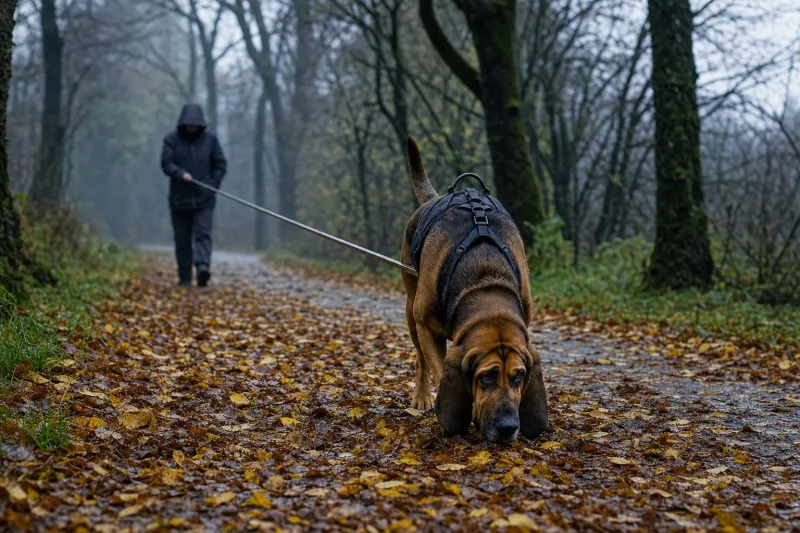
Around October, handlers who started mantrailing in the summer notice something odd. The dog has "improved" overnight. Forty-minute trails it lost at the first junction in July, it now takes all the way to the end without looking back.
Nothing happened to the dog. Something happened to the air.
The cold season is the best mantrailing season of the year, on one condition: that you understand what cold does to scent, and what it asks of you in return.
In summer the sun heats the ground, the air at the surface rises and takes the scent with it, into a diffuse column the dog has to search for above its head. We described the mechanism in our article on scent and weather. In autumn and winter it works the other way round: the ground is colder than the air above it, the particles have no energy to rise and stay in the layer 5 to 50 cm off the ground. Which is exactly where the nose works.
Cold changes time as well. The bacteria that break down the organic part of the trail work more slowly, and evaporation drops. A trail that visibly "ages" within an hour in summer stays workable much longer in winter, so you can train older trails with the same dog without putting it in difficulty.
And it changes the hour. In summer you train at 7 in the morning or after sunset, because at noon convection tears the trail apart. From November to February you can work at any time of day: the sun is low and the ground does not warm up. The only limit left is daylight, which is gone by five.
The autumn surface is close to ideal. Wet leaves and wet grass catch the scent and hold it. Soft ground also keeps the mechanical trace of each step, crushed vegetation and disturbed soil, which for the dog is extra information. A trail on leaves in November is easier than the same trail on asphalt in July, even if it is twice as long.
Cold asphalt is friendlier than hot asphalt too: it no longer "burns" the scent or lifts the air. It is still a poor surface, where the trail survives mainly at the edges: along the kerb, in the grass between paving slabs, along fences. If you see your dog working the edge of the pavement, it is not wandering. That is where the scent is.
Drizzle and light rain are the handler's ally. Humidity keeps the particles low and binds them to surfaces; many dogs visibly work better in fine rain than in dry weather.
Heavy rain is another matter. It washes scent off smooth surfaces and moves it: in town towards gutters and drains, on open ground downhill. After a downpour the trail has not disappeared, but it is no longer exactly on the person's path. It has shifted a few metres, in the direction the water ran. An experienced dog makes that correction on its own. A beginner needs short trails, so it does not lose heart.
Fresh snow holds scent very well and, on top of that, shows the track. Here comes the first trap, and it is the human's: the handler sees the footprints and starts steering without realising it, and the dog learns to read the leash instead of the air. On fresh snow, have the layer walk on paths that are already trodden, or train after a little more snow has fallen over the track.
Old snow with an ice crust is the hardest. The scent stays trapped underneath and escapes slowly; the dog works slowly, nose to the cracks, to the places where the crust has broken, to the vegetation poking through. Shorten the trail and raise the reward.
The third situation is wind over snow. On an open, snow-covered field with no obstacles at all, the wind moves the scent tens of metres away from the physical track, and the dog will work a parallel line downwind. That is not a mistake. If you want to see exactly what happens, the simulator has settings for wind, rain and temperature: you draw the trail and add a crosswind. Then you watch where the scent cloud ends up relative to the person's steps.
We raise the age of the trail, not the distance. The cold season is the time to move from 30 minutes to an hour or two, then to trails laid in the evening and worked in the morning, because the scent lasts. The distance can stay the same.
We alternate surfaces within the same session: leaves, wet grass, cold asphalt, snow when there is any. A trail that crosses all of them teaches the dog to switch strategy without getting stuck. We wrote about this in the article on city, forest and mixed terrain.
Below −5 °C we shorten the sessions. The dog tires faster and cold muscles injure easily. Five minutes of brisk walking before the start, trails of 15 to 20 minutes instead of an hour.
On salted pavements we wash the paws after training and check the pads. Dogs with long hair between the toes get ice balls there; boots help, if the dog accepts them.
Water stays on the list in winter. A dog working its nose loses water through breathing even in the cold, so the water break halfway along the trail stays, as in summer.
And light: a head torch for the handler, something reflective on the dog and on the layer. In December, a trail started at four in the afternoon finishes in the dark.
The person who lays the trail and then hides stays still, in the cold, sometimes for an hour. It is the most neglected risk of the season, because all the attention is on the dog.
The rules are simple. The layer dresses for waiting, not for walking: a thermal layer, an insulated seat pad, a flask. The waiting time is agreed in advance and kept to. A charged phone and an agreed signal, in case they want to be picked up early.
In the forest, from autumn into winter, it is also hunting season. A reflective vest for everyone, dog included, and we stay off hunting grounds on announced days. Anyone who wants to be a layer at our sessions will find the details under volunteering.
If you started mantrailing in the summer, be ready to see your dog differently over the coming months: more confident, faster, more willing to take an old trail to the end. The credit belongs neither to you nor to the dog, but to the cold air. Use it. It is the best time of year to raise the bar.
Articles
On 17 and 18 October there are TSAC and FCI-BH exams in Bucharest. If you have entered, you have two weeks left. If you are aiming for the next session you have more...

The game “I Ask. I Wait. I Respect. – The Park Adventure” runs free in the browser at joc.mantrailing.ro/en and takes about twenty minutes. What stays with the child...
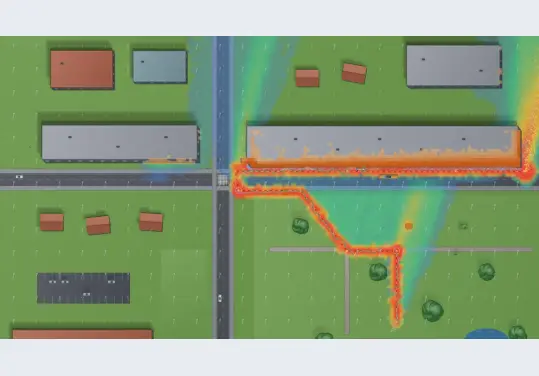
There is a moment every handler knows. The dog stops, lifts its nose, turns a full circle, then pulls sideways, several metres off the line you watched the person wa...
Events


