Have you ever run a mantrailing session early in the morning and had everything go perfectly - your dog picked up the trail quickly, worked with confidence, found the person without hesitating? Then tried again at noon, same location, same distance, and your dog seemed to be working through fog? Losing the trail, doubling back, looking uncertain?
It wasn't the dog. It was the sun.
Scent doesn't stay still. It moves, rises, spreads, or concentrates depending on temperature, wind, humidity, and terrain. If you understand how this works, you'll understand why your dog performs differently from one session to the next - and you can choose the timing and location of your training sessions much more intelligently.
Heat and direct sunlight
When the sun heats the ground, the air near the surface becomes warmer than the air above it. Warm air rises - and it carries scent particles with it. This is called thermal convection, and it's the biggest enemy of a dog following a ground trail.
Instead of tracking scent at ground level, the dog has to find it in the air column above, which is diffuse and unpredictable. A trail that was clear and easy to follow at 7am can be nearly invisible to a dog by 1pm.
This is why mantrailing training ideally happens early in the morning or in the evening - not out of habit, but because of physics.
Shade and cooler temperatures
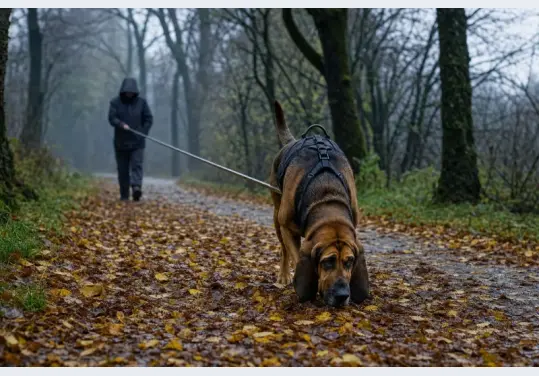
In shade or when temperatures are lower, scent stays close to the ground. The particles don't have thermal energy to rise, so they remain concentrated in the air layer from ground level up to about 50cm - exactly the zone where a dog's nose works.
This explains why autumn and winter training sessions often produce dogs that seem more confident and faster on trail. They haven't suddenly improved overnight - they have better conditions.
Another practical observation: a trail that alternates between sun and shade creates discontinuities in the scent path. The dog may follow perfectly in a shaded section, lose the trail when it enters sunlight, then pick it back up when it returns to shade. Many handlers interpret this as a training problem. It's actually a physics phenomenon.
Wind: enemy or ally?
Wind moves scent sideways from the direction the tracked person actually walked. If the layer walked in a straight line, the scent may be found by the dog several metres to the left or right of the actual trail - in the direction the wind was blowing.
Experienced dogs learn to run the scent cone - meaning they work not on the exact line of the trail, but in the lateral dispersal zone of the scent. You can see this when a dog takes a wide arc from the apparent line of the trail but still arrives at the destination. He hasn't gotten lost - he's working smart.
Strong wind can disperse scent over a wide area, making it harder to pinpoint the exact trail. Light or no wind keeps scent more concentrated and easier to follow.
Rain
Rain has a paradoxical effect that depends a lot on intensity.
Light rain or drizzle before a training session can actually be beneficial. It moistens the soil and vegetation, which helps scent particles bind to the surface and remain more stable. Many dogs work excellently after light rain.
Heavy rain, on the other hand, can wash the trail away - especially on pavement or terrain with fast runoff. On forest terrain, where soil absorbs water, the trail survives better even after intense rainfall.
Rain that comes one to two hours after the trail was laid has less impact than rain that falls immediately after. Scent has time to bind into the soil and vegetation before the rain arrives.
Water and waterways
Scent can float on the surface of water. The light scent particles from the tracked person settle on the surface of a river or lake and are carried by the current.
A well-trained dog can follow scent from the bank of a river, parallel to the direction of the current, and can indicate where the person exited the water. This is an advanced technique used in real search and rescue operations, but it's based on the same principle: scent is physical, and it follows the laws of physics.
In training, if the trail crosses a stream or a wet area, don't be surprised if your dog works closer to the water level or pauses at the bank - he's searching for scent that has floated downstream.
Frost and snow
In freezing temperatures, scent particles get locked under the frost or snow layer. The scent is preserved but harder to access. Dogs can still track trails on snow - sometimes even better than in summer, because snow holds particles well.
The problem comes when snow melts and refreezes. The thaw-freeze cycle breaks up the layers and disperses scent unevenly.
How to use all of this in training
Instead of fighting weather conditions, learn to read them. If you want to train a beginner dog, choose early morning, overcast weather, after light rain. If you want to increase difficulty for an advanced dog, train at noon in full sun or with moderate wind.
Note the conditions at each session - temperature, time, wind, humidity. Over time, you'll notice clear patterns in how your dog works under different conditions, and you'll be able to explain results instead of attributing them to "good or bad days."
Mantrailing is a sport where the handler learns just as much as the dog. Understanding the physics of scent is part of that.
For the cold months, see also how scent behaves in autumn and winter: wet leaves, rain, snow and what we change in training.