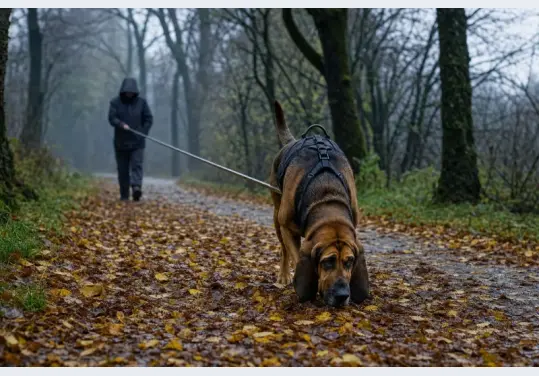
Mantrailing in autumn and winter: cold, rain and snow on the trail
Around October, handlers who started mantrailing in the summer notice something odd. The dog has "improved" overnight. Forty-minute trails it lost at the first junct...

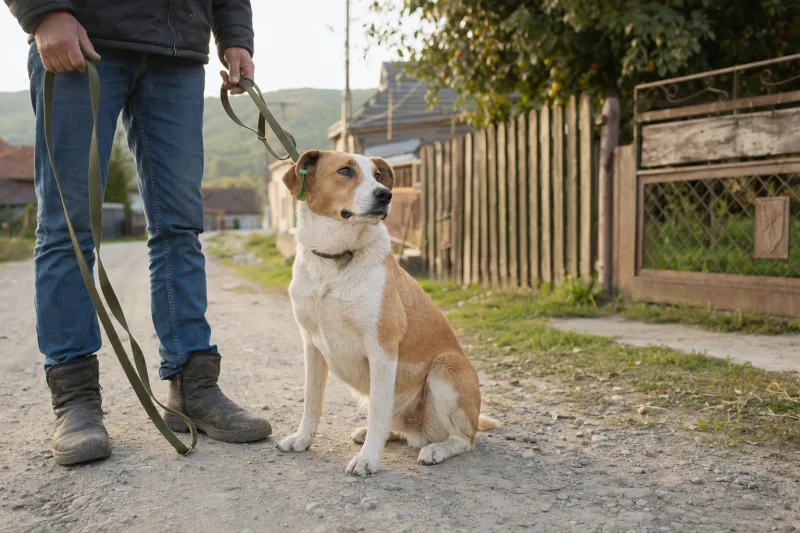
More than 3.67 million dogs in RECS, Romania's registry of owned dogs, are recorded as mixed-breed or "common breed". If uncontrolled breeding stopped today, the first effects on abandonment could show within a few years. For the last existing generation to disappear biologically, the theoretical wait would be around 15 to 20 years.
A puppy left in a cardboard box, a female with a litter at the edge of a village, a shelter with no free kennels: they look like separate situations. They are the same problem repeating itself year after year. Dogs keep breeding and nobody takes responsibility for the puppies that are born.
In Romania, the debate about stray dogs comes back every time shelters overflow or a community finds abandoned animals on public land. Most of the time the effects are treated: dogs are caught, transported and housed. Far more rarely is the cause tackled with any consistency, the uncontrolled breeding of dogs with and without owners.
What would happen if every common-breed and mixed-breed dog in Romania were neutered and no more puppies were born by accident? How long would it take for abandonment to fall, and when would there be no mixed-breed dogs left?
The short answer: the number of abandoned puppies could drop visibly within a few years, but the biological disappearance of the last generation of mixed-breed dogs would take around 15 to 20 years. This is a purely theoretical scenario. The goal worth pursuing is the end of uncontrolled breeding, of abandonment and of suffering, with mixed-breed dogs still very much around.
The most recent public report of RECS (Registrul de Evidență a Câinilor cu Stăpân, the national registry of owned dogs kept by the Romanian College of Veterinarians), titled "RECS Report 2014-2025", records 5,318,381 dog registrations from the registry's launch until the reporting date, 15 March 2025.
The breakdown by breed shows:
| Category | Number recorded in RECS |
|---|---|
| Mixed-breed dogs | 2,527,937 |
| Common-breed dogs | 1,151,911 |
| Total, mixed-breed and common-breed | 3,679,848 |
The two categories make up about 69.2% of all registrations in the report.
These numbers need careful reading. The report presents registrations accumulated between 2014 and 2025; it is not a census of the dogs alive at a given moment. Dogs that have since died may still be in the registry, and dogs that were never microchipped and registered do not appear at all. So 3.68 million describes the size of the registered category, not the exact number of live, unneutered mixed-breed dogs in Romania.
There is another limitation. The public report gives no complete national picture from which neutered dogs could be subtracted to get the number of fertile ones. Romania currently has no public statistic that supports the statement "there are exactly X dogs that can still breed".
The RECS figure is only the registered part of the dog population. Stray dogs are not in the registry, and many owned dogs, especially in rural households, have never been microchipped. The real number of dogs in Romania is far higher than the registered one, even though there is no official estimate we could quote.
Neutering is more than advice for owners of common-breed dogs. Government Emergency Ordinance no. 155/2001 on the programme for managing stray dogs makes neutering compulsory for common-breed dogs and their crosses, with or without an owner, under the conditions set by the implementing rules.
Failing to comply is an offence, with fines between 5,000 and 10,000 lei (roughly 1,000 to 2,000 euro). The same ordinance requires dogs to be identified by microchip.
Government Decision no. 1,059/2013 approves the implementing rules for the ordinance and details how dogs are managed, identified and neutered. Registration of owned dogs in RECS is also governed by Order no. 1/2014 of ANSVSA, the national veterinary and food safety authority.
Abandonment is regulated separately, by Law no. 205/2004 on animal protection. The law obliges keepers not to abandon or drive away their animals, and defines abandonment as leaving an animal that is owned and cared for by a person on public land, without food, shelter or medical treatment. Abandoning or driving away an animal whose life depends on human care is an offence punishable by a fine of 3,000 to 12,000 lei (about 600 to 2,400 euro).
Romania is therefore not starting from zero. The legal framework exists. The problems are incomplete identification of the dog population, unequal access to veterinary services, too few inspections and uneven enforcement. An obligation that stays on paper cannot stop the next litter of unwanted puppies.
Take an ideal scenario, impossible to achieve fully in practice:
The 15 to 20 years are not counted from the day the law was passed, from the creation of RECS or from the first neutering campaign. The clock starts the moment uncontrolled breeding truly stops.
If Romania managed that now, in 2026, the theoretical timeline would look like this:
But every new litter pushes the deadline further away. A dog cannot reproduce alone, yet one unneutered female reaching one fertile male is enough for a new litter. Puppies born today can become the parents of further generations.
Say breeding is not fully stopped and puppies are still born in 2030. They can live until 2045 or 2050. If some of them breed, there is another generation, and the horizon moves again. This is why the problem cannot be solved by neutering a large number of dogs once. The measure has to start now, reach every community and continue until no uncontrolled litters appear.
We do not have to wait 15 or 20 years to start. We have to start now, so that those 15 or 20 years can begin to run.
A study published in 2024 in Scientific Reports, based on data from more than 584,000 dogs in the United Kingdom, estimated the median lifespan of mixed-breed dogs at about 12 years. That does not mean every dog dies at 12: some live less, others reach 15 to 18, and a few go well beyond that.
If all births stopped today, the likely course would be:
| Interval | Likely effect |
|---|---|
| 0 to 2 years | The number of accidental litters and abandoned puppies falls sharply. |
| 3 to 5 years | A consistent drop in young dogs entering the stray population becomes visible. |
| 5 to 10 years | The mixed-breed population ages and shrinks considerably, if no new births occur. |
| 12 to 15 years | Mainly the dogs that were very young at the start of the programme are still alive. |
| 15 to 20 years | In the perfect scenario, the last generation alive at the start has almost completely disappeared. |
So the arithmetic answer is about 15 to 20 years until the existing population practically disappears, if breeding stopped completely. Neutering does not make the dogs alive today disappear. It prevents a new generation for which no responsible person exists.
This is a theoretical exercise, not a forecast for Romania. We do not know the exact age structure of the population, the number of unregistered dogs or the real neutering rate. The figure should not be used to promise that "in 20 years there will be no more mixed-breed dogs".
No. Abandonment and the existence of mixed-breed dogs are two different things.
Neutering would remove one of the main sources of abandonment: puppies from unwanted matings. But people also abandon adult dogs, purebred dogs and animals bought without any serious thought. A dog can end up on the street after its owner moves house, after an illness, because of vet bills, through lack of education, after the owner's death or simply through an irresponsible decision.
So total neutering would not produce "zero abandonment" overnight. If it came with microchipping, inspections, fines and education, the number of abandoned puppies could start falling within the first one to two years, and the pressure on shelters could ease visibly in about three to five years.
Almost completely eliminating stray dogs would require keeping these measures in place for at least one canine generation, with constant work on every source of abandonment.
In other words, neutering can turn off the tap, but shelters, adoptions and fines still have to deal with the water already on the floor.
A national programme should be judged by the share of fertile animals left in each community, not only by the total number of operations performed. If the easily reachable dogs in cities are neutered while households, rural and peripheral areas and stray populations stay uncovered, breeding continues.
Even a relatively small group of fertile females can produce many puppies every year. Some of them will breed in turn before the authorities or NGOs reach them. That is why one-off campaigns, held once a year with no follow-up records, have a limited effect.
What is needed is territorial coverage, continuity and tracking of results: how many dogs were identified, how many were neutered, how many remain fertile and how many new litters appeared.
An effective strategy cannot be reduced to catching dogs off the street. It would have to include, at the same time:
Which dogs must be neutered by law in Romania?
Government Emergency Ordinance no. 155/2001 requires the neutering of common-breed dogs and their crosses, with or without an owner, under the conditions and with the exceptions set out in the implementing rules. For a specific animal, how it is classified and when the operation should take place is a matter for a licensed veterinarian.
Are all 3.68 million dogs unneutered?
No. The figure comes from the "mixed-breed" and "common breed" categories in the RECS report, but the public report does not show that all these animals are alive and unneutered. Unregistered dogs do not appear in the statistics either, so the real number of dogs, owned or stray, is much higher.
How long until there are no mixed-breed dogs left, if they stopped breeding?
In a perfect scenario, if breeding stopped now, in 2026, the last existing generation could disappear in about 15 to 20 years, so around 2041 to 2046. Any new litter born in the meantime pushes that date further away. The estimate is based on how long dogs live and is not an official demographic forecast for Romania.
Would neutering eliminate abandonment for good?
Not on its own. It would sharply reduce the abandonment of puppies from unwanted litters, but adult dogs and purebred dogs can still be abandoned. Microchipping, traceability, inspections, fines, responsible adoption and education are needed at the same time.
A mixed-breed dog is worth no less than any other and is not to blame for having been born. Many mixed-breed dogs are outstanding family dogs, working dogs or good partners for all sorts of activities. The debate about neutering must not turn into a debate about getting rid of them.
The right question is not "when will we have no more mixed-breed dogs?", but:
How soon can we reach the point where no dog is born without someone taking responsibility for its whole life?
A dog does not choose to be born and cannot be blamed for people's lack of responsibility. We do not need to build a Romania without mixed-breed dogs. We need a Romania without puppies born for abandonment, without animals thrown onto the street and without shelters forced to repair, endlessly, what prevention could have stopped.
If Romania managed to identify and neuter, within a short time, most of the dogs that breed uncontrollably, the first results would show within a few years. A stable change would need at least 10 to 15 years of consistent enforcement, funding, record-keeping and education.
Neutering alone does not solve every form of abandonment, but without breeding control any shelter system will keep treating the effects of a problem that renews itself permanently.
A responsible country is not the one that builds ever more kennel places, but the one where ever fewer dogs end up there.
Editorial note: the legal information and statistics were checked in October 2026. The article is informative and does not replace legal or veterinary advice.
Articles
Around October, handlers who started mantrailing in the summer notice something odd. The dog has "improved" overnight. Forty-minute trails it lost at the first junct...
On 17 and 18 October there are TSAC and FCI-BH exams in Bucharest. If you have entered, you have two weeks left. If you are aiming for the next session you have more...

The game “I Ask. I Wait. I Respect. – The Park Adventure” runs free in the browser at joc.mantrailing.ro/en and takes about twenty minutes. What stays with the child...
Events


