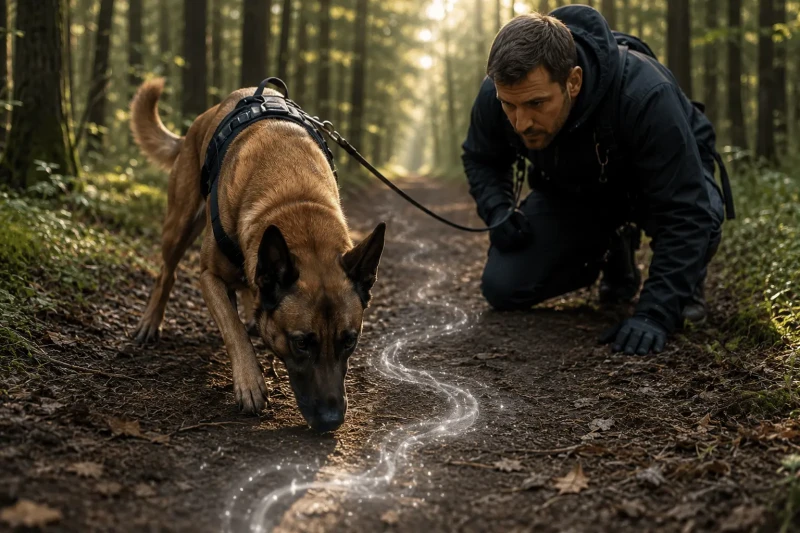
At your first mantrailing training session, the layer lays the trail five minutes before you start your dog. At the next session, maybe ten minutes. Then twenty. Gradually the time gap increases - and at some point you start wondering: how far back in time can my dog actually go? And why does it matter?
It matters because the age of the trail fundamentally changes how the dog works. And because in real search and rescue, teams rarely arrive at the point of disappearance within the first few minutes. A two-hour-old trail is a luxury. A twelve-hour trail is reality. A trail that's twenty-four hours old or more - and dogs still find them.
What happens to scent over time
A fresh trail laid five to ten minutes ago is intense and rich with information. The person has left behind dead skin cells, sweat, personal bacteria, fragrance, laundry detergent from their clothes, and a unique biological combination that forms that individual's scent signature.
In the first hours, these particles sit concentrated at ground level and in the surrounding vegetation. The dog picks them up easily and can follow them at speed.
As time passes, several things happen simultaneously. The particles gradually disperse - wind moves them, heat lifts them. Bacteria in the soil begin breaking down the organic components of the scent. Foot traffic from people and animals adds thousands of other olfactory stimuli on top of the original trail. Rain may wash some of them away.
Even so, the trail doesn't disappear suddenly. It dilutes and fragments. Trained dogs can work on fragmented trails - it simply requires more concentration and more time.
Practical time intervals and what they mean for training
A thirty-minute-old trail counts as fresh - any dog with a handful of training sessions behind them can follow it without much trouble. It's the classic starting interval for any team just beginning.
Things shift after the first hour. Between one and two hours, the particles have partially dispersed and the trail already calls for a somewhat more experienced dog - though on terrain without heavy foot traffic, it's still reasonably clear. A dog with six to twelve months of regular training handles it without drama.
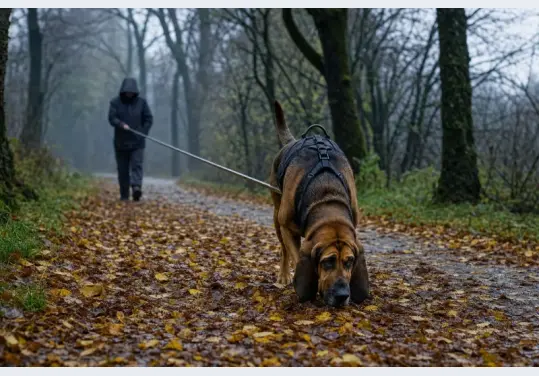
Somewhere between three and six hours, the gap between a sport dog and one headed toward utility work starts to show. The trail is visibly degraded, fragmented wherever there's been traffic, and the dog can no longer move at a brisk pace - it has to hunt for fragments and stitch them together. A session at this trail age looks different even to the eye: more stops, more checking, more lateral movement while searching for the lost thread.
Past six hours you're effectively in SAR territory, which can stretch out toward twenty-four hours. The trail is seriously fragmented, and on certain surfaces - sun-baked asphalt, areas hit by heavy rain - it may have vanished entirely. The dog then works the surviving scent islands, trying to reconstruct a thread that's no longer continuous. In forests, where soil protects the particles far better, a trail this age survives considerably longer than it would on city streets.
Beyond twenty-four hours, you're on the terrain of other specialties altogether - area search dogs, or in the most tragic cases, cadaver dogs. That doesn't mean classical mantrailing on a trail this old is impossible; exceptionally trained dogs can pull it off. It's just not what you should expect from an average mantrailing dog, and it shouldn't be the standard you measure yourself against.
Which surfaces preserve a trail longest
Soft, moist soil - grass, forest floor, moss - holds the trail longest. Particles bind to moisture in the soil and are protected from evaporation.
Vegetation - leaves, whether winter or summer - acts like a sponge for scent. A trail through dense forest is much longer-lived than one across open fields.
Concrete and asphalt are the worst surfaces when it comes to how long a trail actually lasts. There's no soil to absorb anything, heat builds up intensely in the surface, and steady air currents move through at pedestrian level - between the three, the trail evaporates fast. In warm weather, a trail on asphalt that's three to four hours old can be practically inaccessible.
Snow is surprisingly good at holding a trail. It seals particles in place and keeps them there - dogs follow trails in fresh snow with real ease. The problem shows up at melting, when the water carries the scent away with it.
The role of training with trails of different ages
Many owners always train with fresh trails of ten to fifteen minutes and wonder why their dog seems stuck at competitions or when trying older trails. The reason is simple: the dog has learned to work on intense scent. When that intensity drops, he doesn't know how to search for the fragments.
Gradually introducing older trails into training is essential. It's not a sudden jump but a progression: fifteen minutes to thirty, thirty minutes to an hour, an hour to two, and so on, in small steps. At each new level, the dog learns to use his nose more carefully, to not rush, to search rather than just follow.
This is also the fundamental difference between a good sport dog and an exceptional one: the exceptional dog can work on any trail age, not just a fresh one.
For real search and rescue
If your goal is utility work or SAR, understanding trail age is critical. In real interventions, teams often receive vague information: "he left yesterday morning." That could mean a twenty-hour trail, on variable terrain, possibly with rain in the middle.
SAR dogs prepared for aged trails work methodically, slowly, and with a lot of patience from the handler. They're not less capable than sport dogs chasing fresh trails - they're trained another way, for a different kind of problem.
If you practice mantrailing as a hobby but you're thinking ahead toward utility work, the simplest thing you can do starting tomorrow is work one-to-two-hour trails into your regular sessions. You don't need special gear or a professional layer for that - just patience, and the nerve to let your dog search instead of run.