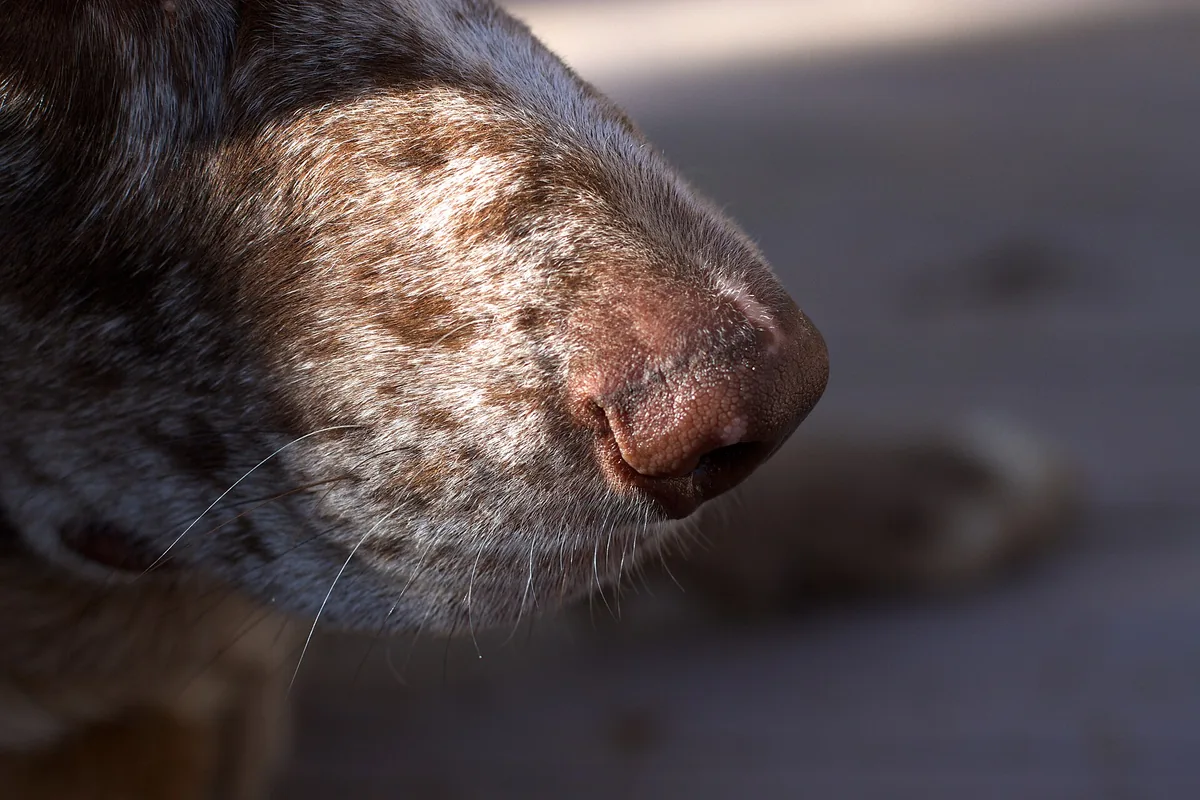
The nose leather, before the scent
The nose leather, the planum nasale, is the bare, pigmented skin at the tip of the nose, with a pattern of grooves that stays the same for life and is unique to each dog; in a healthy dog it is wet and cold. It is richly innervated by the trigeminal nerve. In 2020, Bálint et al. trained three dogs of 9, 18 and 40 kg to choose, from at least 1.6 m, a surface 11–13 °C warmer than the air, about as warm as a furry mammal: they succeeded in double-blind experiments, and in 13 pet dogs scanned with fMRI the warm stimulus activated the left somatosensory association cortex.
How exactly the nose leather senses heat is not known; the authors say the mechanism remains to be worked out and that a role for the moisture in cooling the body is unlikely, the surface being too small. The formula “the wet nose catches scent molecules” does not appear in any source we read: the mucus that holds odorants is the one inside the nose, on the mucosa.
Sniffing is not breathing
When it searches, the dog sniffs in bursts of 4-7 per second. The frequency does not depend on body size, unlike airflow and the volume of each inhalation, which grow with body mass; the four German shepherds tracked by Thesen (1993) sniffed about 6 times per second in all phases of the search. Sniffing produces a laminar, one-way flow toward the dorsal meatus and the ethmoturbinates; that is why it is more efficient for smelling than ordinary inhalation.
At the peak of inhalation, each nostril “pulls” air from an area of about 1 cm in front of it, smaller than the distance between the nostrils, so the nostrils take separate samples, from the left and from the right, which helps locate the source. The dog usually starts sniffing with the right nostril; with a new, non-threatening scent it switches to the left when it meets it again, and with adrenaline or a veterinarian's sweat it stays on the right (Siniscalchi 2011, abstract). The olfactory pathways stay on the same side: the right nostril feeds the right hemisphere.
Exhaling to the side
Exhaled air leaves the nasopharynx, passes through the respiratory region and exits at the nostril. Because of the internal shape of the nasal vestibule, it comes out as a jet directed downward and to the side, with two vortices, not straight back over the trail. The jet stirs up scents from the ground, which can then be inhaled, without scattering the sample. The phrase “lateral slits of the nostrils” does not appear in the sources we read; the mechanism described is the shape of the vestibule and the movement of the nostrils, done by the levator nasolabialis and the levator labii superioris.
Two paths in the nose
In the vestibule, inhaled air is turbulent and well mixed; then the flow splits. A single path, the dorsal meatus, the channel under the roof of the nose, carries odorant-laden air to the olfactory part, bypassing the respiratory conchae: in Craven's (2010) computer model, about 12-13 % of the inhaled air reaches the chemosensory region (with the nostril relaxed; other reviews give 5-15 %, without a reference). The rest passes over the ventral nasal concha, the maxilloturbinate, short and very complex in the dog, where the air is warmed, humidified and filtered and where there are only a few olfactory neurons, then descends through the ventral meatus toward the pharynx and the lungs.
Panting or sniffing
The dog does not cool itself by sweating but by panting, mouth open and tongue out: air then passes through the mouth, larynx and trachea, not through the nose. The dog either sniffs or pants, never both at once. Gazit and Terkel (2003) tested six detection dogs, four Malinois and two Labradors, before and after 20 minutes of running on a treadmill: outdoors, the detection rate dropped significantly after exercise and the search took longer; indoors all of them found the explosive, but more slowly. The authors believe that adaptation to exercise can be learned through training. Jenkins (2018) adds that panting lowers olfactory efficiency, and that dehydration of the nasal mucosa lowers the activity of the enzymes in the mucus. On the trail, in the heat: breaks, water, shade.
The olfactory recess
The olfactory region is a recess at the back of the nasal cavity, excluded from the respiratory path by a bony plate, the lamina transversa. It contains ethmoturbinates coiled like scrolls, lined with olfactory epithelium over an area of about 200 cm²; in the dog, the ethmoid bone is very well developed, with four large endoturbinates and six ectoturbinates (Sisson). Air turns 180° here and flows laminar and slow; on exhalation no air enters or leaves the recess, so the scent stays on the receptors between two sniffs. Highly soluble odorants are deposited at the entrance to the recess, along the dorsal meatus and the septum, the less soluble ones more evenly, throughout the recess (Lawson 2012).
The olfactory epithelium contains hundreds of millions of sensory neurons (Craven 2010). Textbooks and reviews give over 220 million receptors (Jenkins 2018, after a neuroanatomy textbook), and popular literature 200–300 million, versus about 5 million in humans. The genome count: 1,094 olfactory receptor genes, of which 20.3 % pseudogenes (Quignon 2005); for humans, the same paper cites estimates of 650-900 genes. The atlas does not compare “how many times” better the dog smells.
Toward the brain
The axons of the olfactory neurons gather into bundles, the olfactory nerves (cranial nerve I), pass through the many openings of the cribriform plate of the ethmoid bone and reach the ventral surface of the olfactory bulb, which sits on the cribriform plate, under the frontal lobes. In the bulb's glomeruli they synapse with the mitral cells: about 1,000 axons converge on each second-order neuron (Jenkins 2018). In the dog, the bulb takes up about 0.31 % of brain volume, measured on five fixed brains (Kavoi and Hassanali 2011); in humans, the same measurement gives a much smaller proportion. What the brain does with the signal, from the piriform lobe to the frontal cortex, is on the page “The dog's brain”.
The vomeronasal organ
A second chemical system: the vomeronasal (Jacobson's) organ, paired and symmetrical, sits on the ventro-rostral face of the nasal septum, just above the palate, largely surrounded by the vomeronasal cartilage. It communicates with the mouth through the nasopalatine duct, which starts in the palate, at the incisive papilla, behind the upper incisors, and detects chemical signals of low volatility, including pheromones. In the adult dog, its sensory epithelium keeps producing neurons (Dennis 2003). The “flehmen” grimace of horses has not been described in the dog in the sources we read.
What it means for mantrailing
Nose close to the ground, short and frequent sniffs, separate samples from the two nostrils, an exhaled jet that stirs up the ground: this is the mechanics you see in a trailing dog. Thesen (1993) described three phases, searching, deciding, tracking; in the deciding phase, the dogs sniffed 2-5 footprints for 3-5 seconds and chose the correct direction in all 20 tests. Hepper and Wells (2005) showed that six dogs determine direction from 5 footsteps, not from 3, and only if the human's scent is there. The atlas does not claim “how many times” better the dog smells than a human, because no primary source gives such a figure with a method.