You have passed the BH. At training your dog runs hour-old trails of half a kilometre and takes the junctions without you checking your watch, and someone in the group has told you it is time for the IRO. Our page on the IRO Mantrailing regulations tells you what is scored. This is about what the day looks like, from the draw to the last box on the judge's sheet, so you do not find out on the field that scent discrimination happens on a semicircle, or that the person you are looking for was driven to the end of the trail with the windows up.
The figures come from the international FCI-IRO regulations for rescue dogs, as we have laid them out on our pages on obedience and dexterity, how the test is run and the mantrailing test. The advice comes from training.
Three parts, one result
The IRO mantrailing test has three levels: V (the preliminary test), A and B. At each level you take three parts: obedience and dexterity, scent discrimination and the trail itself. You pass only with at least 70 % of the points in each. A dog that works the trail perfectly and refuses the tunnel goes home without a certificate, and so does one that does flawless obedience and loses the trail at the second change of direction.
At Mantrailing Romania the BH comes before the IRO test. A dog that cannot stay calm next to a group of people and beside traffic has no business on an exam trail through a town. If you have not taken it yet, our 12-week plan is where to start.
Morning: the draw and the obedience
Before any work starts, the order of the teams is drawn by lot, for all levels. You can be first or last, and that changes the dog's day: the first team works in the cool and waits for the rest of the day, the last waits for hours and works in the heat. Prepare for both: shade, water, a quiet place where the dog can sleep between parts, away from the other teams.
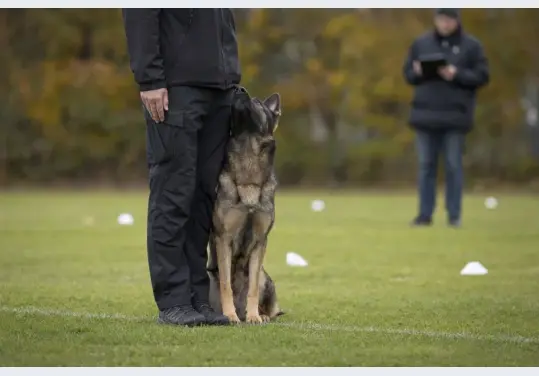
Obedience and dexterity are done on a field, as in the BH, but with obstacles. At level V there are nine exercises: recall, walking on the leash, sit and recall, change of position, down with distraction, carrying and handing over an object, distance control, the tunnel and the wooden bridge. At A and B the leash goes (free heeling), the obstacles gain the mobile bridge and the horizontal ladder, and the retrieve on the flat and directional control at a distance are added.
Every exercise starts and ends in the basic position, on the judge's signal: the dog sitting straight and close on your left, its shoulder at your knee. At the obstacles the basic position is taken two paces in front of the obstacle and again behind it. Brief praise after an exercise is allowed. The judge watches you too: behaviour, teamwork, sportsmanship. A handler leaning over the dog is marked as a fault. A fault repeated throughout, such as a crooked sit, costs little on each exercise but goes into the overall impression.
For teams that come from mantrailing with no obedience background, points are easier to lose here than on the trail. The bridge and the tunnel take a few weeks to learn. Not the last one.
Meanwhile, someone is laying the trail
While you are on the obedience field, the trail layer has already left. The regulations are strict with them, and every rule exists so the dog is left no way to the person except scent.
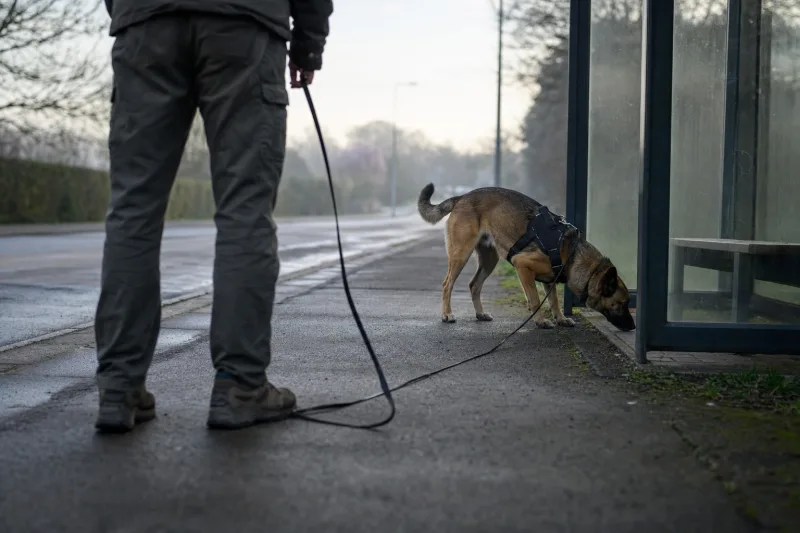
They have not set foot in the exam area in the last 14 days. A friend can lay the trail, but not a member of your family. The start is a point you can describe: a car, a bus stop, a bench, the entrance of a building, a pedestrian crossing. After a short pause there, the layer walks at a normal pace along the route agreed with the judge, plan in hand and usually a GPS too. No food, no toy. Once the trail is laid, they stay at least 2.5 km away from it. At least 15 minutes before your start they are driven to the end by a roundabout route that does not cross the trail, in a closed vehicle with the windows up and the air conditioning off. There they stay passive and wait, and other people in the area keep at least 5 metres away.
Each dog gets its own trail, in a separate area: forest, clearings, fields or a quiet urban area, with changes of terrain and crossings of paths or streets. The regulations want the trail to be crossed by outsiders, at least in its middle section; if nobody has crossed it, the judge can ask someone to.
If your training trails are laid in deserted places, this is where you lose. Move them to places where people walk months before the exam, so that on the day there is nothing new for the dog.
Scent discrimination: a semicircle and one command
It is held on a training ground, a meadow or a car park. The "victims", the people playing the person to be found, are two at V, three at A, four at B. Each hands the judge an article with their scent, labelled neutrally with numbers or letters, so you cannot guess whose it is. Then they set off from a marked line, walk 15 metres in parallel at the same speed to a second line, and from there take up their positions on a semicircle with a radius of 5 metres, backs to you.
The judge hands you one of the articles. You release the leash and send the dog with a single command, voice or hand. The dog has to take the most direct route to the row and alert on the right person, with the type of alert you have declared: bark, bringsel or position. You report the alert, go to the dog when the judge signals and end the exercise as you like: pick the dog up or call it.
The exercise is worth 10 points at V, 20 at A and B. The part many teams neglect is the report: the handler sees the dog sit down at the third person and says nothing, because at training there is nobody to report to.
Train the sentence. "The dog is alerting on person three", said out loud, every time, at home too.
The trail: the numbers for each level
| V | A | B |
|---|
| Trail length | about 500 m (1,000 paces) | about 1,000 m (2,000 paces) | about 2,000 m |
| Changes of direction | 2 | 3 | at least 4 |
| Crossings | 1 street or path | 1 | 2 streets |
| Changes of terrain | 1 | at least 1 | at least 1; urban and open 50/50 |
| Age of the trail | 60 minutes | 4 hours | 6 hours |
| Search time | 20 minutes | 45 minutes | 60 minutes |
| Maximum points | 100 | 200 | 200 |
At V, 20 minutes for 500 metres sounds comfortable. With two changes of direction, a change of terrain and a crossing, a dog that circles at every corner uses up the minutes faster than you think. At A, somewhere between metre 600 and metre 800 a stranger sits or lies, placed there so the judge can see what your dog does with a person who is not its person.
At B, the trail is six hours old and half of it runs through town. Six hours means a whole afternoon of traffic, pedestrians and sun on the trail before you set off.
The points at V: 10 for taking up the trail, 40 for following and holding it, 40 for locating and alerting, 10 for discrimination. At A and B two new boxes appear, 20 points each, and they are about you: handler behaviour, then tactics and teamwork. Out of 200 points, 40 are given for what you do with the line and with your voice.
The judge can stop the work at any moment if convinced the dog can no longer continue on its own. And the basic rule: if the person is not found, the test is not passed, whatever points you collected on the way.
What the judge sees in you
Taking up the trail starts at the point the person left from. The dog gets the scent article, you give the command, the dog picks the direction. If the dog picks it, you have the take-up points. If you show it, with the line or with your body, the judge sees.
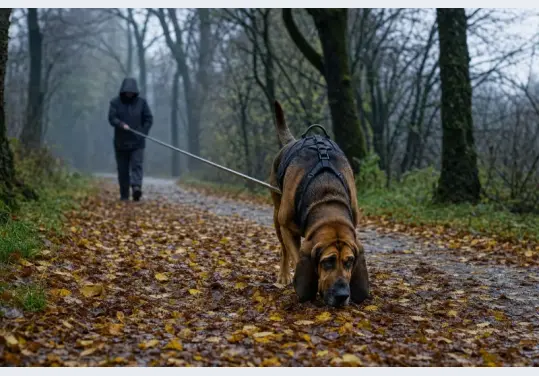
On the trail, most points are lost at the changes of direction and at the crossing, and usually the human loses them. The dog reaches the corner, loses the trail, goes back to the last certain spot, makes a circle, then a wider one, and picks the branch where the scent is fresher. That is how it works, and we have written about why. The handler who pulls the line towards the "logical" direction or starts talking breaks exactly the process the judge wants to see. Tactics and teamwork mean standing still, line slack, and letting the dog finish the circle. When it goes, you go after it.
At the alert, the judge wants the same thing as in discrimination: the declared type, clear, and your report. A dog that reaches the person, wags and looks at you has not alerted. One that barks once and walks off, likewise.
Which level you are training for
Put the exam figures next to our difficulty levels. V is intermediate to advanced: half a kilometre, an hour old. A is advanced: a kilometre, four hours, a stranger on the trail. B comes close to real scenarios: two kilometres, six hours, half of it through town. If at training your dog reliably runs trails of 200 metres and 30 minutes, the road to V is measured in months, not weeks, and it runs through trails laid by people the dog does not know, from town start points: a bus stop, a bench, a car.
Two things to change in training once a team is preparing for the exam. First, the format: the layer leaves from a distinctive point, is driven to the end, does not come back along the trail, carries no food. The dog learns that the person is not at the end of a path it knows and that the party at the end comes from you. Second, the whole day: obedience in the morning, a break, discrimination, a break, the trail. A dog that has only ever run trails has never spent five hours at an exam with other teams around.
The exam sessions we take part in or host are listed under events. If you want to know whether your team is ready for V, take the dog to a training session, or to your own group, and put it on an hour-old trail laid by a stranger from a bus stop. You will have the answer in 20 minutes.