
Through this clear and progressive structure, IRO Mantrailing ensures high training standards for search and rescue teams, guaranteeing that they are capable of intervening efficiently and professionally in real-life situations. IRO certifications are not merely sporting exams, but a confirmation that the team can meet the demanding requirements of operational work, where every decision and every track can make a difference.
International Rescue Dog Organisation
The IRO mantrailing test (RH-MT): examination regulations explained
IRO (International Rescue Dog Organisation) is one of the most important international organisations regulating the activity of search and rescue dogs. Its remit includes the Mantrailing discipline, which is used in real-life operations to locate missing persons.
About the discipline
What is the IRO test?
The IRO test is the examination of the International Rescue Dog Organisation for search and rescue dog teams, run under the joint FCI-IRO regulations. For mantrailing it is the RH-MT test, in three levels, V (pre-test), A and B, each with a nose-work part and an obedience and dexterity part, both of which must be passed to obtain the title. At Mantrailing Romania we ask for a passed BH before a team enters the IRO test.
Mantrailing involves tracking a specific person based on their individual scent, with the dog being trained to distinguish that unique scent from numerous other traces and environmental stimuli.
Within IRO, the evaluation of Mantrailing teams (dog + handler) is structured into three qualification levels: V, A, and B. Each level represents a progressive increase in difficulty and complexity, both from a technical and operational perspective. These levels are designed to test not only the dog's olfactory ability, but also cooperation with the handler, control, discipline, and the team's adaptability in varied conditions.
Exam structure
Each IRO Mantrailing level includes three mandatory tests, all of which must be successfully passed in order to obtain qualification:
Test 1
Obedience and Agility Test
This test evaluates the working foundation of the team. The dog must demonstrate an appropriate level of obedience, control, and emotional stability, regardless of the environment. Basic exercises are assessed, such as heeling, response to commands, behaviour in the presence of distractions, and the ability to work calmly and with focus. The agility component assesses the dog's mobility, movement safety, and ability to overcome various obstacles, all of which are essential aspects in real search and rescue missions.
Obedience and Agility Test
Test 2
Scent Differentiation Test
This test is essential for the Mantrailing discipline. The dog must demonstrate that it can correctly identify and select the correct scent of the searched person, usually provided in the form of a personal item. It must also clearly differentiate it from other human scents. The test confirms that the team is working on an individual scent and not on a general track or other visual or environmental cues. The dog's accuracy and confidence at this stage are fundamental to the success of the entire Mantrailing test.
Scent Differentiation Test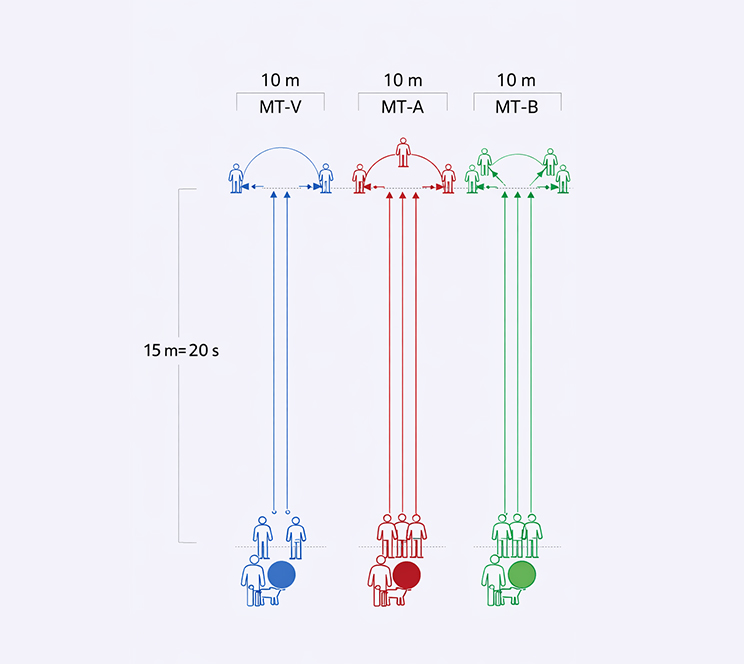
Test 3
Mantrailing Test
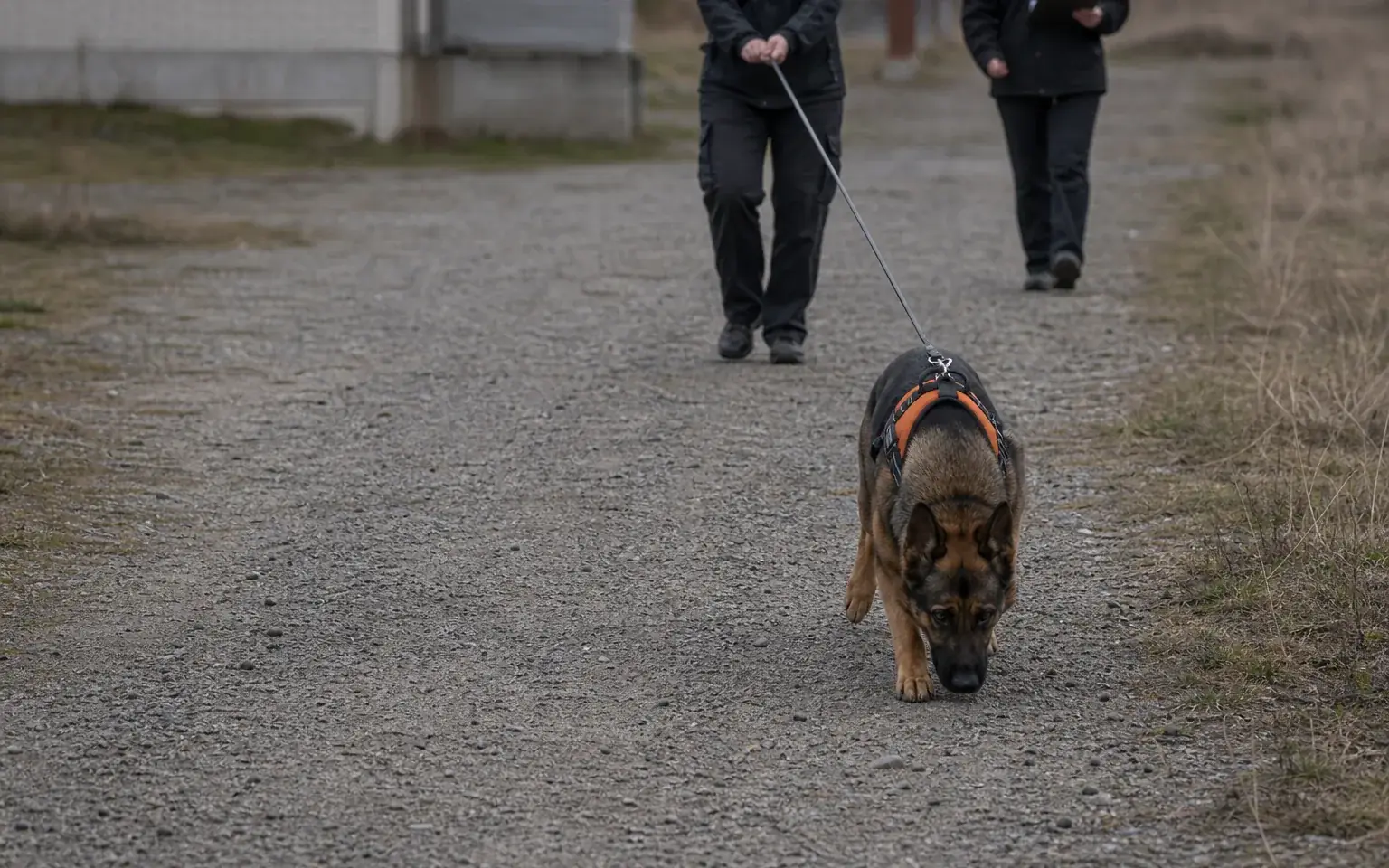
This is the main and most complex test, in which the dog must track the trail of a missing person in a realistic scenario. The difficulty increases with the level (V, A, B) and may include factors such as the age of the track, trail length, and different surfaces (urban, semi-urban, natural). It may also involve intersections, contamination with other human scents, and temporary loss of the trail. The evaluation focuses on the dog's ability to maintain the correct scent, the handler's working method, accurate reading of the dog's signals, and cooperation between the two throughout the entire mission.
Mantrailing Test
Questions and answers
Frequently asked questions about the IRO test
What is the IRO test?
The examination of the International Rescue Dog Organisation for search and rescue dog teams, under the joint FCI-IRO regulations. For mantrailing it is the RH-MT test in three levels: V (pre-test), A and B, each with a nose-work part and an obedience and dexterity part.
What are the IRO mantrailing levels?
V is the pre-test that checks the basics, dexterity and steadiness; A and B follow with longer and older trails and more demanding conditions. Both the mantrailing test and the obedience and dexterity test must be passed at each level.
Do I need the BH before the IRO test?
At Mantrailing Romania, yes: we ask every team for a passed FCI BH (companion dog test) before entering the IRO test, because it proves the dog is steady in traffic, around people and around other dogs.
Where can I read the official IRO regulations?
The complete International Testing Standards for rescue dog tests are published by the IRO and the FCI; the link is at the bottom of this page.