Trial A - obedience
The test is passed if at least the rating "sufficient" is obtained, with 70% of the points in Trial A - that is 42 of the 60 points.
FCI-BH regulations · A.Ch.R.
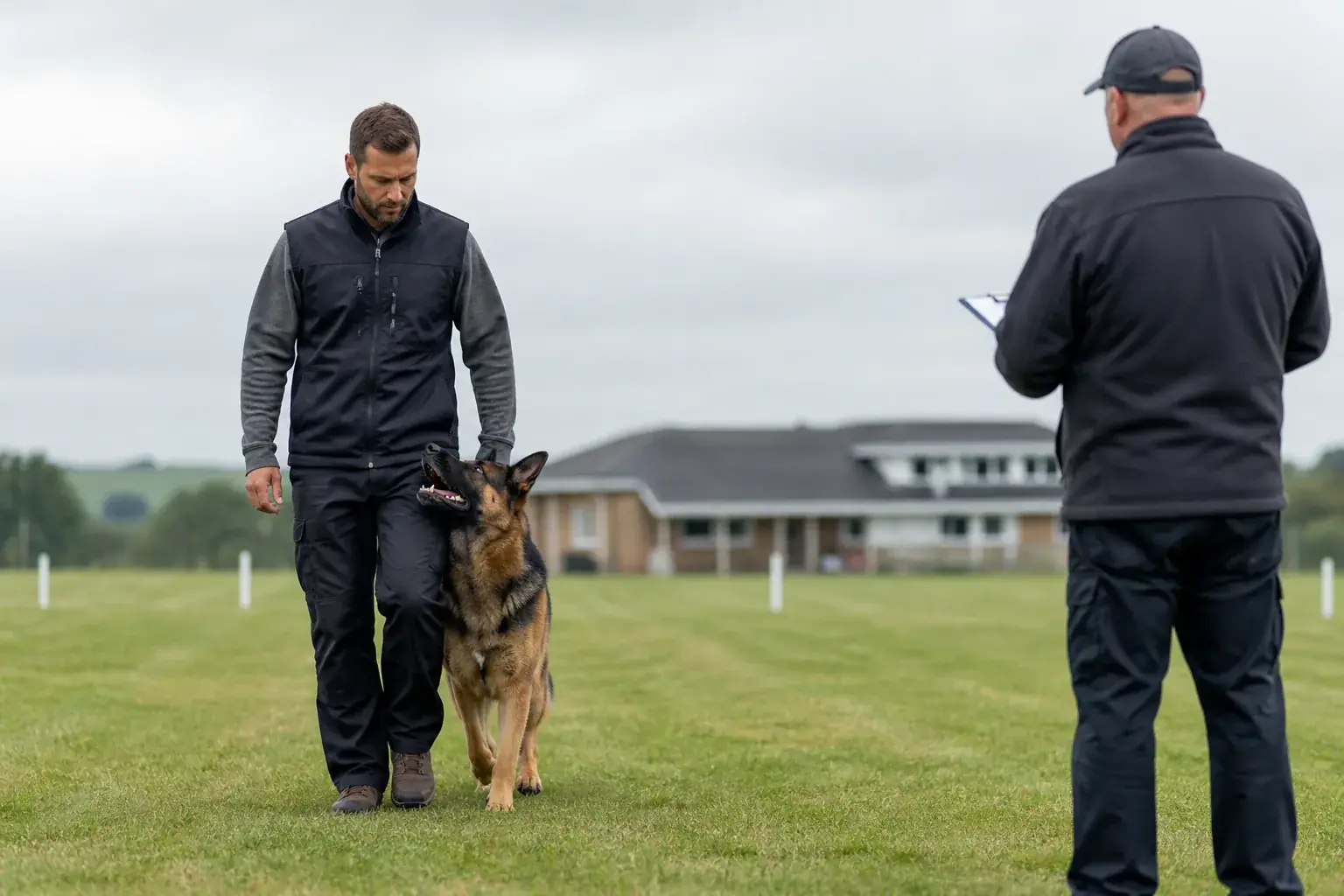
The BH has two parts: one on the examination field, where basic discipline is scored, and one out in the street, where what counts is how the dog behaves among people, cars and other dogs. It is the compulsory gateway to every higher examination for working dogs.
About the examination
Within the FCI-BH examination, the dog's social compatibility must be analysed first and foremost, the technical execution being secondary.
In the obedience trial the judge focuses on the dog's attitude, and the level of obedience has to demonstrate basic discipline. What is being looked for is not the polish of a competition dog, but an animal that works willingly and stays manageable.
All dogs are accepted for the examination, regardless of breed or size. The minimum age for participating in the BH examination, within A.Ch.R. examinations, is 12 months.
Passing the BH examination is the preliminary condition for participation in all higher-level examinations for working dogs. Regardless of the result, it must be recorded in the exam documentation and in the performance book.
Passing conditions
The test is passed if at least the rating "sufficient" is obtained, with 70% of the points in Trial A - that is 42 of the 60 points.
It is also passed if, in all exercises of Trial B, the dog shows behaviour considered sufficient by the trial judge.
If the organising association requests a ranking and an awards ceremony, these will be decided by the trial judge.
Trial A · part one
Four things the judge watches regardless of the exercise.
The dog must show that it wants to work, not that it is merely forced to do so. Dogs must show willingness to work for the handler and a free attitude, without pressure. The dog's expression must be assessed: body posture, ear and tail position, muscle tension, unnatural movements, breathing rhythm, salivation, anxious behaviour. Negative reactions to verbal commands will be penalised.
The dog's performance must be cheerful and motivated - willingness to work and an enthusiastic performance are priorities.
The dog must pay attention to its handler throughout the entire examination, but without displaying an exaggerated, unnatural posture and gait. At the same time, it must execute commands promptly and without hesitation.
The performance of the handler and dog team must be harmonious, with the dog being handled in a natural and fluent movement and gait for the dog.
In addition to a positive attitude and harmonious performance, attention must also be given to the technical aspects of execution. The dog must be correctly aligned, parallel to the handler, with the shoulder at the level of the handler's knee. Verbal commands must be executed according to their description.
In evaluation, a distinction must be made between primary and secondary elements. The primary elements of an exercise are described in the exercise title. It is important that the evaluation reflects the primary elements more than any mistakes in secondary elements.
The dog must perform the exercise cheerfully, on the handler's command. Any behaviour indicating fear or stress will result in point deductions.
Deductions
Trial A · conventions
The definitions below apply to all obedience exercises. Open the ones you need.
The basic position refers to the dog sitting at the handler's left. Each exercise begins and ends with the basic position, and it may be taken only once in the introduction of an exercise. In the basic position the dog must be attentive to the handler, positioned straight on the handler's left so that its shoulder is at the level of the handler's left knee, sitting straight and parallel. The handler must stand upright, with arms naturally along the body.
The exercise introduction represents the starting part, including the basic position, of the exercises "sit from motion" and "down with recall". It takes place over a distance of a minimum of 10 and a maximum of 15 steps, up to the point where the command is given to perform the exercise.
In exercises where the dog is picked up from a position, the pick-up may be done directly from the front or by going around behind.
For recalling the dog, the dog's name may be used instead of a recall command. Using both will be considered a double command. The dog must come to the recall cheerfully, directly, promptly, determined and motivated, and must sit close in front of the handler.
On the command to move into the basic position, the dog must immediately move into the final position on the handler's left. It may go around to the right and behind the handler, or pass in front and take the sit directly on the handler's left, pivoting into the basic position.
If the handler needs one additional command for the dog to move into the final basic position, 1.5 points will be deducted. If 2 additional commands are needed, 2.5 points will be deducted. If, after a total of 3 commands, the dog does not move into the basic position, the entire exercise may be graded with a maximum of "insufficient".
Verbal praise and petting the dog are permitted only after an exercise has been fully completed, for a maximum of 5 seconds; during this time, the dog may leave the basic position. If the final position of an exercise also constitutes the starting basic position of the next exercise, then after rewarding there must be a 3-second pause.
At the beginning of the obedience trial, competitors present themselves in pairs, together with their dogs, to the judge. The presentation is done with dogs on leash. Handlers introduce their name, the dog's name, and the examination they are participating in.
The judge indicates the start of the exercise. All other elements - turns, halts and changes of pace - are carried out without the judge's signal. If a handler completely omits an exercise, the judge will request that it be performed from the beginning, without penalty. Omitting a part of an exercise is penalised.
Trial A · the exercises
On the judge's signal, one of the two competitors moves to the starting point for "heeling on leash", and the other to the point for placing the dog in the down position for "down under distraction".
Exercise 1 · 30 points
At the start of the examination, the handler presents to the judge with the dog on leash, stating their name, the dog's name, and the examination they are participating in. Then, on the judge's instruction, they move to the starting point.
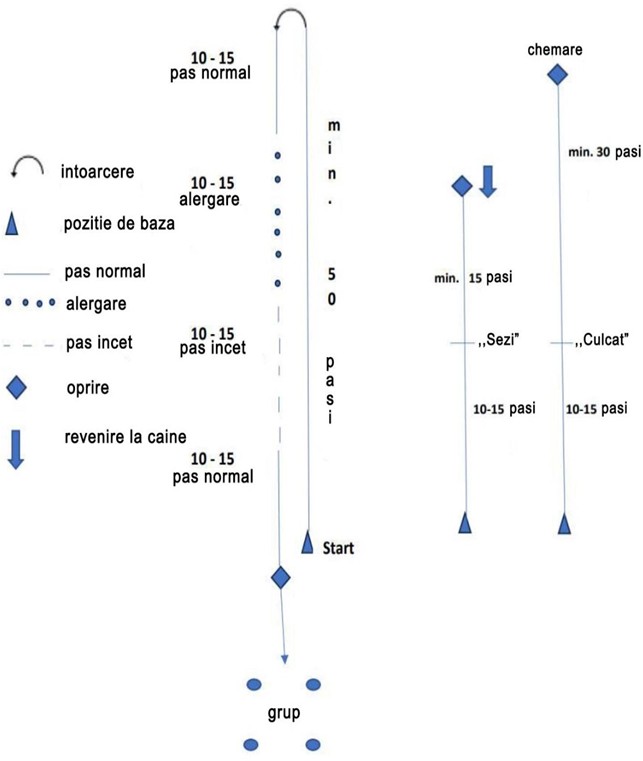
On the judge's signal, they start moving. From the basic position, the dog must, on the first command "Heel!", follow the handler cheerfully, attentively, confidently and determinedly, without stress and focused on the handler. It must remain at all times with its shoulder level with the handler's knee, moving forward together parallel to the handler. They will walk in a straight line at a normal pace for 50 steps.
After 50 steps, a left about-turn is performed, with the handler pivoting to the left. The dog may turn behind the handler, going around to the right, or may turn directly to the left together with the handler, maintaining position.
After the turn, the team proceeds at a normal pace for 10-15 steps, then changes to a run for another 10-15 steps, then to a slow pace for 10-15 steps, then back to a normal pace for another 10-15 steps. At each change of pace, the command "Heel!" may be used. The changes of pace must be clearly recognisable, clearly differentiated from the normal pace, and executed without intermediate steps.
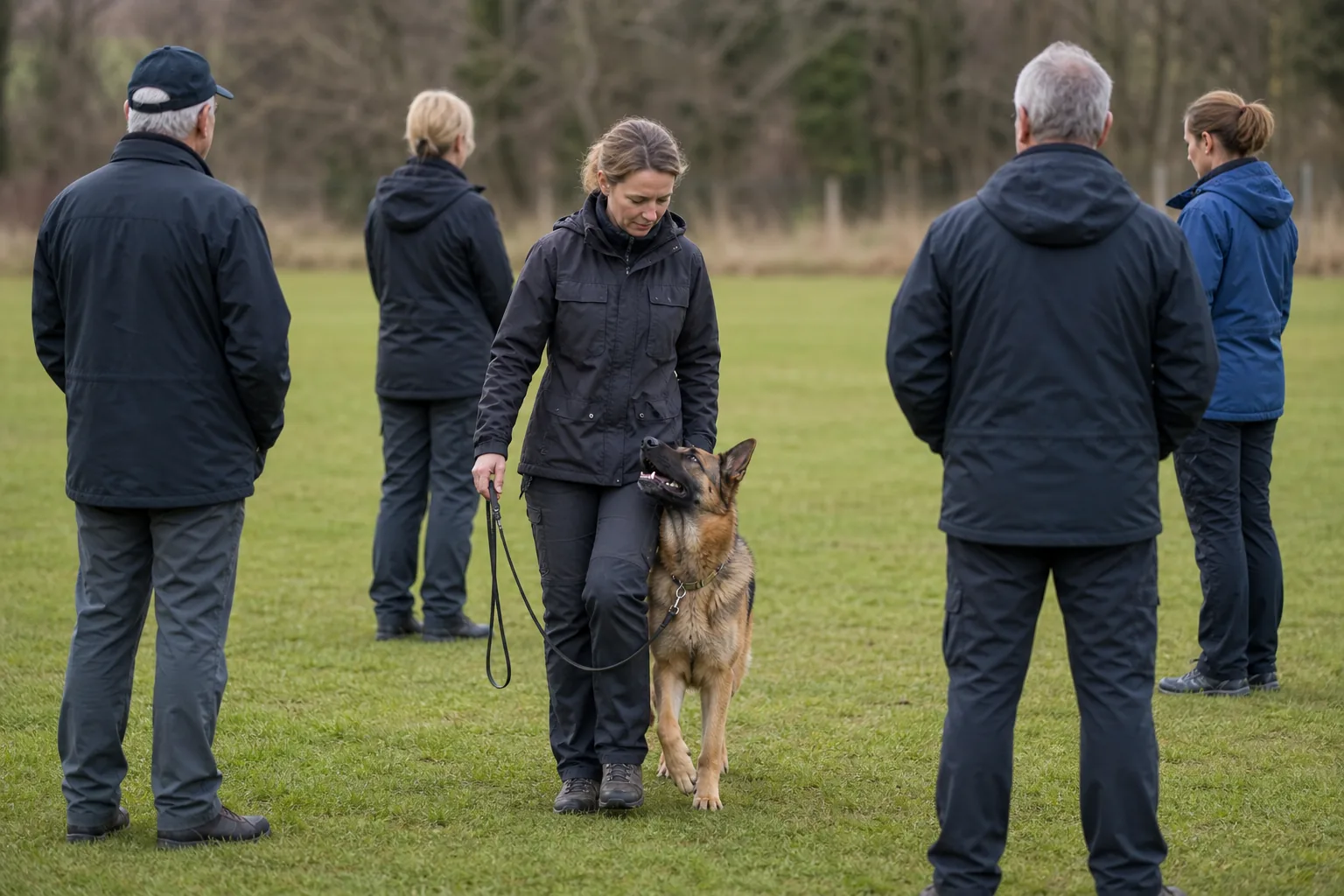
After the last 10-15 steps, the team performs a halt. They then set off with the command "Heel!" and enter a moving group of 4 people positioned nearby. In the group, they circle one person on the right and one on the left - a figure-eight movement - and perform a halt in the basic position. On the judge's signal, they leave the group, return to the start point and take the basic position for the next exercise.
Penalised: faulty heeling with incorrect positioning - too far ahead, too far behind or to the side -, a faulty basic position, slow or hesitant sitting, additional commands, lack of attention, of determination, of motivation and of concentration, apathetic attitude, signs of stress, nonverbal help given to the dog, or coercion.
Exercise 2 · 10 points
From the start point, on the command "Heel!", the team proceeds straight ahead. After 10-15 steps, the handler gives the command for the "sit" position. The handler may stop and, if necessary, remain next to the dog until it takes the sit position, or may continue moving. The dog must sit immediately. The handler continues 15 steps forward at a normal pace, stops and turns to face the dog. On the judge's signal, the handler returns to the dog and takes the basic position.
Penalised: faulty heeling, slow sitting, nervous or restless waiting, lack of attention, and behaviour indicating stress. If, instead of sitting, the dog lies down or remains standing, 50% of the total points allocated to the exercise will be automatically deducted. If the dog does not perform the exercise even after 3 commands (1 plus 2 additional), the exercise receives 0 points and the examination continues with the next one.
Exercise 3 · 10 points
The team proceeds straight ahead. After 10-15 steps, the handler gives the command for the "down" position. The handler may stop and, if necessary, remain next to the dog until it lies down, or may continue moving. On the command the dog must lie down immediately. The handler moves 30 steps forward at a normal pace, stops and turns to face the dog.
On the judge's signal, the handler calls the dog. It must come quickly, directly, determined and without signs of stress, and must sit front, straight and close to the handler. The handler then gives the command to move into heel and the dog must move into the final basic position, going around to the right and behind the handler or directly to the handler's left. The dog is then leashed and the team moves either to the waiting point or to the judge.
Penalised: faulty heeling, slow lying down, inattentive or agitated waiting, slow and undetermined coming on recall, as well as any help given by the handler or faulty positioning of the handler. If, instead of lying down, the dog sits or remains standing, 50% of the total points will be automatically deducted. If it does not perform even after 3 commands, the exercise receives 0 points.
Exercise 4 · 10 points
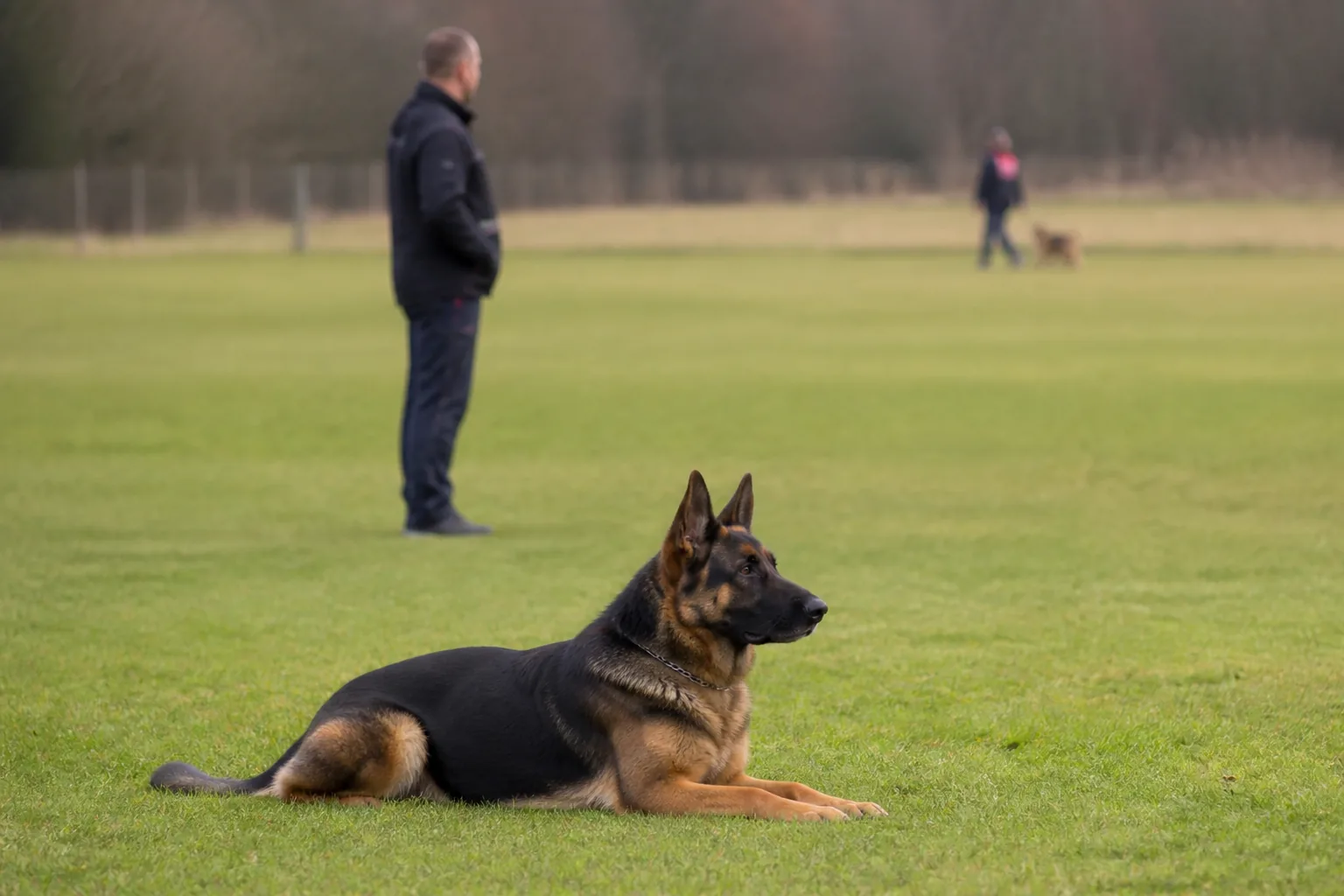
Before the beginning of the obedience trial for the paired team, the handler leaves their dog in the down position at the waiting place indicated by the judge.
In the basic position, the handler removes the dog's leash and places it in a pocket, or diagonally across the body, on the shoulder on the dog's side. On the judge's signal, the handler gives the command "down". The dog must lie down promptly, without stress. After that the handler must move at least 10 metres away, stop and stand calmly within the dog's field of view, turned in profile toward the dog and facing the examination area.
The dog must remain calm in the down position, without any intervention from the handler, while the other team performs the obedience exercises. When the other team has finished "down with recall", on the judge's signal the handler returns and positions themselves on the right side of their dog. On another signal, they command the dog to take the basic position.
Penalised: a faulty basic position, help given by the handler, the dog's agitation in the down position, or an attitude indicating stress. If the dog leaves the down position by more than 3 m from the marked place before the other team completes "heeling on leash", the exercise receives 0 points. For leaving the position after this moment, the exercise may be scored with a maximum of 5 points.
Trial B
Only dogs that have passed Trial A may take part. It is held in public places - streets, alleys or pedestrian squares - that is, outside the examination field, and must not obstruct public traffic.
For this trial, evaluation and awarding of ratings does not depend on points. For passing, the general impression left by the dog's behaviour in public space and traffic is very important.
Due to its particularities, this trial requires a long duration. The examination must not be superficial because of the large number of participants.
The exercises described below are indicative and may be modified by the judge depending on the conditions available to the organiser. The judge has the right to request the repetition or modification of an exercise in unclear situations.
Situation 1
On the judge's signal, the handler with the dog on leash moves to the indicated area, followed by the judge at an appropriate distance. The dog must heel on a loose leash, with its shoulder level with the handler's knee, and behave indifferently toward pedestrians or traffic.
Their route will intersect with that of a pedestrian who cuts across their path, and the dog must remain indifferent. The team then enters a group of at least 6 people. One of them approaches the handler and they shake hands. The dog is given the command to sit or down and must remain in position during this brief interaction.
Situation 2
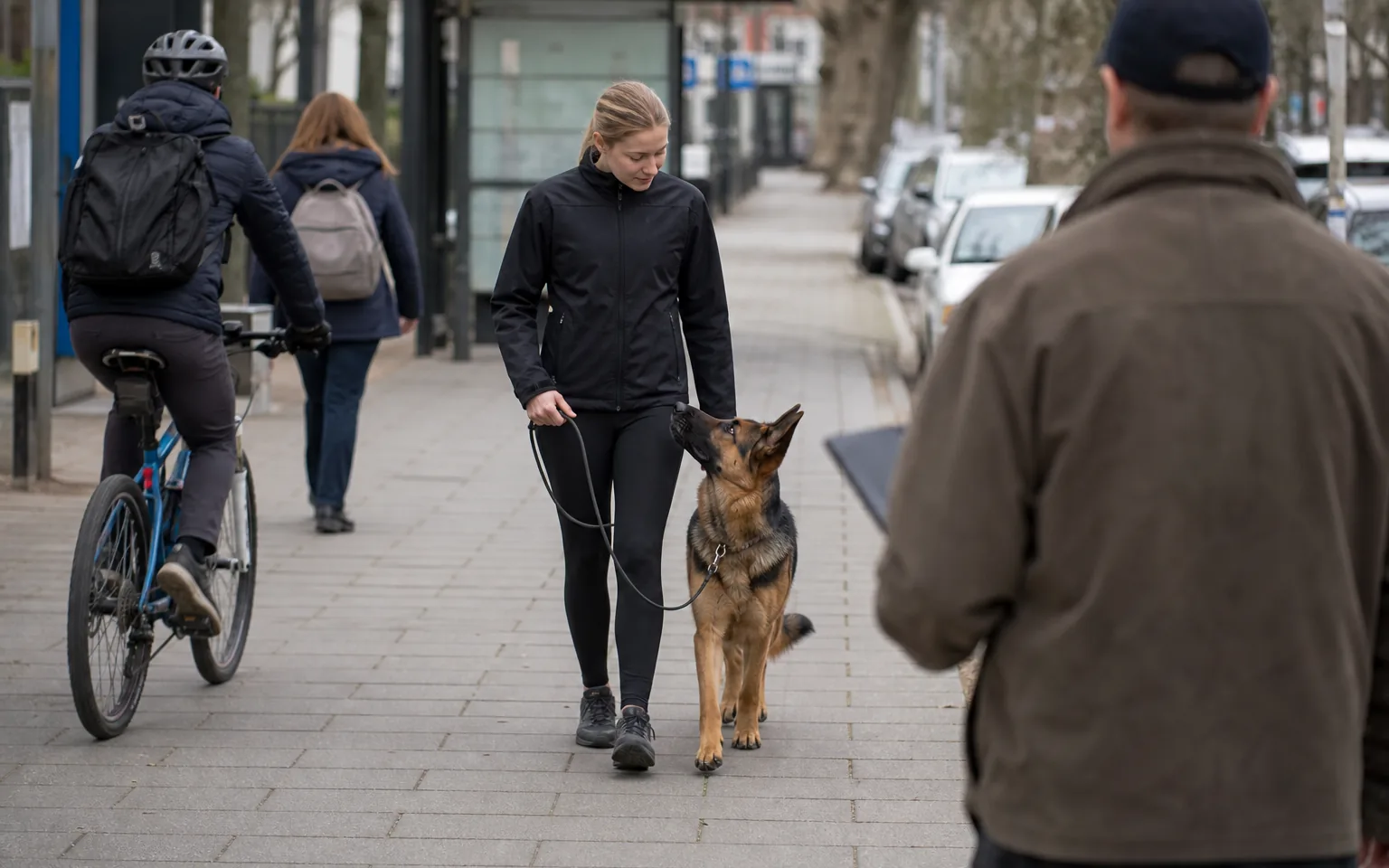
The team is overtaken, at a short distance, by a cyclist who, coming from behind, honks. The cyclist turns around and passes the handler and dog again, this time from the front, also honking. During the pass, the dog must be between the handler and the cyclist. The dog must see the cyclist and remain indifferent.
Situation 3
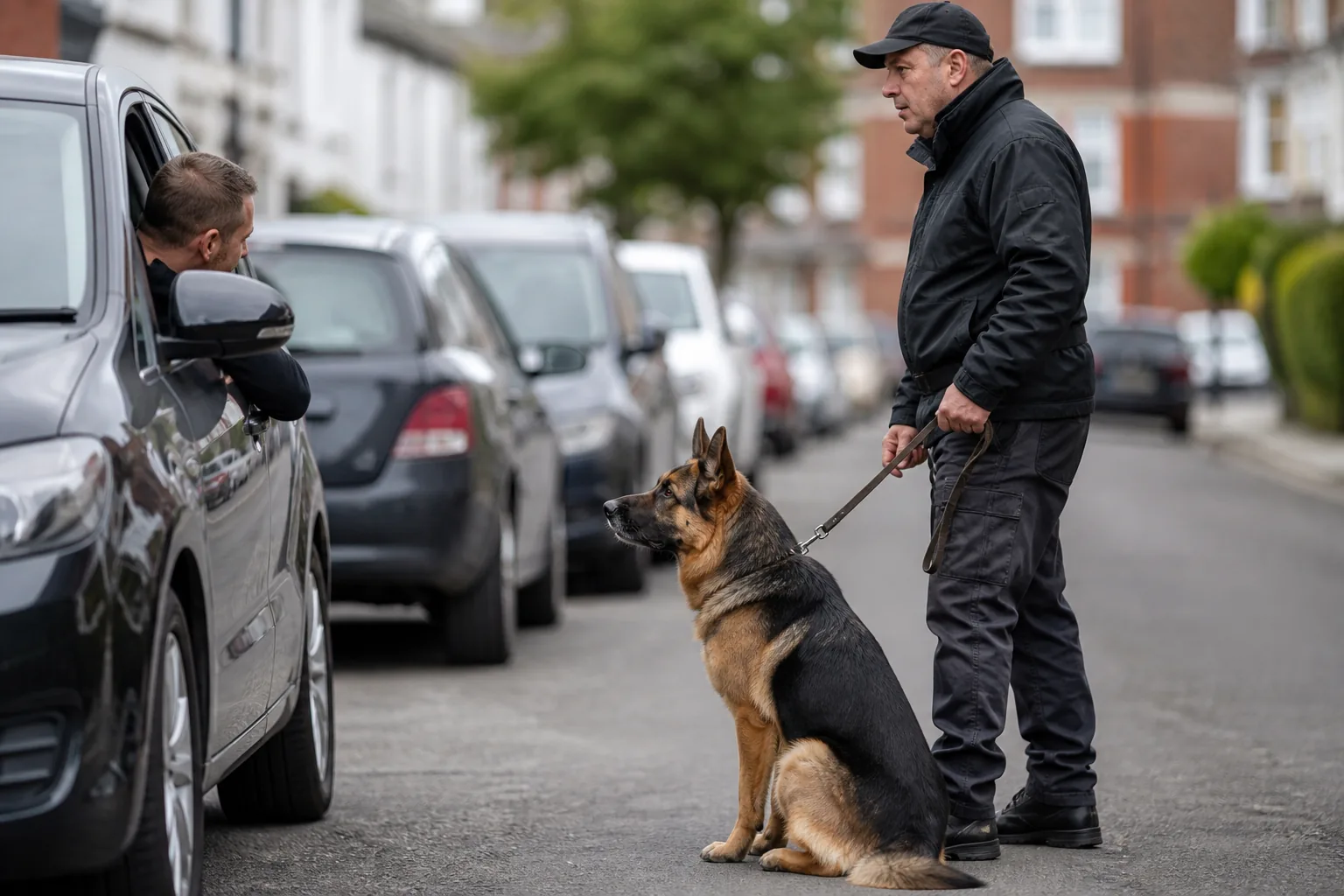
The dog must heel on a loose leash. The team passes by a few cars. The engine of one car will be started, the door of another will be slammed. A car then stops next to them, the driver opens the window and interacts with the handler. The dog is positioned in sit or down and must remain indifferent to cars and traffic noises.
Situation 4
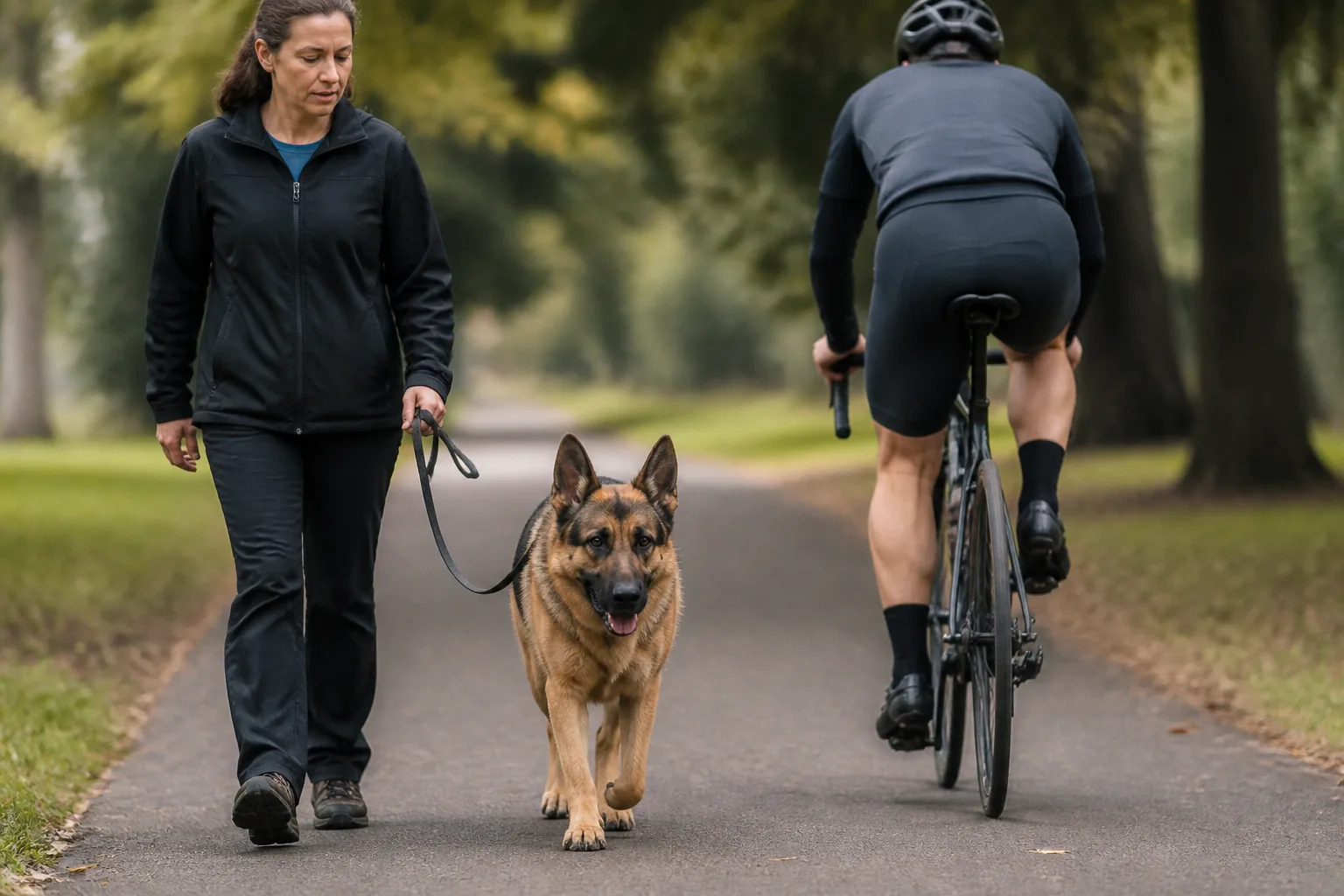
The team moves into a quieter area. At least 2 joggers overtake them without slowing down, pass them and then return, still jogging. The dog does not have to maintain strict heeling, but must not interact with the joggers. The handler is allowed to place the dog in the down or sit position. The exercise may also be carried out with skaters.
Situation 5
On the judge's signal, the team moves in moderate traffic. When meeting another handler with a dog, the dog must remain indifferent. The handler may give the command "heel" or, as appropriate, "sit" or "down".
The handler then ties the dog to a fixed point, leaves and exits the dog's field of view. The dog may stay in any position. During this time, another handler with a dog on leash passes by the examined dog at a distance of about 5 steps. The examined dog must remain calm and quiet. The helper dog must not be aggressive, must not pull hard on the leash and must not bark.
The judge decides whether the exercises are carried out in the same place for all participants, or whether they prefer to judge the dogs separately, in different locations.
Frequently asked
The BH (Begleithundprüfung) is the FCI companion dog test with a traffic part: four obedience exercises worth 60 points on the trial field (heeling on leash, sit, down with recall, down under distraction), passed with at least 70%, followed by a behaviour test in traffic without points. In Romania the minimum age is 12 months. It is the prerequisite for every other FCI-IGP trial and, with us, before the IRO test. See also our guide to all FCI exams.
Dog at least 12 months old and identifiable by microchip; temperament evaluation before the trial; obedience part of 60 points, passed with 42 (70%); then the traffic part: group of people, cyclists, cars, joggers, other dogs and being left tied alone for a short time. No gunshots. Aggression towards people or dogs means disqualification.
All of them. All dogs are accepted for the examination, regardless of breed or size. The minimum age for participating in the BH examination, within A.Ch.R. examinations, is 12 months.
The test is passed if at least the rating sufficient is obtained, with 70% of the points in Trial A - that is 42 of the 60 points. It is also passed if, in all exercises of Trial B, the dog shows behaviour considered sufficient by the trial judge.
Passing the BH examination is the preliminary condition for participation in all higher-level examinations for working dogs. Regardless of the result, it must be recorded in the exam documentation and in the performance book.
The first additional command costs 1.5 points, the second 2.5 points. If a dog does not perform the exercise even after a second additional command, the exercise is scored 0 points. An incorrect position - sitting on the down command, for instance - reduces the exercise to 50% of its total points, and performing before the command costs 2 points.
No. Only dogs that have passed Trial A, the obedience trial, may take part in the socialisation trial.
Behaviour. Within the FCI-BH examination the dog's social compatibility must be analysed first and foremost, the technical execution being secondary. In the socialisation trial the assessment does not even depend on points: what matters is the general impression left by the dog's behaviour in public space and traffic.
Appendix
The abbreviations used in the official text, if you read it at source.
The list is reproduced from the regulations as printed. The abbreviation RE appears in the original with two different meanings.
The description of the trials reproduces the regulations published by A.Ch.R. - the Romanian Kennel Club. For any detail that matters in an examination, the official document remains the reference.
Official BH 2025 regulations (PDF, ach.ro)
This page was last edited on 23.12.2025.
Our advanced training course works on exactly the two halves of this examination: basic discipline on the field and steadiness in town, among people, cars and other dogs. Write to us and we will tell you where you stand now.