The IRO mantrailing test: what exam day actually looks like
You have passed the BH. At training your dog runs hour-old trails of half a kilometre and takes the junctions without you checking your watch, and someone in the gro...

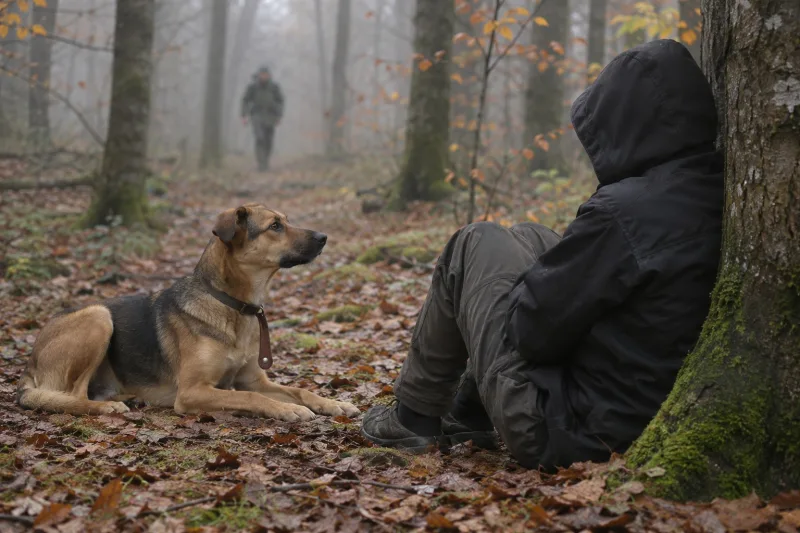
Your dog reaches the person, jumps up, spins twice and looks back at you for the reward. Until now that was enough. It no longer is, for two reasons: in the IRO test you declare in advance how your dog alerts, and in a real search the person may be 200 metres away from you, in a forest, and you have to find out somehow that they have been found. Choosing between bark, bringsel and position comes down to three questions: whether you will see the victim or hear the dog when it finds the person, what your dog does on its own, and who is at the end of the leash.
Three conditions, all at once. Place: the signal happens next to the person found, not on the way and not at the spot the person has since left. The alert: it lasts until you get there. The position: the dog does not leave the person to come and fetch you.
A dog that reaches the person, wags and looks at you has not alerted. One that barks once and walks off, likewise. The IRO judge sees exactly that, and we have described what exam day looks like: the declared type, clear, at the person, and your report out loud.
A false alert shows in the eyes. A dog that has found the person it was looking for looks at them. A dog barking at a bush where the victim stood last week looks at you, checking whether it got the answer right.
On a trail, with 10 metres of line between you, you reach the person at the same moment as the dog. The alert here is a final indication: the judge wants to see that this is the person being sought and that the dog decided. Of the 200 points in the IRO mantrailing test, 40 at level V and 50 at A and B are for locating and alerting, and how the alert is ended, by lifting the dog off or calling it back, is left to the handler.
In area search the dog works loose, far from you, sometimes for minutes without you seeing it. There the signal has to make its own way to you. A loud bark, so that you can hear it. The dog comes to you with a bringsel. It takes a position, stays put and waits to be seen.
It is the only signal that reaches a handler who cannot see the dog, which is why it is the standard method in woodland and on open ground. The condition is that the dog barks beside the person, facing them, close but without contact, and keeps going until you arrive.
Where it fails: next to passing cars, in strong wind, which shifts where the sound seems to come from, and in snow or dense vegetation, which swallow it. With naturally quiet dogs. A bark squeezed out of frustration is the first thing to go when the dog tires, which is to say exactly when it matters most.
In an avalanche, a bark from 30 metres away can go unheard.
There is one more thing, rarely talked about: at the end of the signal is a human being. For a lucid adult the bark is good news, they know on the spot that help is coming. For a small child, an elderly person with dementia or someone hypothermic, a large dog barking a metre away can mean panic or flight. Our page on the bark alert has the criteria, the stages and the mistakes in full.
A piece of leather or webbing about 15 centimetres long, attached to the collar. The dog finds, takes it in its mouth, comes back to you and leads you to the person. Four links, each trained separately. The fourth, leading back, is why some teams give up: the dog has just been rewarded on coming back and now has to leave again for the victim.
In exchange you get a signal you never have to interpret. The object is in the mouth or it is not. It works in noise, it works with quiet dogs that do not bark, it can be seen through vegetation. It fails when the object snags in a thorn bush and when the dog grabs it out of excitement, with no find. That is why the object is for this and nothing else: it is not a toy and it is not worn outside work.
On a trail, with you ten metres behind, the bringsel solves a problem that does not exist: there is nobody to notify. Done without the object, the refind, where the dog comes to you and leads you in, has the same chain and the same fragile link. The full chain is on our bringsel page.
Down, sit or standing still beside the person. The dog marks the spot with its own body. It is the calmest option for the person found and the only one that works with a dog that makes no sound at all.
The limit is simple: a position does not bring you to the dog. A dog in a perfect down, 200 metres away, in a forest, tells you nothing. The position is for situations where you can see the dog or will reach it quickly anyway: the trail on the line, small sectors, open ground.
The down is the easiest to spot from a distance, but on cold, wet or stony ground the dog gets up on its own after a while, however well it was trained. The sit can be held anywhere, but from 50 metres you cannot tell it from a dog that has stopped to scratch. Standing with a fixed gaze is comfortable for the dog and hard for you to read; as the only signal we do not recommend it. More on our position alert page. Bark plus position solves the limit: the bark brings you, the position keeps the dog beside the person. It is two criteria to hold at once, so more to train, but it is the only variant in this family that also works at distance.
Will you see or hear the dog? If you work, or will work, large sectors, forest, broken ground, you need something that reaches you: a bark, or in noise a bringsel. If you work on the line and want a signal for the exam, a position is enough and is the easiest for a judge to read.
Start from what the dog does on its own. A dog that barks at a closed door and at the ball under the sofa has half of a bark alert already. One that fetches everything it finds and will not let go has the raw material for a bringsel. One that holds a down for three minutes in the garden, with you 20 metres away, has the position. Do not force a quiet dog to bark, and do not ask a dog that cannot hold a one-minute down at home to hold one next to a stranger.
Who is at the end? If your team is often called out for children or elderly people with dementia, a second alert, by position, is worth training and using when the coordinator asks for it. A dog that can do both is more useful than one that does only one perfectly.
Check what your certification requires, too. Some tests accept any reliable signal, others explicitly require an audible one, which rules out the position and the bringsel as the only signal. Check the certifications page before you invest months in a method that will not be accepted.
| Alert | Reaches you on its own? | The dog it suits | Where it fails |
|---|---|---|---|
| Bark | Yes, the sound travels | Vocal, barks easily and on cue | Machinery, wind, snow, dense vegetation, a frightened person |
| Bringsel | Yes, in two trips | Quiet, fetches and holds objects | Snagged object, long chain, grabbing out of excitement |
| Position | No | Quiet, calm, holds duration | Large sectors, forest, cold ground for the down |
Rewarding too early. The dog learns that a short bark or two seconds of down is enough, and rebuilding duration takes months.
Distance before duration. The order is: the behaviour outside any search, then beside a subject in plain view a few metres away, then duration, from two seconds to thirty and beyond, and only at the end do you move away. Reversed, that order produces a dog that gets far away and goes quiet.
The same hiding places. The dog learns the spot and starts alerting at last week's bush. Change them more often than feels necessary.
Reward from you. If the subject rewards, the dog stays oriented towards the person. If the reward always comes from the handler, the dog learns that the value is with you and starts turning back. In training it looks like a detail. On a callout it shows.
Switching method halfway. A dog taught to stay and bark has "I do not leave the person" firmly in place; moving to a bringsel or a refind, where coming back to you is precisely what is asked, means rebuilding the chain from scratch. Choose before you start.
Your next session: decide on the alert, write it in your trail log and for two weeks work only with the subject three metres away, in plain view, reward coming from them. Duration comes afterwards. If you want someone watching the dog while you watch the clock, come to a training session, and if the signal is for a search team, the road continues on our volunteering page.
Articles
You have passed the BH. At training your dog runs hour-old trails of half a kilometre and takes the junctions without you checking your watch, and someone in the gro...
More than 3.67 million dogs in RECS, Romania's registry of owned dogs, are recorded as mixed-breed or "common breed". If uncontrolled breeding stopped today, the fir...
Around October, handlers who started mantrailing in the summer notice something odd. The dog has "improved" overnight. Forty-minute trails it lost at the first junct...
Events


