A dog that's only ever worked in a park can get stuck at the first training session on a street. A dog that has always worked in the forest can seem confused and slow in the city. It's not about talent or poor training - it's about different environments where scent behaves completely differently.
Each type of terrain has its own olfactory rules, its own traps, and its own advantages. If you understand how your dog works in each environment, you can train smarter and avoid the frustration of sessions where everything seems to go wrong without knowing why.
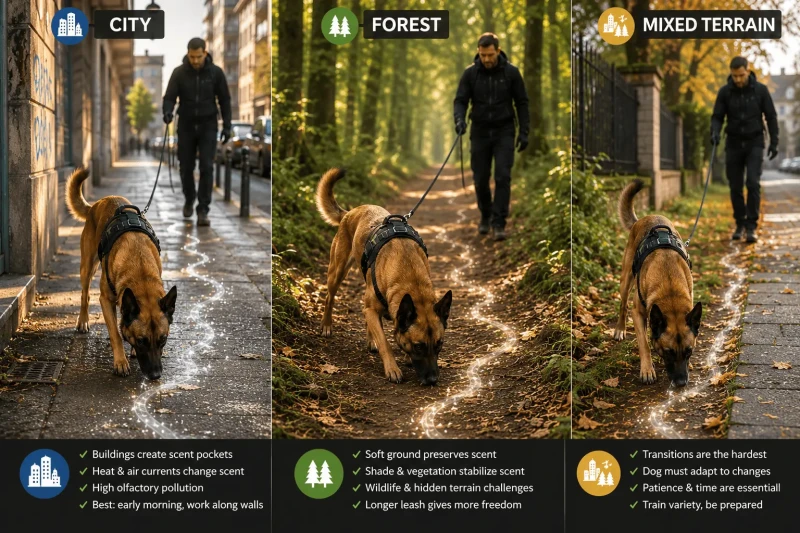
Mantrailing in urban environments
The city is a challenging environment for several reasons that have nothing to do with trail distance or complexity.
The biggest headache comes from buildings, which break scent up into unpredictable pockets. Walls reflect it - a trail that passes next to a tall building may be found by the dog on the wall itself, not on the pavement. Scent rises along facades, drifts down through air currents between blocks, and behaves unpredictably at street corners where wind kicks up small vortexes.
Then there's the heat. Asphalt warms up and lifts scent along with the rising air - we touched on thermal convection in the weather article, and in cities the effect is amplified by heat stored in concrete and asphalt. A summer day can make a two-hour-old trail practically inaccessible by noon.
And on top of that, olfactory pollution is enormous. Exhaust fumes, garbage, food from restaurants, the scent of other dogs and people - the dog has to filter through all of it to find the specific signature of the person it's tracking. It's a cognitive workload that natural terrain simply never demands.
The advantage of urban settings: hard surfaces preserve foot trails well in cooler weather, trails can be precisely controlled by the handler since you know exactly where the layer walked, and the dog learns to work in the presence of distractors - an essential skill for any utility work.
Practical tip: in urban settings, let your dog range closer to building walls and don't rush to correct him if he seems to lose the trail at a corner - he may be searching for reflected scent. Urban sessions work best early in the morning before asphalt heats up.
Mantrailing in the forest
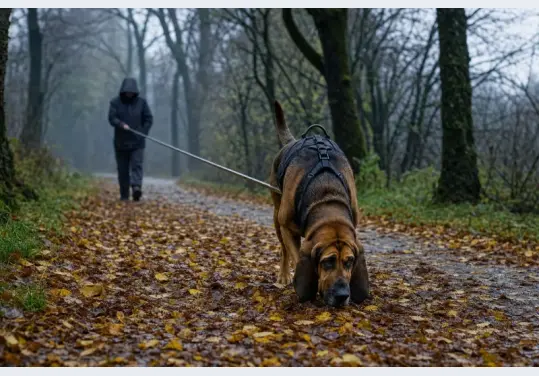
The forest is the environment where most mantrailing dogs progress fastest in the beginning. Not because it's inherently easier, but because conditions are more stable and friendlier to scent.
Forest floor - soil, moss, leaves - absorbs and holds scent particles much better than any artificial surface. The natural shade of trees maintains lower temperatures, reducing thermal convection. Wind is filtered by vegetation, so scent stays more concentrated and closer to the actual trail.
A dog working in the forest can follow three-to-four-hour-old trails with an ease that won't be found on a sunlit street.
But the forest has its traps too. Dense vegetation can physically hide the layer - a dog indicating "found" may actually have located the person hiding behind a bush two metres from the handler, invisible to human eyes. Uneven terrain complicates the handler's work: a ten-metre leash between trees becomes a practical nightmare. Animals - rabbits, deer, foxes - leave thousands of tempting scent trails. Young dogs get distracted frequently in the forest.
Practical tip: in the forest, a longer leash (ten to fifteen metres) works better than a short one - it gives the dog freedom to explore around vegetation without being constrained. Pay attention to when the dog circles in tight spirals - it usually means he's found the area but hasn't precisely located the person yet.
Mixed terrain: the most difficult
A trail that starts in a park, passes through a residential area, and ends at the edge of a forest is more demanding than any of its individual components. Not because it's long or complicated - but because the dog must manage the transitions.
The transition from forest to urban is the trickiest moment. The dog works focused on a clear and stable scent in the forest, steps onto a street, and suddenly everything changes: the surface, the scent intensity, the noise level, the temperature. Many dogs make a visible pause at this transition - they seem to reset and restart the search.
This isn't a problem - it's adaptation. The handler needs patience in these moments, must not rush the dog, and shouldn't intervene before giving the dog time to recalibrate.
The transition from urban to open space (field, large park) is usually easier - the dog moves from fragmented scent to clearer, more stable scent.
How to train for all types of terrain
The most consistent advice from any experienced mantrailing instructor is: vary the terrain. Don't always train in the same place. A dog that has worked in ten different locations - dense urban, park, forest, field, riverbank - has a flexibility that a dog always trained in the same setting will never develop.
Introduce new terrain gradually and with simple trails. If your dog has always worked in the park near your home, don't take him straight to an 800-metre trail through the city centre. Start with 100 metres on a quiet street, with a simple trail and fresh scent. Give him time to learn the rules of the new environment.
And remember: maximum difficulty in a new environment should come with minimum trail difficulty. New environment plus long trail plus aged scent equals too much at once.
Real mantrailing - in search and rescue or advanced competitions - never takes place on predictable terrain. The more variety you train in, the more prepared your dog will be for whatever terrain he encounters.