
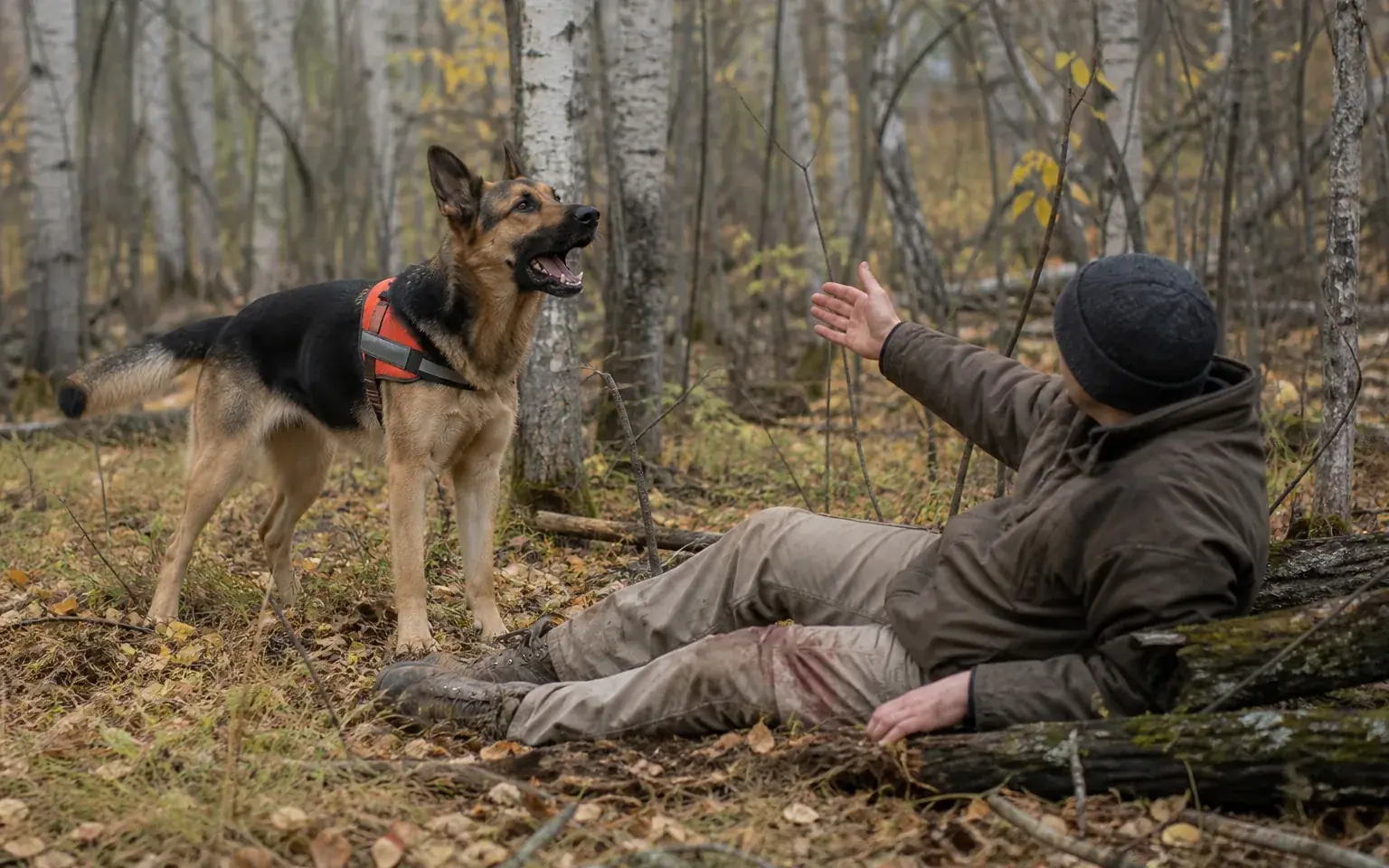
The bark alert
It is the only alert that travels to a handler who cannot see the dog. That is why it remains the most widely used method in area search - and why it is worth knowing exactly what is required, not just that the dog "has to bark".
The definition that matters
What a bark alert actually is
Every dog barks. Few bark in order to report a find, in one specific place, for as long as it takes. The difference between the two is not intensity. It is criteria.
A bark alert has three conditions, and all three have to hold at the same time. Place: the dog barks next to the person it found, not on the way back and not at the hide the person has since left. Persistence: it barks until the handler arrives, not three times. Staying: it does not leave the person to come and fetch you.
The last condition is the one teams discover late. A dog that finds, barks briefly and then runs back to the handler has not given an alert - it has improvised a poor refind. And the handler, who did hear barking, sets off towards where the sound came from and finds an excited dog rather than a person.
What it is not: bark and hold
Search online and "bark and hold" turns up next to "bark alert" constantly. They are unrelated. Bark and hold belongs to protection sport: the dog barks at a decoy in a suit and engages if the decoy runs. An alert in search and rescue is the opposite - the dog must not touch the person, and the person is usually still, sometimes unconscious.
The confusion is not only terminological. A dog coming into search and rescue from sport, with bark and hold well established, may bark correctly and still close the distance, with an intensity that frightens an injured person. Worth checking explicitly rather than assuming.
Criteria
What a correct alert looks like
A judge or a coordinator is not watching enthusiasm. They are watching things that can be measured.
| Criterion | What is required | What counts as failure |
|---|---|---|
| Place | Next to the person, in view | Barking at the hide, not the person |
| Persistence | Continuous until the handler arrives | Intermittent, with long gaps |
| Staying | Does not leave the person | Sets off towards the handler and back |
| Orientation | Facing the person | Barking into space, turned towards the handler |
| Distance | Close, without physical contact | Too far to mark the spot, or on top of the person |
The false alert, and how to spot it
A false alert is a correctly executed bark at nothing. The dog has learned that barking produces a reward, so it barks - at an old hide, at lingering scent, or simply at a bush that resembles the places where it has found people before.
There is one reliable tell: no target. A dog that has found someone looks at the person. A dog barking falsely looks at the handler, checking whether it has guessed the right answer. It is obvious on the field and almost invisible in written descriptions.
The cause is nearly always in the training: reward given too early, before barking was clearly tied to the presence of a person. See the common mistakes below.
Methodology
Training, stage by stage
The order below is not a suggestion. Each stage assumes the previous one is stable, and skipping one is paid for at stage three or four, when you no longer know what broke.
Stage 1 - Barking on cue, away from searching
The dog learns to bark on request, as a game, with nobody hidden and no search context at all. The point is to have a behaviour you can ask for at any time, not to connect anything yet. Do it in the garden, indoors, anywhere quiet.
Stage 2 - Transferring it to a hidden person
The subject sits a few metres away, in view or barely covered. The dog arrives, barks, the subject rewards. The distance stays deliberately short: we want the link "person found → bark" to form cleanly, without the effort of searching on top of it.
Stage 3 - Duration
This is where most of the work happens. The reward is delayed progressively: two seconds, five, ten, thirty. The build is neither linear nor tidy - a dog that held thirty seconds yesterday may break at ten today, and pushing a criterion that has already been lost undoes what you built.
Stage 4 - Distance
Only now does the handler move away. The dog searches, finds, barks, and the handler arrives after a realistic delay - not after two seconds. This is where the method is actually tested, because everything that worked at twenty metres can collapse at two hundred.
Who gives the reward, and what that changes
If the reward comes from the subject, the dog stays oriented towards the person, which is what we want. If it comes from the handler, the dog learns that the value is with the handler and starts turning back towards them. The difference looks small in training and is obvious on a callout.
Most teams let the subject reward at first, then move gradually to a mixed reward, so that dependence on the subject does not become a problem of its own.
Common mistakes
- Rewarding too early. The dog learns that a short bark is enough. Repairing it takes months of rebuilt duration.
- A subject who moves. If the subject reacts, the dog starts barking to produce movement rather than to report a find.
- Barking at the hide instead of the person. This appears when the same hiding places are used over and over. The dog learns the place, not the person. Vary hides more often than feels necessary.
- Adding distance before duration. The reverse order produces a dog that gets there and goes quiet.
Operational context
When the method fits
The bark has one advantage no other method has: it reaches the handler on its own. The dog does not have to come back, and the handler does not have to see anything. The sound makes the journey.
That is why it is the standard in area search in woodland and open ground, where the dog works wide sectors far from the handler, often out of sight for minutes at a time.
When it becomes unusable
- Rubble with machinery running. An excavator drowns out any dog. USAR work uses scheduled silences precisely so that alerts can be heard - where that is not possible, barking does not help.
- Strong wind. It shifts the apparent direction of the sound, and the handler sets off the wrong way.
- Snow and dense vegetation. Both absorb sound. In avalanche work, a bark from thirty metres can be undetectable.
- Naturally quiet dogs. This is temperament, not a training fault. See suitable breeds for predisposition to vocalise.
What to do with a dog that does not bark
Do not force it. A bark produced through frustration is the first thing to fail under fatigue, which is exactly the moment you need it. For quiet dogs there are three real alternatives: the bringsel, the refind, and the position alert - each with different terrain and team requirements.
The part rarely discussed
The effect on the person found
Discussions about alert methods are almost always held from the team's point of view. But at the other end of the signal there is a person, and they did not ask for a barking dog.
For someone conscious and lucid, barking is good news: they know immediately that they have been found and that help is coming. Many teams prefer it for exactly that reason - the alert reassures the casualty at the same time as it calls the handler.
For someone frightened, disoriented, hypothermic or living with dementia, the same scene reads differently. A large dog barking insistently a metre away can cause panic, attempts to flee, or defensive reactions. For how a callout actually unfolds, see how a search works.
When barking is ruled out by the casualty, not the terrain
Some searches come with a known profile from the start: a small child, an older person with dementia, someone with an anxiety disorder. There, the alert decision stops being about acoustics.
Teams that handle such cases often train a second option - the position alert - and use it when the coordinator asks for it. A dog that can do both is more useful than one that does only one perfectly.
Frequently asked questions
Frequently asked questions
01
At what age can you start training a bark alert?
Barking on cue can be played with from a few months old, with no connection to searching at all. Transferring it to a hidden person, and especially building duration, needs maturity and the ability to concentrate, so the serious work usually starts after a year. A dog pushed too early learns to bark briefly and leave, and that is the hardest thing to repair later.
02
How long until a bark alert is reliable?
The barking itself is learned quickly. What takes time is persistence at long distance, with the handler arriving late, in unfamiliar terrain, after the dog has already worked for an hour. Most teams spend months on duration and distance, not on barking.
The test of reliability is not whether the dog barks, but whether it is still barking after three minutes, tired, two hundred metres away from you.
03
Can you switch from a bark alert to another method?
Yes, but it costs. A dog that has learned to stay and bark already has a firm behaviour of not leaving the person. That helps with a position alert and gets in the way of a refind, where returning to the handler is exactly what is required.
Moving from bark to refind means rebuilding a whole chain, not adding one link. Choose the method from the discipline before you start, not after.
04
What do you do with a dog that does not bark?
Do not force it. Some dogs are naturally quiet, and a bark produced through frustration is the first thing to fail under fatigue, which is exactly when you need it.
For quiet dogs there is the bringsel, the refind, and the position alert, each with different terrain and team requirements. The right choice starts from the discipline and the working environment, not from wanting to use a particular method.
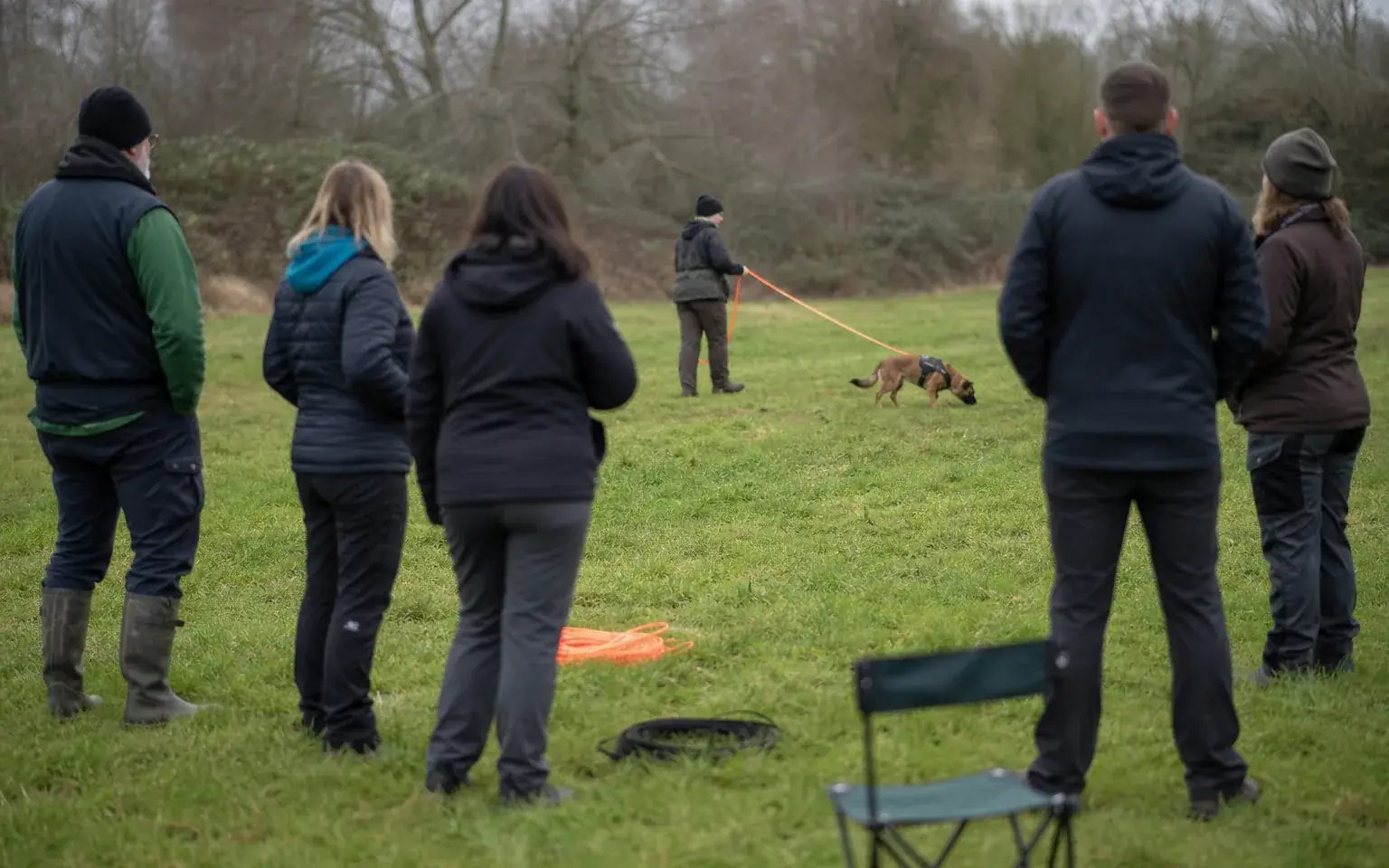
The alert comes after the foundation
A reliable alert is built on a dog that searches properly. That foundation is laid in mantrailing.