
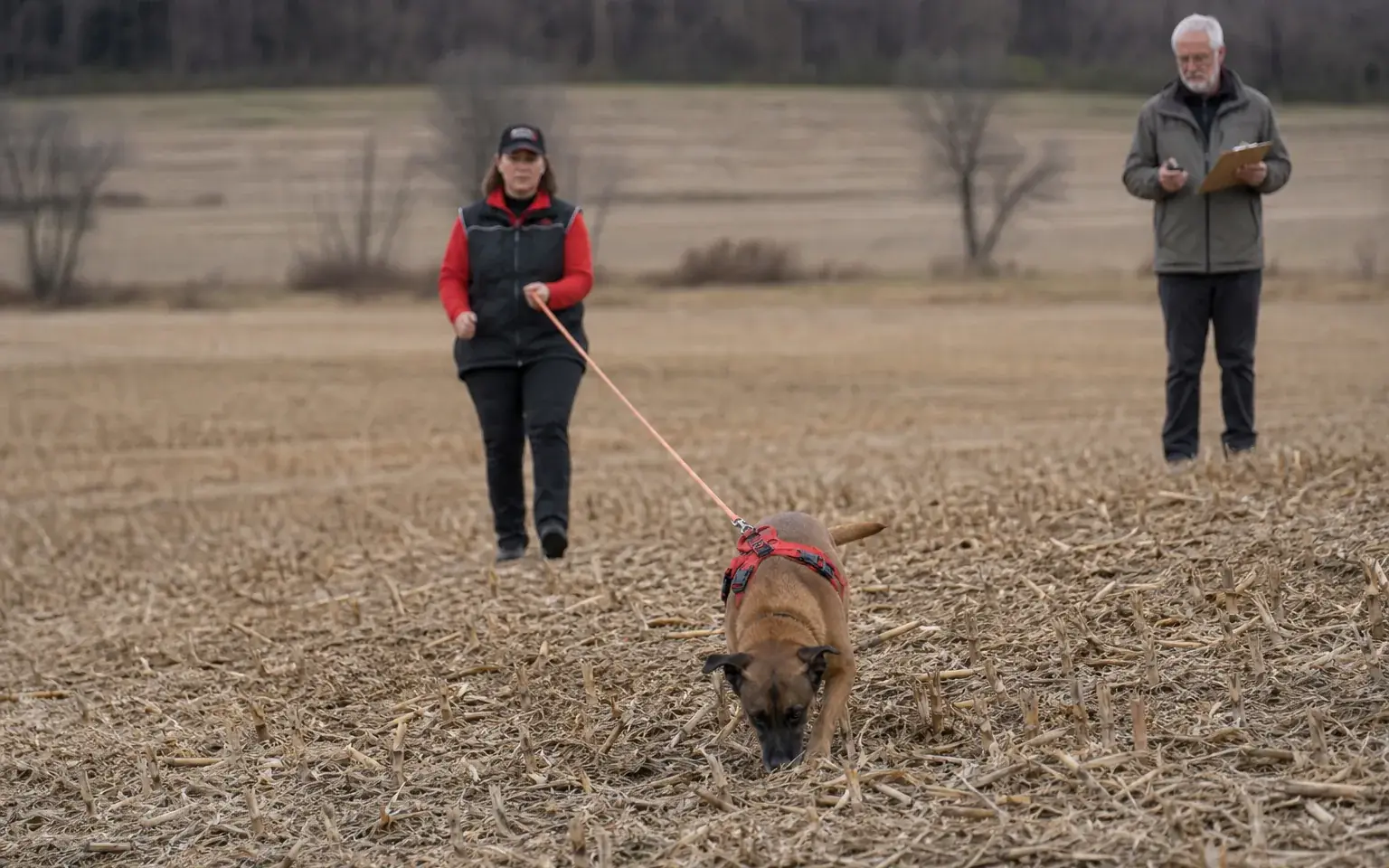
Search and Rescue Dogs
Search and rescue dog certifications
The main certifications for search and rescue dogs are IRO (the international standard for mantrailing, area and rubble search, plus obedience and dexterity), TSAC (a tiered system), the BH test (the obedience foundation) and Mantrailing Hungary K9 (a tiered certification for mantrailing). Each has progressive difficulty levels, and certification is what proves the team can work safely in a real operation.
In short
What turns a trained dog into a recognised team
Mantrailing Romania is the only project in the country that documents these exams in detail - a real advantage for anyone who wants to understand the system before entering it. Below is the comparative picture; each exam also has its own in-depth page. For context, see the guide on search and rescue dogs.
Why certification matters
A dog can be excellent in training, but without certification it cannot be sent to a real operation. The standardised exam guarantees that the human-dog team works safely, predictably and effectively in real conditions, alongside other teams and the authorities. Certification is not a formality - it is the line that separates a hobby from operational responsibility.
BH - the obedience foundation
The BH (social companion) test certifies basic obedience and control of the dog in distracting environments. In most systems it is the mandatory prerequisite before advanced rescue exams - without a dog that is reliable off-leash, nothing that follows makes sense.
IRO - the international standard
The IRO exams (International Search and Rescue Dog Organisation) are recognised worldwide and cover several disciplines: mantrailing, area search, rubble search, tracking, avalanche and water. Each discipline is passed in progressive levels (usually an aptitude test, followed by levels A, B, C, with increasing difficulty). IRO also includes an obedience and dexterity test, documented separately on the site.
TSAC - tiered evaluation
The TSAC exam is a tiered evaluation system for working dogs, with requirements that gradually increase in difficulty. It is a recognised certification path for teams preparing for utility and rescue work.
Mantrailing Hungary K9
The Mantrailing Hungary K9 system offers a certification dedicated to mantrailing, with clear difficulty levels. It is especially relevant for teams building their foundation on individual scent trailing - the basis of any search dog.
Quick comparison
| Certification | What it tests | Level |
|---|---|---|
| BH | Basic obedience, control in distracting environments. | Foundation / prerequisite |
| IRO | Mantrailing, area, rubble, tracking, avalanche, water + obedience and dexterity. | International, progressive levels (aptitude → A/B/C) |
| TSAC | Working dogs, requirements at increasing levels. | Progressive levels |
| Mantrailing Hungary K9 | Mantrailing on an individual trail. | Difficulty levels |
The typical certification path
In practice, a team usually follows this path: first the scent foundation through mantrailing, then the BH test for obedience, then the introductory levels of an IRO or TSAC discipline and, over time, the operational certifications that allow taking part in real operations. See all the exams and certifications explained step by step, or how it all connects in the guide on how to become a volunteer with your dog.
Frequently asked questions
Frequently asked questions
01
What certifications exist for search and rescue dogs?
The main ones are IRO (the international standard for mantrailing, area and rubble search, plus obedience and dexterity), TSAC (a tiered system), the BH test (the obedience foundation) and Mantrailing Hungary K9 (a certification for mantrailing). Each has progressive difficulty levels.
02
Which certification should I start with?
With the BH test, which certifies basic obedience and control in distracting environments. In most systems BH is the prerequisite before advanced exams. Only after a solid foundation of obedience and mantrailing do you move on to the introductory IRO or TSAC levels.
03
What is the difference between IRO and TSAC?
IRO is the internationally recognised standard, with exams across several disciplines and progressive levels. TSAC is a tiered evaluation system for working dogs. Both certify that the team can work safely; the choice depends on the organisation and discipline the team trains in.
04
Is certification mandatory to take part in operations?
Yes. For a real operation alongside the authorities, the team must hold the appropriate certification, which guarantees it can work safely and effectively. Certification is re-evaluated periodically, usually through at least one exam per year, depending on the level.
Want to understand the exams in detail?
Explore our dedicated pages for each certification - unique in Romania.