Mantrailing in autumn and winter: cold, rain and snow on the trail
Around October, handlers who started mantrailing in the summer notice something odd. The dog has "improved" overnight. Forty-minute trails it lost at the first junct...

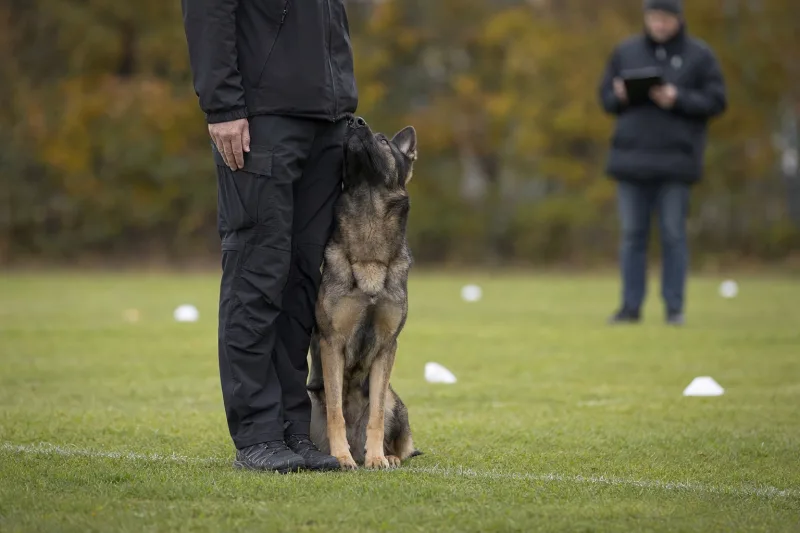
On 17 and 18 October there are TSAC and FCI-BH exams in Bucharest. If you have entered, you have two weeks left. If you are aiming for the next session you have more time, but the same question in front of you: what does your dog do when there is nothing visible left to earn and a stranger with a clipboard is watching the two of you?
That is what the BH checks. The regulations say it almost in these words: the BH assesses the dog's social compatibility first, and technique comes second. Nobody is looking for a competition dog. They are looking for one that works willingly and stays manageable among people, cars and other dogs. And, something many people learn late, the BH is the entry condition for every higher utility-dog exam: without it you cannot enter IGP, IBGH or FH.
The figures below come from the FCI-BH regulations valid since 1 January 2025, as applied by the Romanian Kennel Club (A.Ch.R.). The plan comes from the way we prepare teams in our advanced course.
The dog must be at least 12 months old. Breed and size do not matter.
There are two parts. Part A, obedience, is done on the field and is worth 60 points; you pass with 70%, which is 42. Part B, the social part, is done on the street and has no score: at each situation the judge notes whether the dog's behaviour was "sufficient" or not. Fail either part and you have failed the exam.
Part A has four exercises, but one of them is worth half the points. Heelwork on the leash brings 30 out of 60: 50 paces in a straight line, an about-turn, then changes of pace (normal, running, slow, normal again, 10 to 15 paces each), a halt, and entering a moving group of four people, circling one of them and halting in the middle of the group. The other three exercises share the remaining 30 points: the sit out of motion, the down out of motion with a recall from about 30 paces, and the long down while another team does its exercises a few metres from your dog.
If you have time to learn one paragraph of the regulations by heart, make it the deductions. The first extra command costs 1.5 points. The second, 2.5. An exercise still not performed after the second extra command scores zero. A wrong position (the dog sits when you asked for a down) cuts half the points of that exercise. An exercise performed before you ask for it, out of anticipation, costs 2 points. Praise is allowed only after the exercise, for at most 5 seconds, then a 3-second pause.
Part B happens in a real public place, with people who have nothing to do with the exam. You meet a group, cyclists, cars, joggers, and at some point another dog passes about five paces from yours. Nobody asks for anything spectacular. They watch whether your dog stays calm, whether it pulls, whether it barks, whether it badly wants to get to the other dog.
In preparation we see the same things year after year, and it is rarely a weak dog.
Most often: repeated commands. At home we say "sit… sit… SIT" without hearing ourselves. On the field, the third command means 4 points lost out of a 10-point exercise. Three exercises like that and you are below 42.
Then the help from the body, which the handler does not see but the judge does: the shoulder that dips, the hand that "points" at the ground, the step that slows a fraction before the command. The dog learns that signal, not the word. The judge counts it as an extra command.
Anticipation is the sister of body help. The dog sits before you say so, because it has learned the order of the exercises. It costs 2 points each time, and it says something worse than the points: the dog is working a pattern, not working with you.
On the recall, most points are lost on the way. The dog comes, but sniffs all the way to you, or sits crooked in front of you, or does not move into the basic position. Every correction is one more command.
The long down usually gives way when the second team walks past the dog. The first one was interesting; the second is too much.
And exam-day stress, which is not the dog's. The place is new, there are a lot of people, the handler breathes differently and holds the leash differently. The dog feels it. The difference between teams that pass and teams that do not is, almost every time, the number of mock exams they did beforehand.
Three sessions of 10 to 15 minutes a week, plus a group session when you can. Short sessions beat long ones; the BH asks for attention, not stamina. Each week adds something and keeps everything that came before.
Put your phone on a bench and film five minutes of ordinary work. Count the repeated commands and the helping gestures. Almost everyone is surprised by what they see.
Then build the basic position: the dog sitting at your left, shoulder level with your left knee, straight and parallel to you. Only that, about 20 repetitions a day, with an immediate reward and no extra command. The basic position opens and closes every exercise in Part A. If it is clean, half the exam is already clean.
Loose leash, not taut. Ten paces, halt, basic position, reward. Then 20. Then 50. Practise the about-turn separately and slowly until the dog makes it without lagging. There is one command, "Heel!", at the start and at each change of pace. Not continuously.
Normal, running, slow, normal, 10 to 15 paces each. The changes must be clearly visible, with no in-between steps, and the dog must follow them without being told twice. Do the group of four with friends in the park first; a week later, with people the dog does not know. Enter, circle one person, halt inside, leave.
The lead-in is 10 to 15 paces of heelwork, then the command. On the sit, you walk on and the dog stays. On the down, you walk about 30 paces, turn around and call.
The recall uses either the dog's name or the command. Both at once is a double command and is penalised. The dog comes straight, sits close in front of you, then moves into the basic position. Work the recall on its own, from short distances with a big reward, before you attach it to the down.
The dog down, you at a distance, and someone working another dog nearby. Start with 30 seconds and a quiet dog next to yours; build up to the length of another team's whole exercise.
In parallel, Part B. Go into town at busy hours, meet cyclists, joggers, groups, a dog passing a few paces away. You do not correct and you do not pull. You look at the distance where your dog stays calm and work below that threshold, closing in by one step from one session to the next.
The whole exam, in order, with a "judge" the dog does not know, on a new field, with no food and no toys in sight. Visible motivational objects are not allowed in the exam, so rewards need thinning out gradually from week 8 onwards. Two or three complete run-throughs, with the 5- and 3-second pauses respected, show you exactly where you are still losing points.
The last week is not for new things. Short sessions, exercises the dog does well, plenty of free walking.
Check the paperwork: the performance record book, the dog's documents, the microchip, the organiser's notice with the time and place of registration. For equipment, the regulations allow a metal collar worn non-slip, a plain leather or fabric collar, or a chest harness.
Teams report in pairs, dogs on the leash: your name, the dog's name, the exam you are taking. The judge gives the signal to start; the turns, halts and changes of pace you do on your own, with no signal. If you skip a whole exercise, the judge asks you to do it again, without deduction. If you skip part of one, it is penalised.
Your dog knows what to do. The only new thing on the field is you, with your pulse up. Talk to the dog exactly as you do in training, no louder and no more often.
With the BH passed, the utility-dog exams open up: IGP, IBGH and FH. If what you care about is temperament rather than precision, TSAC answers the question "is the dog balanced and under control?", while the BH also asks how precisely the team works.
If you would rather go through the 12 weeks with someone beside you, that is exactly what we do in the advanced training course: 34 stages, from the initial assessment to mock exams. The dates of the next sessions are under events.
See also on the site:
Articles
Around October, handlers who started mantrailing in the summer notice something odd. The dog has "improved" overnight. Forty-minute trails it lost at the first junct...
The game “I Ask. I Wait. I Respect. – The Park Adventure” runs free in the browser at joc.mantrailing.ro/en and takes about twenty minutes. What stays with the child...
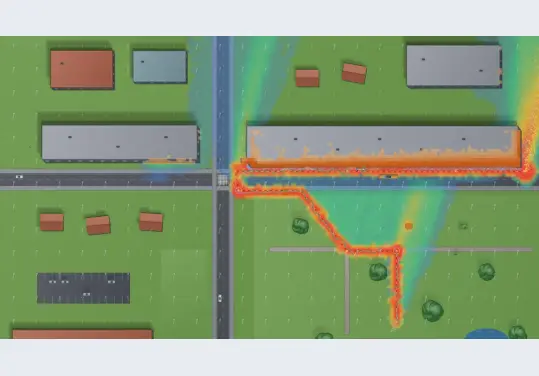
There is a moment every handler knows. The dog stops, lifts its nose, turns a full circle, then pulls sideways, several metres off the line you watched the person wa...
Events


