
The bringsel
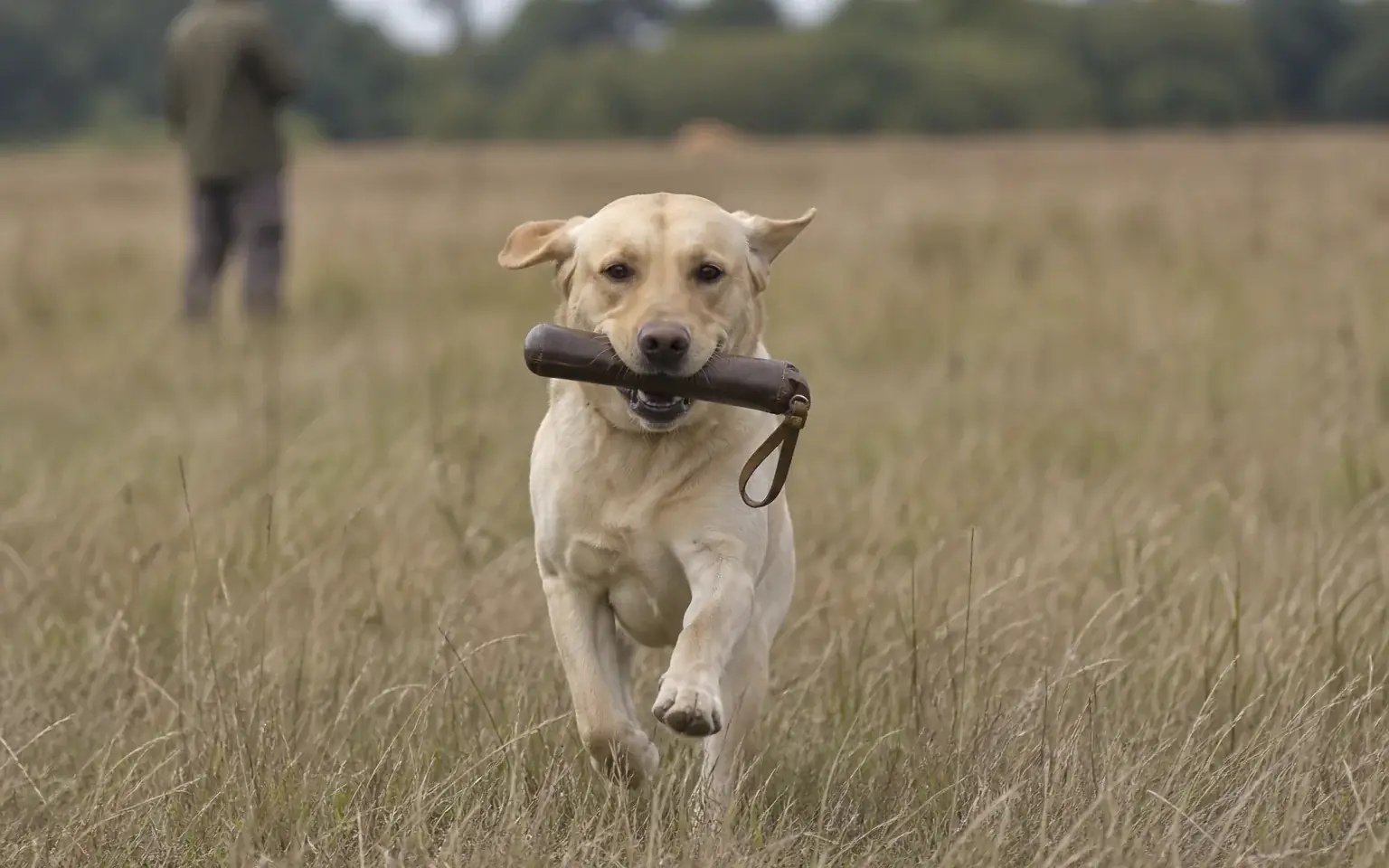
The dog finds, takes hold of an object hanging from its collar, comes back to you and leads you in. Four links instead of one - in exchange for a signal you never have to interpret.
The object
What the bringsel is
A short object - usually a piece of leather or webbing, around fifteen centimetres long - attached by a strap to the dog's collar or harness. It hangs free while the dog searches. On finding someone, the dog takes it in its mouth.
The detail that decides whether the method works is how it hangs: free enough to be picked up on the move, but not so long that it snags in vegetation, in debris, or between the dog's legs. A bringsel caught in a thorn bush becomes a false signal at best and a hazard to the dog at worst.
The material matters less than people think, as long as it survives saliva, rain and chewing. What matters is that the object is for this and nothing else: not a toy, never used in play, not worn outside work.
Why the method exists
It came from the need for a signal the handler can read at distance without relying on hearing. A bark is lost in noise, in wind, in snow. An object in the dog's mouth can be seen - and, more importantly, cannot be mistaken for anything else.
Structure
The full behaviour chain
The bringsel is not one behaviour but four, linked in order. Each is trained separately before they are joined.
| # | Link | What most often breaks |
|---|---|---|
| 1 | Finding the person | Nothing - this part is already built |
| 2 | Taking the object | Grabbing it out of excitement, with no find |
| 3 | Returning to the handler | Dropping the object on the way |
| 4 | Leading back | The most fragile link in the method |
The difference between holding and presenting
A dog that comes back with the object in its mouth has done three quarters of the job. But the handler has to see the object clearly, not guess at it. That is why many teams require an explicit presentation - the dog stops in front of the handler and lifts its head - rather than accepting any return with the object somewhere in its jaws.
The criterion is practical, not cosmetic: in the field, in poor light, with a dog coming through scrub, the difference between holding and presenting is the difference between seeing the signal and missing it.
Methodology
Training, stage by stage
Stage 1 - Interest in the object
The dog learns to take and hold the object entirely outside any search. No hidden person, no terrain, no context. Just the object and holding it, until that feels ordinary.
Stage 2 - Taking it on the find
The subject waits close by, in view. The dog arrives, takes the object, is rewarded. This is where the link that matters is formed: person found → take the object. If that link stays weak, the rest of the chain is built on nothing.
Stage 3 - The return
Short distances at first, with the handler a few metres away. The object must still be in the mouth on arrival, not somewhere along the route. A dog that drops it halfway learns that it did not matter, and dropping becomes part of the behaviour.
Stage 4 - Leading back
The hardest link, and the reason some teams give up on the method. The dog has to set off again, in the right direction, with the handler following. For a dog that has just been rewarded at the handler, going back out is counterintuitive.
Build it with very short distances and reward at the person rather than at the handler, so that returning to the field gains value.
Grabbing it accidentally
The most common fault specific to this method: the dog takes the object out of excitement, out of boredom, or because it has learned that the object in its mouth produces attention. The result is a perfectly executed false signal.
Prevention starts at stage 1: the object is never used in play and is not worn outside work. If the fault has set in, the repair means going back to stage 2, with reward strictly conditional on a person being present.
Why it is used
Advantages and limits
The bringsel has one quality no other method matches: the signal is binary. The dog either has the object in its mouth or it does not. There is no "maybe it found something", no interpretation, no degrees.
Compare that with a refind, where the handler has to judge whether the dog jumping up was a signal or enthusiasm. Or with a position, which can be mistaken for a pause. The bringsel leaves no room for doubt, and under stress that is worth more than it looks on paper.
The remaining advantages follow from it: it works in noise, where barking is lost; it works with naturally quiet dogs; and it is visible at distance, including through vegetation.
The limits
- The longest chain. Four links means four places it can break, and under fatigue they break from the tail end backwards.
- The object can snag. Dense vegetation and rubble are precisely the terrain where the method is otherwise useful.
- Longer time to the location. A dog that stays and barks tells you where the person is immediately. A bringsel comes to you, then takes you - two journeys instead of one.
- More equipment to maintain. See the equipment of a canine search team.
Operational context
Where it is used
The bringsel is an area search method, for terrain where barking does not carry: high background noise, machinery running, sectors where sound gets lost.
It is also used in large teams, where several dogs work at once and a visual signal is easier to attribute correctly than a bark coming from somewhere in the woods.
Why it is not used in mantrailing
On a trail the handler is attached to the dog by the line and reaches the person at the same moment. There is nobody to notify and nowhere to be led. The bringsel solves a problem that does not exist there.
That distinction matters more than it appears: it is why a reader arriving from the mantrailing pages does not need to learn this method. On a trail the relevant question is the final indication at the person, not a signal at distance.
Frequently asked questions
Frequently asked questions
01
Can the bringsel be combined with barking?
Yes, and some teams do it deliberately: the dog takes the object and barks at the same time, so the signal is both visible and audible. The cost is two simultaneous behaviours required on the find, so training takes longer. If you work terrain where sound sometimes carries and sometimes does not, the combination is worth the effort.
02
What if the dog loses the object in the field?
Operationally, losing the object means the signal has gone: the dog comes back without it and you have no way of knowing whether it found anything. That is why many teams carry a spare bringsel and check the attachment before every sector. In training, a dog that drops the object often has a problem at the third link, not with the equipment.
03
What do certifications require?
It depends on the organisation. Some assessments accept any reliable signal, others explicitly require an audible one, which would rule out the bringsel as the only method. Check the requirements on the certifications page before investing months of training in a method that will not be accepted.
04
How long until the chain is reliable?
Longer than for a bark alert, because there are four links instead of one. The first three come together over a few months. Leading back - the fourth link - is what takes time, because it asks the dog to return to the field exactly when it has just been rewarded at the handler. The test of reliability is the whole chain, run after an hour of work, in unfamiliar terrain.
Method follows discipline
Four links is a real cost. It is only worth paying if your terrain demands a signal you cannot hear.