IRO Mantrailing
IRO Mantrailing - Execution and evaluation MANTRAILING
General regulations
Execution and evaluation MANTRAILING
General:
Before the beginning of the work the sequence of teams is drawn for all test levels.
Any area may be used as testing site. The selection of the area is determined by the TC. The trail is to be sketched entirely by means of a GPS or map.
For each tested D, a distinct trail is to be laid in a separate area.
The trail pattern should be as natural as possible and adapted to the terrain and should include change of terrain. The area can be in a country setting such as forest, lawns and fields, or in quiet, less travelled urban areas. It may also contain path or street crossings.
Within the time frame until the search, the age of the trail should ensure that the trail has been crossed by outsiders. This should apply at least in the inner-city area. Should this not be the case, the TJ may request it to be crossed. At the destination a vehicle picks up the TL and, prior to the test, brings him back. The vehicle with the TL may not cross the laid scent trail again.
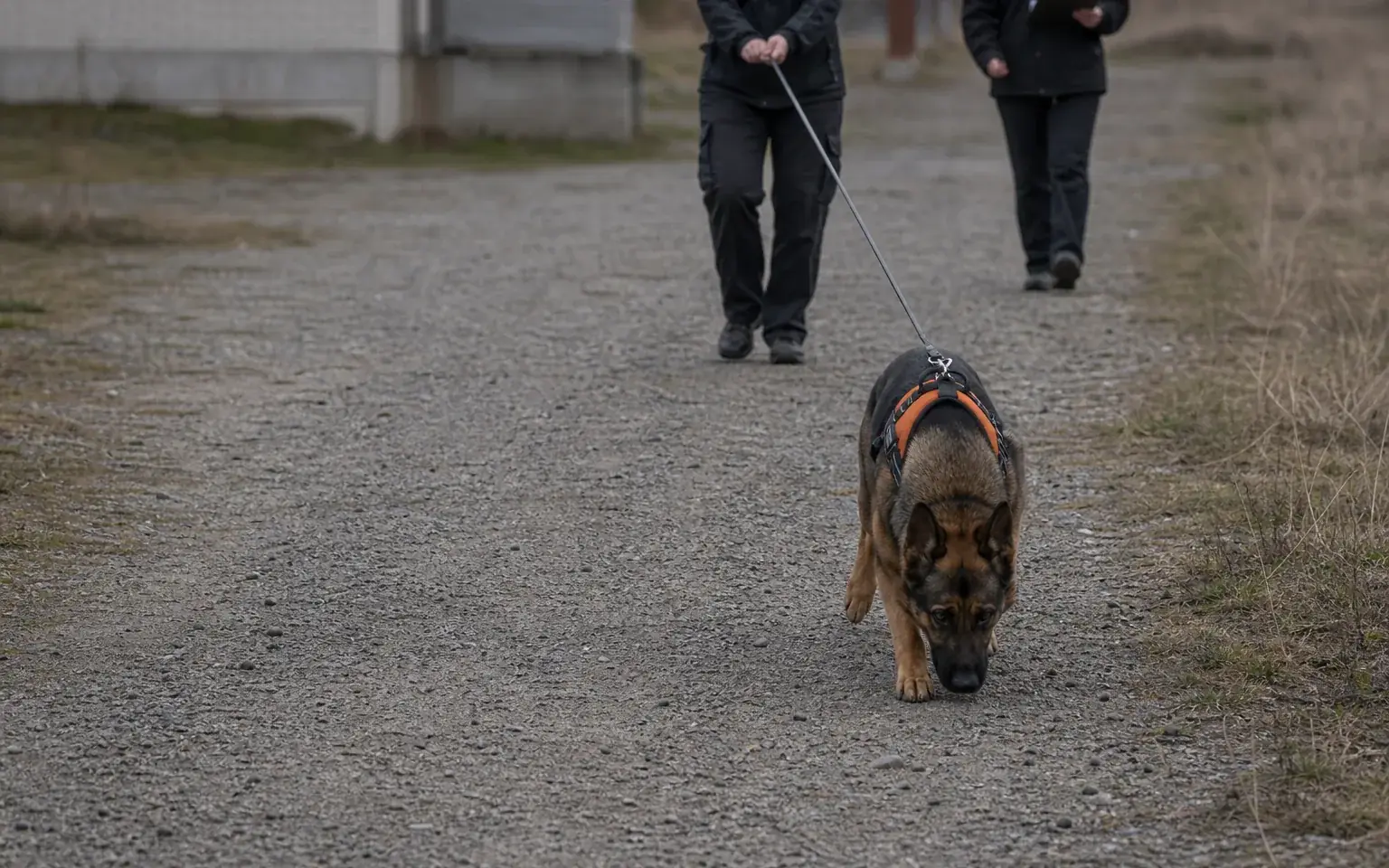
The TL may not have entered the testing area within the last 14 days. The TL has to follow the prescribed route by foot as per instructions at a normal pace and speed from a predetermined starting point. The TL starts at a distinctive spot (vehicle, bus stop, bench, in front of a building, crossing or similar). After a short pause at the starting point, the TL walks at a normal pace in the indicated direction.
The TL has to give the TJ/TC an exact plan with all of the necessary information such as distinctive spots for the trail layout. If necessary, the route has to be recognizable on a GPS device. The TL may be a known person but not be a family member of the DH.
After the trail has been laid, the TL may not approach the trail within 2.5 km. The TL has neither food nor a toy with him.
At least 15 minutes before the test starts, the TL is taken to the destination in a closed vehicle (windows closed, air conditioning off) via detours and without crossing the trail.
The person to be found (TL) remains passive and is at the end of the trail. Additionally, persons close to the destination have to be at a distance of at least 5 m to the HP.
Read more details by accessing the PDF with regulations, point 8 with a click here
International Rescue Dog Organisation
Execution and evaluation MANTRAILING
At the beginning of each odour differentiation exercise the HPs hand-over their scent article to the TJ who then selects the respective scent article after the departure of the HPs. The scent articles must be labelled in a neutral manner (for example with figures or letters) and the DH should not be able to allocate them to the HP.
Number of assistants:
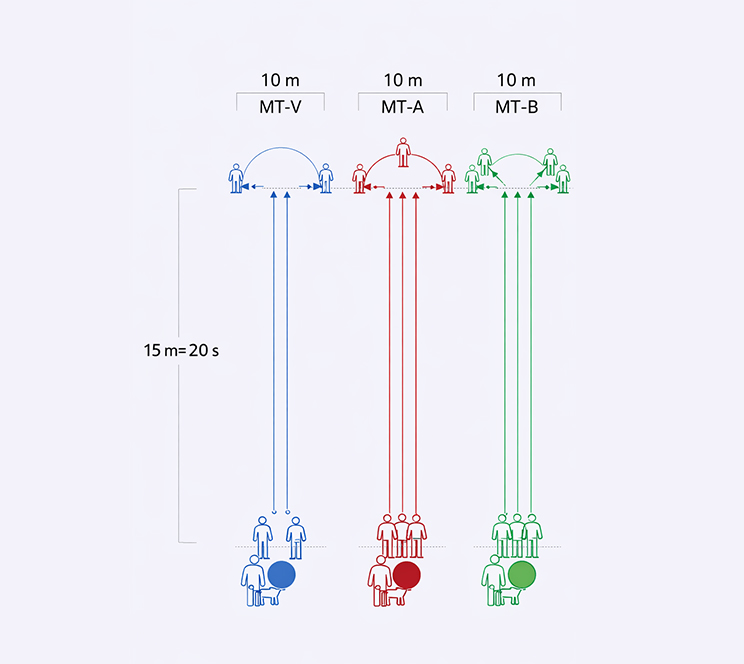
- MT-V: 2 CP
- MT-A: 3 CP
- MT-B: 4 CP
Starting from a line marked, the HPs walk 15 m (20 steps) parallel to each other at the same speed to a marked baseline. From there, they walk to the respective marked position on a semicircle with a radius of 5 m, according to the test level. They remain there standing calmly with their back turned to the starting point.
At the instruction of the TJ the DH readies his D for search. The TJ gives the DH a scent article belonging to one of the persons. The DH off leashes his D and sends him with 1 AC and/or VC to the line of people visibly standing 20 steps away. These people are turned with their back to the DH. The D has to take the most direct route to the persons and alert the right one. The alert must be executed according to the reported type of alert. The DH reports the alert, walks up to his D at the instruction of the TJ and ends the alert. The ending of the alert (picking up/recall) is basically at the discretion of the DH.
The location for the odour differentiation exercise can be the training place, a meadow, a parking lot or the like.
Source: International Examination Regulations for Search and Rescue Dogs of the International Rescue Dog Organisation (IRO)