Mantrailing is often seen as a spectacular activity: the dog starts from a personal item, lowers its nose and follows a trail invisible to humans, through cities, forests or crowded places. To those watching from the outside it looks almost like magic. In reality, mantrailing rests on biology and on one of the most complex sensory abilities in the animal kingdom: the dog's sense of smell.
To understand why your dog does what it does on a trail, why it stops at a junction, why it suddenly lifts its head, why after 20 minutes it wants to sleep, you need to understand how it "sees" the world through scent.
The dog's nose, in numbers
Humans have about 5 million olfactory receptors. Dogs have between 200 and 300 million, depending on the breed. The part of the brain that deals with smell is, proportionally, tens of times larger in a dog than in a human.
Those figures get quoted everywhere. The one that really matters for mantrailing is a different one: how the air reaches the receptors.
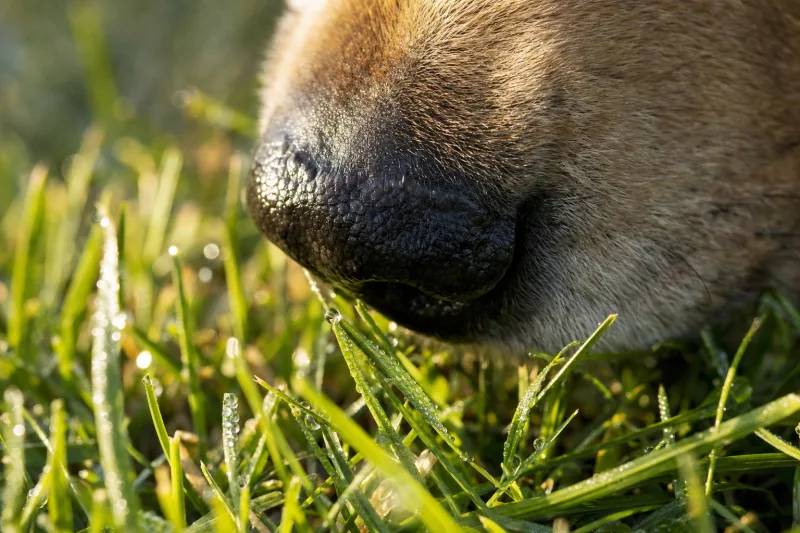
When a dog sniffs, part of the inhaled air is diverted into a separate chamber at the back of the nose, where the receptors sit. The rest goes to the lungs. The air in the olfactory chamber is not expelled straight away; it stays there as long as the dog keeps sniffing, and the molecules have time to settle on the receptors. Exhalation leaves through the side slits of the nostrils, not through the front, so as not to scatter the scent on the ground the dog is examining. The result is a system that can hold a faint scent and compare it with what arrives the next second.
The dog sniffs in short bursts, several times a second, and the two nostrils work partly independently. That is how it knows both what it smells and from which side the scent is stronger. For a mantrailing dog, that means direction.
What a trail really is
A person's scent is not their perfume or deodorant. It is a unique combination of dead skin cells, sweat-gland secretions and the bacteria that live on each person's skin. We shed tens of thousands of those cells every minute without feeling it. They fall, float, cling to grass, to fences, to the trousers of passers-by.
Add to them the mechanical traces of passing: crushed vegetation, disturbed soil. All of it together is what we call the trail.
The dog does not follow footsteps. It follows a complex of information: ground scent, left where the person stepped; airborne scent, settled metres away in the direction of the wind; and the pools in places where the person stopped, waited, leaned on something. Each says something different. To the dog, the corner of a building where the person stood for 30 seconds is a beacon. A footstep on hot asphalt is a whisper.
How the dog reads the trail on the ground
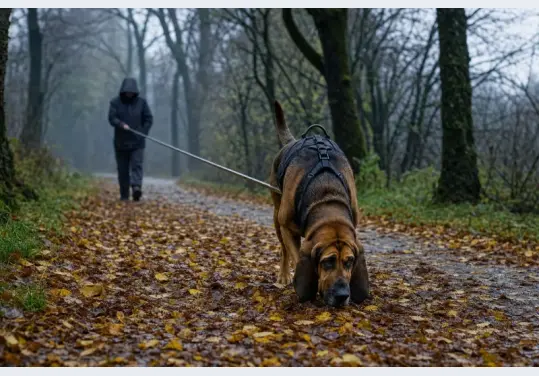
Watch an experienced dog on a trail. Its nose is not glued to the ground the whole time. It alternates: low on surfaces that hold scent (grass, leaves, soil), mid-height or high where the scent has risen or been moved by the wind (asphalt, open junctions, fields). When it changes head height, it has not been distracted. It has changed strategy.
At a junction the dog often loses the trail for a moment. What it does in the next second is the most important thing to watch for as a handler. It goes back to the last point where the scent was certain and starts searching in ever-wider circles until it finds it again. The direction it picks is not random: it compares the freshness of the scent on each branch and takes the "warmest" one. Handlers call this casting. It is the sign of a dog that is working, not one that is lost, and your job at that moment is to stand still and keep quiet.
The dog also uses the absence of scent. When it enters an area where the trail does not exist at all, it turns back quickly. "Not this way" is as useful as "this way", and a good dog exploits it without being asked.
And, the hardest thing for a beginner to believe: the dog tells the person it is looking for apart from everyone else who has walked there. At the start, from the scent article, it builds an olfactory "portrait" of the person. Then it compares it with everything it meets. In a park where hundreds of people have passed in the last hour, the dog follows one.
Why wind and time change everything
Scent does not stay put. Wind moves it sideways, sun lifts it, cold keeps it low, rain washes it away or concentrates it. A one-hour trail across a windy field looks, to the dog, completely different from the same trail in a windless forest.
We have written separately about the effect of weather, about how long a trail lasts and about the scent cloud that forms around a trail. If you want to see all of it at once, the simulator puts it on a map.
Why the dog tires so quickly
Nose work is not passive. At every step the dog analyses and decides: is this my person or someone else? is the scent fresher to the left or the right? did they stop here or just pass? Sniffing in bursts and deciding continuously burn mental energy at a rate an ordinary walk never reaches.
That is why 20 minutes of mantrailing leaves a dog calmer than an hour of running.
It is also why anxious or reactive dogs, which need an occupation that absorbs their attention, respond so well to mantrailing. On daily walks, sniffing is fragmented: a post, a fence, another dog. In mantrailing it is structured, it has a single goal, and at the end there is a person and a reward. The difference shows in the dog within a few weeks.
What all this means for the handler
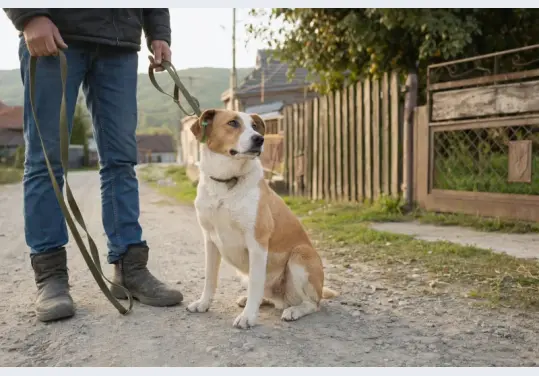
The first practical thing: in mantrailing the dog leads and the human follows. Its nose has information you will never have, and the long line exists so you can let it use it. The track may include changes of environment, controlled pauses, or even a stop at a portable pavilion, depending on the context of the training.
The second: learn to read its signals: head height, breathing rhythm, tension in the body, the return to the last certain point. They tell you what the dog is doing long before you reach the person.
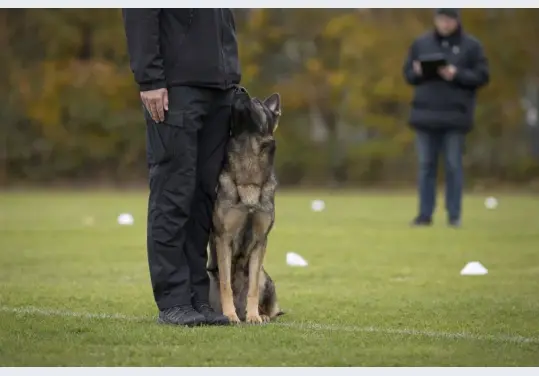
The third: respect fatigue. A dog that stops working after 25 minutes is not being stubborn, it is mentally exhausted. Tomorrow it starts again.
Mantrailing is not magic. It is biology, neurology and respect for the dog's nature.