Pet hotel or boarding kennel
Temporary accommodation for when your dog cannot come with you. For some dogs it is an interesting experience; for other...

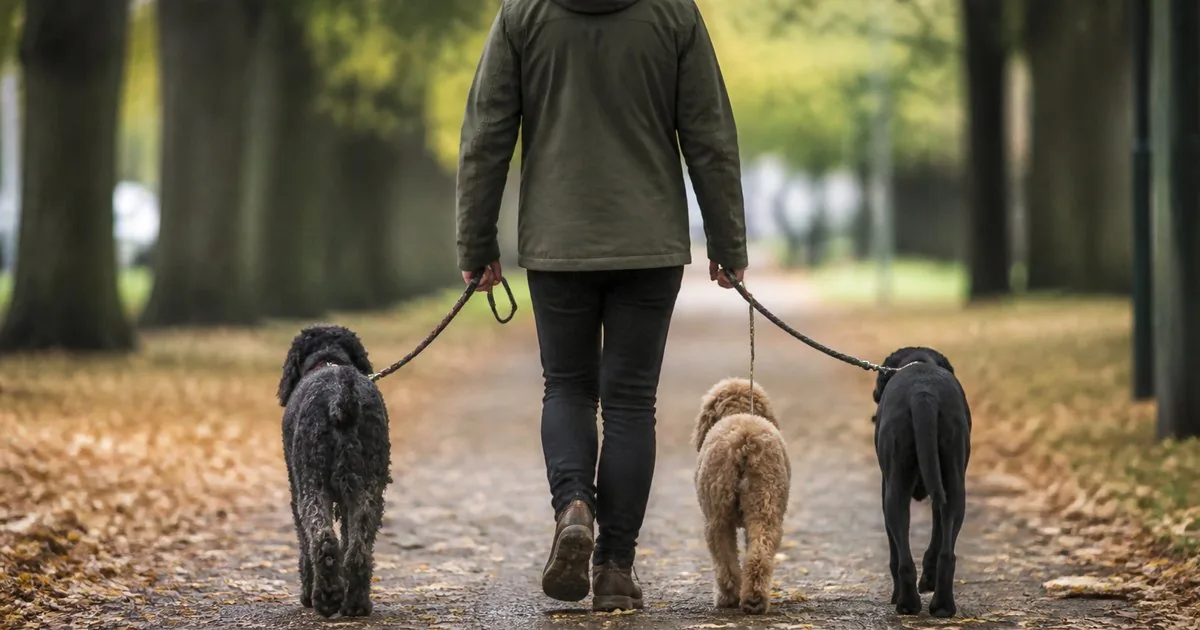
The service involves collecting the dog for a walk tailored to it, alone or alongside a carefully selected group.
A dog walking service can look simple, but the walk is one of the moments with the most variables: traffic, bicycles, children, unknown dogs, noises, temperature, surfaces, discarded objects and situations that change fast. The person walking the dog has to be able to handle the equipment, read body language, keep distance from triggers and make decisions before a situation becomes difficult. An individual walk suits a dog that needs exclusive attention, or that is reactive, fearful, recovering, senior, very young, or simply not comfortable in a group. The pace can be adapted: more time for sniffing, quieter routes, frequent breaks, short attention exercises, or an outing aimed mainly at toileting and relaxing. For a sensitive dog, a good walk is not the one that covered the most ground, but the one it comes back from without having been pushed past its limit of tolerance. Group walks can be enjoyable for dogs that are compatible, used to going out together and able to move along without constant tension. A group should not be put together on size or age alone. What matters is the communication style, the energy level, tolerance of closeness, the social history and each dog's ability to settle. A dog that plays intensely is not necessarily right for every group, and a dog that avoids conflict can be overwhelmed by insistent companions. The number of dogs has to allow real control, not just moving them from one place to another. Each animal's equipment has to be checked, and the leash and attachment system chosen to suit the dog.
Among the situations where it can make sense are owners with a busy schedule, dogs that need an extra outing and animals that can benefit from controlled exploration.
A good walk is not a race to pile up kilometres, nor a guarantee that the animal will sleep all day after the effort.
assessing leash walking and reactions to the environment; choosing the individual or the group format.
collection with an equipment check; route, breaks and handover with observations.
Signs such as constant tension on the leash, intense scanning of the environment, refusing to move forward and difficulty settling after encounters can show how the animal is experiencing the situation.
To reduce improvisation, a suitable harness or collar, a secure leash and identification details, information about triggers and rules about scavenged food and contact with other dogs all have to be prepared.
More useful criteria are the number of dogs the person can actually control, selecting for compatibility within the group, routes and temperatures adapted to the dogs, a detailed initial conversation, and a protocol for keys, access, the leash and emergencies.
The walk can reinforce leash walking, orientation towards the human and calmness, but only if the person uses rules compatible with the family's training plan.
a group walk is not suitable for every dog; forced encounters are not used as socialisation. Among the risks to be discussed are slipping out of the equipment, conflicts within the group, overheating or overexertion and tangled leashes.
A good decision about dog walking: whether individual or in a group, it does not start from the idea that the same format has to work for everyone.
How a service is organised responsibly, how to recognise quality, where the limits are and what to ask before you pay - explained once, for all services.
This page explains the service, it does not sell it. Some of these we run ourselves, others happen at a veterinary practice, a grooming salon, or with people we work alongside.
Frequently asked questions
It can make sense above all for owners with a busy schedule, dogs that need an extra outing and animals that can benefit from controlled exploration.
Useful information includes a suitable harness or collar, a secure leash and identification details, information about triggers and rules about scavenged food and contact with other dogs.
You watch for constant tension on the leash, intense scanning of the environment, refusing to move forward, difficulty settling after encounters, the appetite and water intake, and the quality of the rest.
a group walk is not suitable for every dog; forced encounters are not used as socialisation.
The walk can reinforce leash walking, orientation towards the human and calmness, but only if the person uses rules compatible with the family's training plan.
Care and supervision
Temporary accommodation for when your dog cannot come with you. For some dogs it is an interesting experience; for other...
Boarding plus training sessions. It sounds good, but it only means something once it can be put into numbers: how many s...
Supervision during the day, without staying overnight. Good daycare is not eight hours of uninterrupted play: there is a...
Someone stays with your dog overnight, either at its home or in boarding. It is not simply a person sleeping in the same...
Short visits for a dog that can be alone in between, but needs food, fresh water, a toilet break and possibly medication...
More than a car journey: the dog has to be loaded and unloaded safely, secured inside the car and protected from heat. L...
Write to us about what is actually happening with your dog. We will tell you which kind of service would help - and, if that is the case, that you need none of them.