
Related services
How to choose a service for your dog
Whether it is a pet sitter, a boarding kennel, grooming or physiotherapy, a few things keep coming back: how a service is prepared, how you can tell it is done well, where competence ends and what is worth asking before you pay. They are gathered here, once.
Why a separate page
These principles are the same for every service. Repeated on each page, they would have made all 69 pages look alike - and nobody benefits from reading the tenth version of the same idea. Here they are said once, so that each service page can talk only about what is specific to it.
When a service is actually useful
Whether it fits depends on the real need, on the competence of the person or the organiser and on the dog's own profile, not on a universal promise. Two families can be given the same information and still apply it differently, depending on their schedule, their experience, their home and what their dog needs. An attractive description is not enough; what matters is what can realistically be achieved.
Good education can turn information into more coherent decisions, but it does not remove the need for an individual assessment when the situation is complex. The dog's response is observed and used to adjust the plan; it is not assumed in advance. Two dogs that look equally energetic can have very different stamina, coordination and recovery, and the programme has to be built for the individual. The right activity can bring exploration and conditioning, but the intensity has to be adapted at every stage.
There is no standard form that works identically for every family and every dog. Two animals with similar symptoms or similar journeys can have different medical and logistical needs, which have to be established case by case. The benefits have to be weighed together with the limits and with the effort required from the family. Good organisation can make care easier to access and can reduce errors, but the logistics cannot guarantee the medical outcome.
Before choosing, it is important to separate real needs from unrealistic expectations. Two teams can start from the same difficulty and still need different paces, depending on health, experience, environment and the family's ability to follow the plan. A well-built process can offer clarity, management and new skills, without promising that every difficulty will disappear instantly. The practical value appears when the format answers a real need and can be adapted without compromising safety.
A good decision also starts from what this subcategory cannot do. Two dogs with the same coat type or the same age can differ in how they tolerate touch, positioning and the length of a procedure. Proper care can prevent discomfort and make changes easier to spot, without replacing a medical examination. The decision has to start from the context, the health and the behaviour of the dog, not only from availability or price.
Two dogs of similar age and size can respond differently to the same kind of supervision, because their routine, their history and their relationship with people are not the same. A well-chosen solution can preserve continuity and reduce unnecessary change, without pretending that the owner's absence will go unnoticed. Two teams can use the same product, or attend the same event, in very different ways, depending on size, behaviour and purpose. A well-organised product or event can be useful and enjoyable, but its value depends on fit, safety and transparency.
How it is done responsibly
A well-organised educational service starts before the course or the meeting, by defining what the participants need. Two initial elements matter most: Clarifying things at the start reduces improvisation and shows which information is missing before the work itself begins. After the initial stage, the plan continues with:
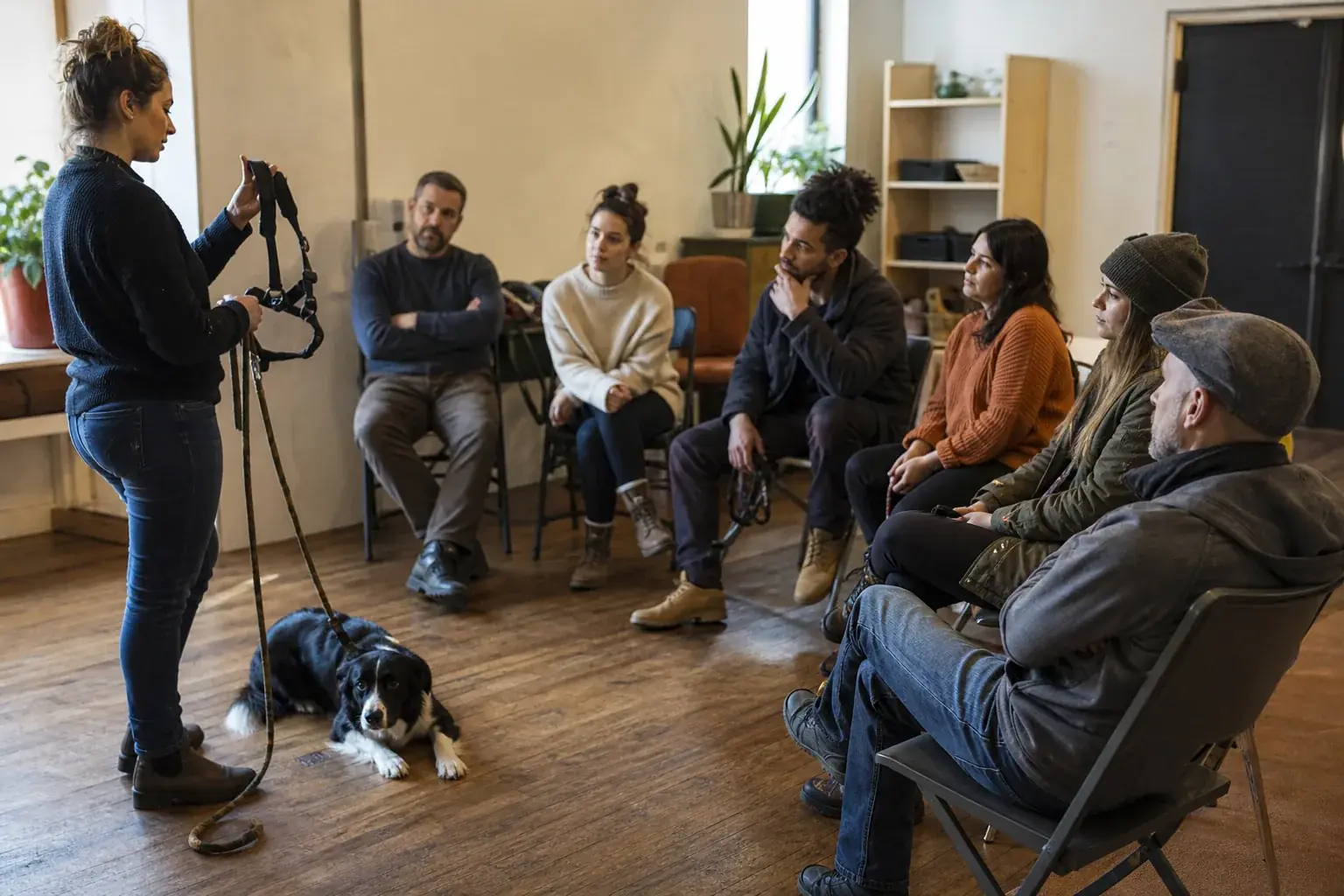
A good educational service does not blame the family and does not hand out rigid recipes. It explains, demonstrates, checks that things have been understood and turns recommendations into steps that fit a real schedule. The participant should leave with written priorities and should be able to note what they applied, what result they saw and which question is still unclear. Responsible preparation starts before the effort, by choosing the right level and the right conditions.
This is the stage where responsibilities, limits and the way of communicating are agreed for when the plan cannot be followed exactly. The practical part then includes: The programme is adapted to age, health, experience and individual preferences. A dog does not only need kilometres; it also needs the chance to process its environment and to recover after effort.
The duration, the surface, the weather, the intensity and the recovery over the following hours give a truer picture than the distance or the time achieved. Organisation starts before the procedure, the journey or the handover, by checking the details and the responsibilities. This is the moment to check whether the chosen format is suitable or has to be changed before the animal is involved. The next steps are:
Medical acts, diagnosis, prescription and treatment belong to the veterinarian. Related services can make access easier and reduce improvisation, but they must not cross that line. Times, products, document numbers, samples and any change in general condition have to be recorded exactly, not reconstructed later from memory. A responsible process begins before the first exercise, by clarifying the history and the goal.
Any serious intervention starts from the dog's history, health, environment and motivation, and from the family's ability to follow the plan. There is no universal technique and no identical results for every team. Noting the context, the distance, the response and the recovery time helps adjust the criteria and avoids conclusions drawn from a single repetition. A responsible procedure starts before any handling, by checking health, tolerance and purpose.
Procedures have to be adapted to what the animal tolerates and carried out within the limits of the person's competence. When there is pain, inflammation, discharge, injury or a sudden change, routine care does not replace a veterinary assessment. It is useful to note the sensitive areas, the products used, how long the procedure took and any reactions during or after handling. The work itself includes:
Responsible organisation starts before the person is left alone with the animal or takes it into their care. The quality of a supervision service shows above all in the details: the information asked for beforehand, how escape is prevented, how encounters with other dogs are handled and how you are told when something unusual happens. A short log about food, water, toileting, rest and changes in behaviour is far more useful than the blanket phrase “he was good”.
A responsible experience starts before the purchase, the booking or the sign-up, with clear information and known conditions. A responsible experience gives clear information, the option to say no, rules that are easy to follow and alternatives for dogs that need distance, breaks or a different pace. For products and events, it is worth noting how well things fit, the behaviour, any faults, any incidents and how the dog recovered afterwards.
The dog at the centre of the decision
The dog has to be seen as a participant in the experience, not as an object to be transported, maintained or made to perform. A single signal does not always establish an emotional state, but several changes appearing together call for slowing down, more distance, a break or a stop. A suitable experience leaves room for breaks and recovery. The dog should never reach the point where it can no longer take food, can no longer orient itself or is only trying to escape the situation.
The dog's perspective can completely change how an apparently successful experience is judged. The signs of recovery matter as well: the breathing settles, the body becomes less rigid, the dog can explore, can turn towards its person and can rest. The aim is not for the dog to put up with anything, but for it to stay in a range where it can adapt.
The absence of an incident does not on its own prove that the animal felt well or that the format suits it. After the activity, you watch whether the animal goes back to its usual behaviour, eats, drinks, sleeps and moves normally. Extreme tiredness, avoidance or lasting restlessness should not be presented as proof of an excellent experience. The behaviour observed before, during and after the experience gives better information than the label “he was good”.
Preparation, whatever the service
Important details have to be up to date and, when they could be forgotten, passed on in writing. If several people are involved, the responsibilities and the limits have to be understood the same way by all of them. Where possible, the dog is prepared gradually: a short meeting, exploring the space, pairing the equipment with rewards, a simple trial run or a shorter session before a long one.
Full exposure on the first day can mask signals and can make repeating the experience harder. The preparation is not there to test how much the dog can tolerate. It creates predictable reference points and makes it possible to stop before fear, frustration or tiredness become hard to manage. Habituation can be broken into small steps, so that the animal gets to know the person, the space, the equipment or the procedure before the demanding moment arrives.
The pace is increased according to the response observed, not simply according to the people's calendar.
How to judge the quality
Quality is not measured only by photographs, by duration, by the number of activities or by an impressive description. The person in charge should be able to explain both the usual procedure and the changes made for a dog that needs a different pace. It is worth asking what the participant will learn, what materials they receive, how they can apply the information and which situations go beyond what the course or the consultation can cover. Transparency is worth more than an absolute promise, because it lets the owner make an informed decision.
Professional work shows above all in prevention and in how things are adapted when the original plan does not work. It is worth discussing the level of effort, the surface, the weather, the breaks, the equipment, the criteria for stopping and how things are adapted for a dog that tires. It is worth clarifying the competence, the paperwork, the consent, how products or samples are kept, the contact with the vet and the procedure if the animal's condition worsens. Serious answers explain what can be controlled, what remains unpredictable and when an alternative is the better choice.
A professional answer does not play the risk down and does not promise that nothing unexpected can happen; it describes the prevention, the limits and the way things are reported. It is worth asking about the methods, how progress is measured, the owner's role, how risk is handled and the situations in which a veterinary consultation is recommended. Marketing claims or a good first impression are not enough to judge quality.
It is worth clarifying hygiene, the products, the duration, the handling, the breaks, the contraindications and the point at which the procedure is stopped and a medical assessment is recommended. It is worth clarifying the experience with this type of dog, access to the home, how escape is prevented, the walks, how instructions are followed and the emergency procedure. It is worth checking exactly what is included, the conditions, the size or capacity, the safety rules, the cancellation or return policy and how an incident is reported.
How it relates to training and behaviour
The link with training is most useful when concrete behaviours are prepared, such as setting up the environment, using signals consistently, reading body language and repeating exercises correctly between meetings. These skills are built in small steps and then generalised; they are not tested straight away in the hardest situation. The information should be used to reduce the need for force. Growling, avoidance or refusal do not automatically become “disobedience”; they are read in context.
The relevant signals should be used to change the environment, the distance, the pace or the plan and, where appropriate, to ask a competent professional for help. The link with training is most useful when concrete behaviours are prepared, such as starting and stopping, changing pace, the recall, waiting, working on a long line and using the equipment safely. Being able to control the dog with signals does not justify keeping the effort going when tiredness, pain or fear appear. Stopping in time is part of the training.
The link with training is most useful when concrete behaviours are prepared, such as going into a crate, wearing a muzzle, taking up a position voluntarily, accepting touch and walking calmly to the vehicle or the practice. Exercises can reduce stress, but they must not be used to mask pain or to put off a necessary medical procedure. The clinical decision stays with the vet. The link with training is most useful when concrete behaviours are prepared, such as orienting towards the handler, responding to signals, waiting, the recall, being handled and relaxing in progressively harder contexts.
A signal performed under pressure does not prove that the emotional state has changed. Avoidance, freezing and growling have to be understood, not suppressed without knowing the cause. The link with training is most useful when concrete behaviours are prepared, such as giving a paw, resting the chin on a support, getting onto a surface voluntarily and accepting touch for short intervals. Cooperation does not mean being held still without limit.
Pulling away, sensitivity and a sudden drop in tolerance can indicate pain and have to be taken seriously. The link with training is most useful when concrete behaviours are prepared, such as wearing the equipment, going in and out under control, waiting, being handled, walking on the leash or settling in a set place. Training should not be confused with forcing the dog not to communicate. Avoidance, freezing or growling can signal fear, pain or conflict and call for a change in how things are managed.
The link with training is most useful when concrete behaviours are prepared, such as calmly trying on equipment, orienting towards the handler, waiting, moving away on cue and taking part in an activity voluntarily. A dog should not be made to wear something, to pose or to take part simply because the product or the event has been paid for. Refusal and the need for a break have to be respected.
Limits, risks and responsibilities
There are a few important limits: Sometimes the most responsible decision is to postpone, to change the format or to choose an alternative, rather than pressing on at any cost. General information has to lead to individual help when there are emergencies, aggression, panic, pain or specific legal and medical requirements. In medical situations, diagnosis, prescription and treatment belong to the veterinarian.
Limits explained honestly protect the dog and help people work together without making dangerous assumptions. The following limits should be considered before choosing: Pain, limping, difficulty breathing or unusually slow recovery are reasons to stop and seek medical assessment, not to raise the motivation. The limits of this format can be summed up as follows:
Being transparent about competence, consent and limits protects the animal, the owner and the professionals involved. High-risk cases, sudden changes or any suspicion of pain need a competent assessment and, sometimes, cooperation between the instructor and the vet. Pain, inflammation, discharge and a sudden drop in tolerance are not solved by more restraint; they call for stopping and for the right assessment.
Where there is a risk of biting, escape or a medical deterioration, the plan needs extra measures and people with the right training. A product or an event can be refused or changed when safety and welfare cannot be maintained in the form advertised.
Putting it into practice
Information becomes useful when it can be turned into small actions: moving a dangerous object, changing the route, getting the rewards ready, separating the dogs at mealtimes or booking a consultation. A good course does not leave the participant with terminology alone, but with priorities and with a way of checking whether the decision they took is helping.
Sources and keeping up to date
Recommendations about health, travel, nutrition and safety can change. It matters that the materials distinguish between general principles and requirements that have to be checked against current official sources. When the person teaching does not know an answer, the right response is to point to where it can be checked, not to fill the gap with assumptions.
A choice made in the dog’s interest
The value of this subcategory lies not in its name, but in the way it is applied. When safety, health, communication and limits are taken seriously, the owner can make a realistic decision and the dog is not forced to put up with an unsuitable situation simply because it was booked and paid for. This subcategory can be genuinely useful when it answers a real need and is organised around the actual dog rather than around an ideal image. An honest presentation covers the benefits, the preparation, the limits and the criteria for stopping.
Quality shows in prevention, in respecting the animal's pace and in working together without impossible promises. It starts from the needs of the individual, from complete information and from the possibility of changing the plan. Respect for the dog matters more than ticking off an activity or a result.
Questions worth asking about any service
Not in the same form. Age, health, previous experiences, the environment and the specific purpose all change how things are organised. Before deciding, an honest assessment is more useful than assuming that the same option will work for every family and every dog. Episodes of fear, escape, biting, travel sickness, pain or treatment should also be mentioned when they are relevant.
These details are nothing to be embarrassed about; they make it possible to prevent situations in which the dog or the people could be put at risk. The participant gets clear priorities, understands what they can apply on their own and knows when an individual assessment is needed. Quality is not measured by the amount of information, but by decisions that are safer and more consistent.
Important limits: General information also does not replace an individual assessment. Whenever there are medical signs, a risk of aggression, panic or special legal requirements, a competent professional has to be involved and current information has to be checked. Training can prepare useful behaviours, can reduce stress through gradual habituation and can help the owner communicate more clearly.
Exercises should not, however, be used to hide pain, tiredness or a mismatch between the format and the dog. It is not enough that the experience ended without an incident. A suitable experience lets the dog recover, eat, rest and move as it normally does, without fear or lasting discomfort. Nor does it replace rest or exploration walks.
The procedure or the logistical part is clearly documented, and the animal's condition is monitored before and after. Any deterioration, unexpected reaction or mismatch in the paperwork is reported quickly to a competent person, without improvising a diagnosis or a treatment. Diagnosis and prescription also belong to the veterinarian. Nor does it promise guaranteed results within a fixed number of sessions.
Nor does it replace a veterinary diagnosis. Nor does it replace a veterinary consultation. The product, the journey or the event keeps to the conditions advertised, and the dog has the option of a break or of moving away. The fact that no incident occurred is not the only criterion;
comfort, fit and the return to normal behaviour count as well. A product on its own also does not solve a behaviour problem.
Recovery is part of the programme
After effort, a dog needs water, quiet and a comfortable surface. Being able to sleep and to go back to walking normally matters just as much as the performance during the activity. If stiffness, limping, refusing stairs or irritability when touched appear the next day, the intensity has to come down and a veterinary assessment may be needed.
Variety without over-stimulation
Variety keeps interest up, but a programme packed with new activities can become tiring. Alternating more demanding days with exploration walks, easy exercises and rest gives the body and the emotions time to adapt. The aim is not to fill every minute, but to build a life in which the dog can be active and can also stop.
Consent and communication
The owner has to know who may receive information, who may approve procedures and what happens if they cannot be reached. Written instructions reduce confusion, especially when someone else is transporting the dog. Recording medication, allergies and previous reactions correctly can affect how safe the care is.
Emergency or routine appointment
Logistical services have to be able to tell a scheduled need from an emergency. Difficulty breathing, loss of consciousness, significant bleeding, major trauma or rapid deterioration require immediate medical contact. In situations like that, the priority is not filling in a form perfectly, but the clinic's instructions and safe transport.
Progress is not linear
A behaviour can come easily in a familiar place and become difficult around other dogs, traffic or interesting smells. That does not mean the animal “knows it and will not do it”; it means the task has changed. Progress is built through generalisation, suitable distances and a temporary return to an easier criterion whenever the context calls for it.
Cooperative handling
A dog can learn to take part in procedures through simple behaviours: giving a paw, standing on a mat, resting its chin on a support or accepting touch for a few seconds. A controlled retreat can work as a break. These exercises do not remove every difficulty, but they reduce the surprise and give the person information about what the animal tolerates.
What to watch between sessions
The owner can regularly check the skin, the paws, the smell of the ears, the breathing, how the dog chews and how it moves. The aim is not self-diagnosis, but noticing changes early. A photograph, a note about when something started and the details of the products used can help the vet or the specialist understand how things developed.
Transparency before you pay
The client has to be able to find out what is included, what is not, how long it lasts, the cancellation terms and their own responsibilities. An attractive photograph cannot replace a description of the limits. For activities with dogs, the rules about health, equipment, access, photography and conflict situations have to be communicated beforehand, not after a problem appears.
Not sure which service you need?
Tell us what is actually going on with your dog and we will tell you which kind of service would help - including when the answer is that you need none of them.