Pet sitter at the client’s home
Someone comes to your dog’s home and keeps its routine going while you are away. The big advantage: nothing around...

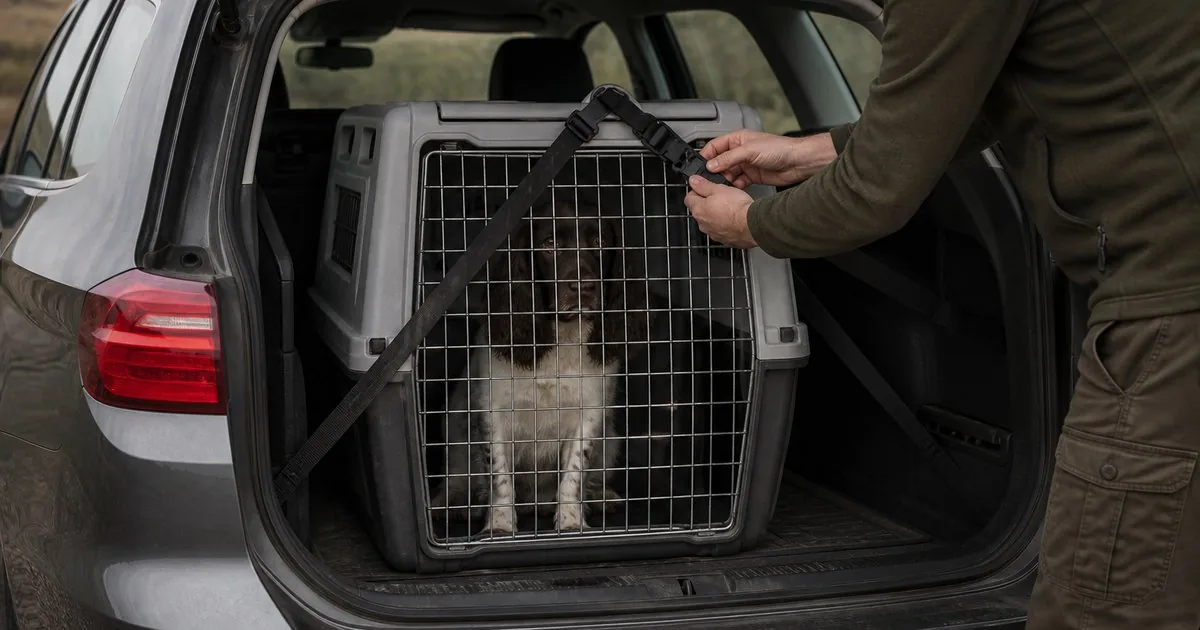
The service moves the dog to a care destination, sometimes without the owner travelling with it.
Transporting animals involves rather more than a car journey. The dog has to be loaded and unloaded safely, properly secured, protected from extreme temperatures and kept under observation. It is not safe for a dog to travel loose in the cabin, on the front seat, or in a way that lets it jump straight out when a door opens. The restraint system can be a suitable crate, a dog guard or a harness designed for securing in a vehicle, depending on size, behaviour, the car and the applicable recommendations.
Before collection, you discuss whether the animal gets travel sick, is fearful, reacts to strangers, struggles to get in, or has any medical restrictions. For a reactive dog, the route and the handover have to be planned so as to avoid needless proximity to other animals. For veterinary visits it matters that the driver receives the relevant information and can pass on the owner's documents or questions.
The driver does not decide on treatments and does not interpret medical results. Their role is to carry out the journey, observe the animal's condition and communicate. If there is difficulty breathing, loss of consciousness, seizures, significant bleeding or other signs of an emergency, the priority becomes contacting the appropriate veterinary service, not keeping to the original schedule.
This subcategory can be relevant in situations such as owners without a vehicle, animals with a booked appointment, and cases where handover and collection can be clearly organised.
Transport is not simply moving from one point to another; loading, securing, temperature, the handover and who has the authority to decide all have to be settled.
gathering information about size and behaviour; choosing the crate or the restraint system.
collecting the dog with no risk of escape; handing it over to the authorised person and confirming arrival.
Signs such as drooling and nausea, trembling or vocalising, trying to get out of the vehicle and difficulty breathing can show how the animal is experiencing the situation.
The owner's preparation includes the address and appointment window, the transport equipment, the documents and contact numbers, and authorisation for the situations in which the owner is not present.
More useful criteria are a clean, ventilated vehicle, animals secured and separated, stops and a route adapted to them, a handover procedure with no uncontrolled open doors, a detailed initial conversation, and a protocol for keys, access, the leash and emergencies.
Getting used to the car, the crate and being handled can make transport safer, but travel sickness or severe panic also needs a conversation with the vet.
it is not a veterinary ambulance unless it has that equipment and setup; no medical decisions are taken beyond the authorisation and competence available. Among the risks to be discussed are road accidents, overheating, escaping while loading or unloading, and conflict between animals.
How a service is organised responsibly, how to recognise quality, where the limits are and what to ask before you pay - explained once, for all services.
This page explains the service, it does not sell it. Some of these we run ourselves, others happen at a veterinary practice, a grooming salon, or with people we work alongside.
Frequently asked questions
It can make sense above all for owners without a vehicle, animals with a booked appointment, and cases where handover and collection can be clearly organised.
Useful information includes the address and appointment window, the transport equipment, the documents and contact numbers, and authorisation for the situations in which the owner is not present.
You watch for drooling and nausea, trembling or vocalising, trying to get out of the vehicle, difficulty breathing, the appetite and water intake, and the quality of the rest.
it is not a veterinary ambulance unless it has that equipment and setup; no medical decisions are taken beyond the authorisation and competence available.
Getting used to the car, the crate and being handled can make transport safer, but travel sickness or severe panic also needs a conversation with the vet.
Care and supervision
Someone comes to your dog’s home and keeps its routine going while you are away. The big advantage: nothing around...
It looks like the simplest service on the list and it is actually the one with the most variables: traffic, bikes, child...
Temporary accommodation for when your dog cannot come with you. For some dogs it is an interesting experience; for other...
Boarding plus training sessions. It sounds good, but it only means something once it can be put into numbers: how many s...
Supervision during the day, without staying overnight. Good daycare is not eight hours of uninterrupted play: there is a...
Someone stays with your dog overnight, either at its home or in boarding. It is not simply a person sleeping in the same...
Write to us about what is actually happening with your dog. We will tell you which kind of service would help - and, if that is the case, that you need none of them.