Overnight supervision
Someone stays with your dog overnight, either at its home or in boarding. It is not simply a person sleeping in the same...

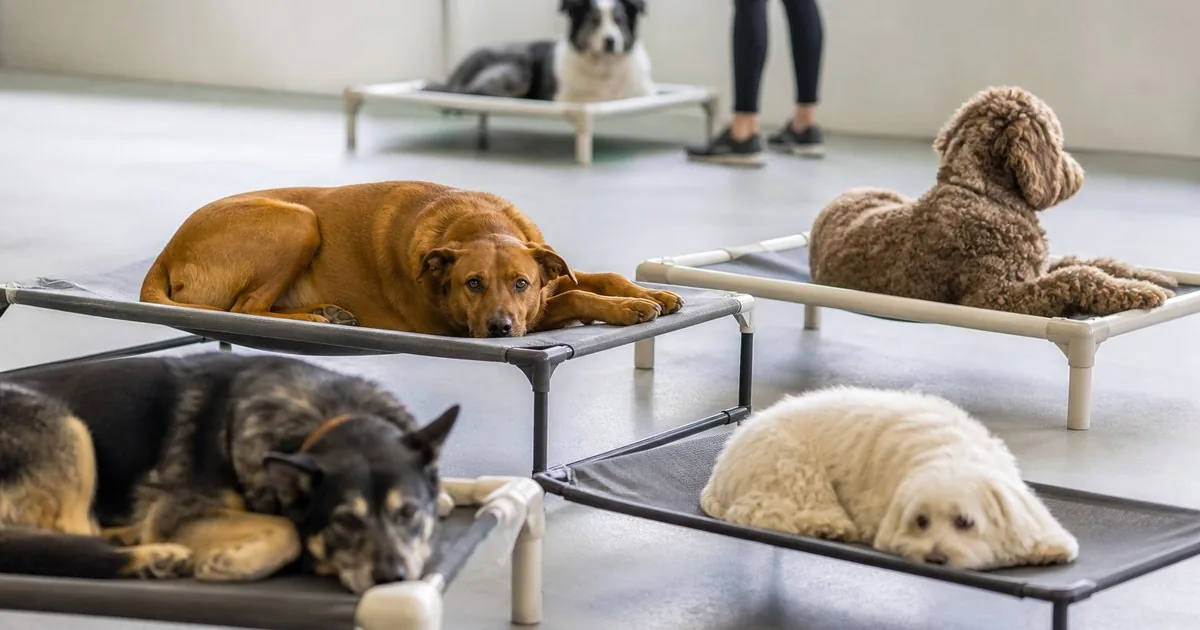
Dog daycare provides supervision through the day and can include periods of play, rest, outings and controlled activities.
Daycare is a service that supervises the dog during the day, without overnight accommodation. It can help families with long working hours and dogs that feel good in an organised environment. A good programme includes arrival, periods of activity, controlled interactions, food where needed, water, breaks and rest. It should not be uninterrupted group play.
Not every dog needs or benefits from daycare. A settled adult may prefer to sleep at home, with a walk in the middle of the day. A shy dog can be overwhelmed by the constant presence of other animals. A very active adolescent may look ideal for long play sessions, but can come home more wound up rather than calmer. The choice has to be made after an assessment and, ideally, after a trial period.
The groups have to be put together on compatibility, and the interactions supervised by people who can step in calmly and early. Dogs need the option of withdrawing. Signals such as avoidance, freezing, repeated lip licking, yawning out of context, hiding, obsessive chasing, blocking access or being unable to stop playing show that the activity has to be changed.
A responsible daycare reports not only how much the dog played, but also whether it ate, rested, toileted normally and showed any changes in behaviour. Realistic information is worth more than spectacular photographs.
It is most useful in contexts such as sociable dogs that tolerate a group environment, families who need supervision during working hours, and animals that benefit from structured activities.
A dog that plays non-stop is not necessarily happy; a lack of breaks can point to over-arousal or an inability to withdraw.
an assessment before admission; forming the groups by compatibility.
alternating activity with rest; handover with information about behaviour and incidents.
Signs such as one-sided chasing, hiding or trying to get out, repeated mounting and being unable to rest can show how the animal is experiencing the situation.
Beforehand you need information and resources such as a history of interaction with other dogs, the medical condition and health requirements, the feeding schedule, and information about resource guarding.
More useful criteria are a suitable ratio of staff to dogs, spaces for separation and rest, competent intervention before things escalate, a detailed initial conversation, and a protocol for keys, access, the leash and emergencies.
Daycare can provide settings for social behaviour and self-control, but free play does not replace individual training or the relationship with the owner.
it is not a compulsory method of socialisation; fearful or reactive dogs may need a different format. Among the risks to be discussed are group conflicts, accidents in play, excessive tiredness and insufficient supervision during free play.
A good decision about dog daycare does not start from the idea that the same format has to work for everyone.
How a service is organised responsibly, how to recognise quality, where the limits are and what to ask before you pay - explained once, for all services.
This page explains the service, it does not sell it. Some of these we run ourselves, others happen at a veterinary practice, a grooming salon, or with people we work alongside.
Frequently asked questions
It can make sense above all for sociable dogs that tolerate a group environment, families who need supervision during working hours, and animals that benefit from structured activities.
Useful information includes a history of interaction with other dogs, the medical condition and health requirements, the feeding schedule, and information about resource guarding.
You watch for one-sided chasing, hiding or trying to get out, repeated mounting, being unable to rest, the appetite and water intake, and the quality of the rest.
it is not a compulsory method of socialisation; fearful or reactive dogs may need a different format.
Daycare can provide settings for social behaviour and self-control, but free play does not replace individual training or the relationship with the owner.
Care and supervision
Someone stays with your dog overnight, either at its home or in boarding. It is not simply a person sleeping in the same...
Short visits for a dog that can be alone in between, but needs food, fresh water, a toilet break and possibly medication...
More than a car journey: the dog has to be loaded and unloaded safely, secured inside the car and protected from heat. L...
Someone comes to your dog’s home and keeps its routine going while you are away. The big advantage: nothing around...
It looks like the simplest service on the list and it is actually the one with the most variables: traffic, bikes, child...
Temporary accommodation for when your dog cannot come with you. For some dogs it is an interesting experience; for other...
Write to us about what is actually happening with your dog. We will tell you which kind of service would help - and, if that is the case, that you need none of them.