Dog daycare or day nursery
Supervision during the day, without staying overnight. Good daycare is not eight hours of uninterrupted play: there is a...

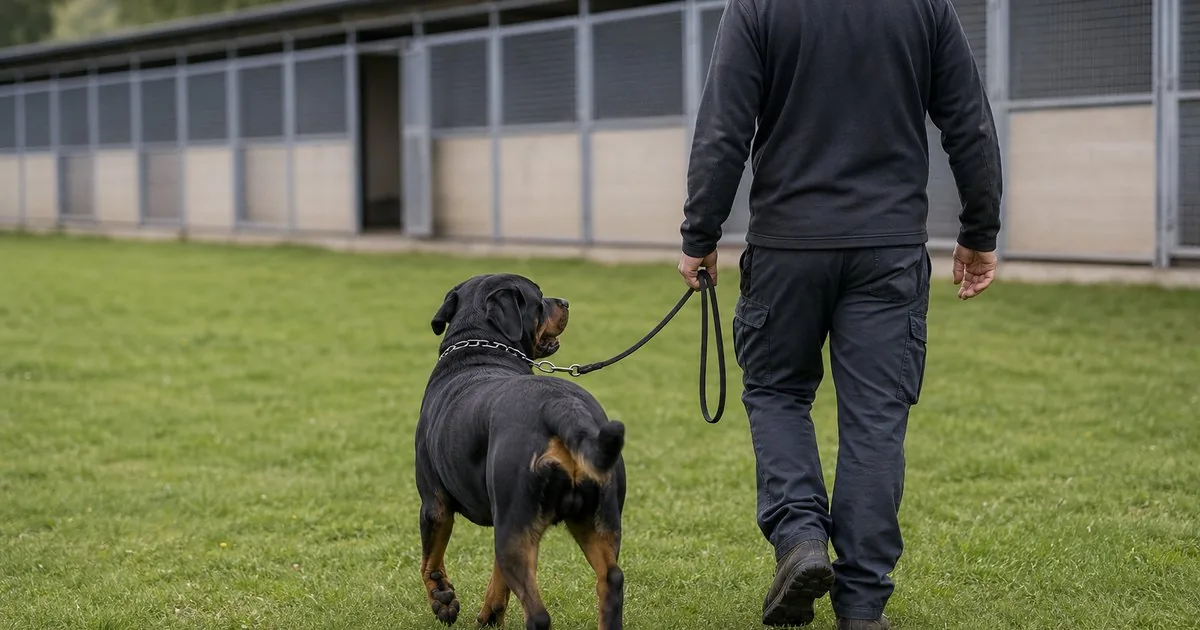
This format combines temporary accommodation with planned education or training sessions, carried out while the dog is boarding.
Boarding accompanied by training activities can be useful for maintaining skills, for introducing some basic exercises, or for working within a structured programme. Even so, the phrase “hotel with training" has to be explained concretely. How many sessions are there? Which goals are realistic? Which methods are used? How is the owner kept informed? What happens after the dog gets home?
A responsible programme does not promise that a dog will come back “fixed". Behaviour is influenced by the context and by the relationship with the person handling the dog. The dog can learn to respond well to the instructor in a controlled environment, but the family has to learn how to carry it on. The handover to the owner is a compulsory part of the process: demonstrations, guided exercises, explanations about the dog's signals and a plan of work for home.
In a boarding kennel with training, welfare must not be sacrificed for quick results. The sessions have to be adapted to the dog's attention span, age, physical state and level of stress. A tired, frightened or over-stimulated dog does not learn well. The programme has to include breaks, sleep, decompression walks and activities that allow natural behaviours.
Complex problems, such as aggression, panic, separation anxiety or sudden changes in behaviour, may need a veterinary assessment and specialist behavioural intervention. Boarding does not automatically remove the cause of the problem, and taking the dog away from the environment where the behaviour appears can hide important information.
It is most useful in contexts such as families who want continuity while they are away, dogs that can live temporarily in a new environment, and basic goals that can be practised safely.
The number of exercises or the length of the stay does not guarantee that the results will transfer home; the owner then has to learn how to maintain the behaviours.
an initial behavioural and medical assessment; defining the goals precisely.
boarding, rest and short working sessions; a practical handover to the owner and a plan to carry on.
Signs such as less interest in rewards, avoiding the instructor, hypervigilance in the boarding space and difficulty sleeping between sessions can show how the animal is experiencing the situation.
A preparation sheet should cover the full training history, the cues and rewards used at home, information about health and written goals, and the behaviours that must not be provoked.
More useful criteria are methods explained transparently, a fair ratio between work and rest, relevant video or demonstrations, a handover session with the family, a detailed initial conversation, and a protocol for keys, access, the leash and emergencies.
Training in a boarding kennel can build skills, but generalising them in the home, on the family's routes and with the usual people has to be worked on separately.
it cannot replace the owner's involvement; complex medical or behavioural cases may need specialist collaboration. Among the risks to be discussed are excessive work, the use of isolation or intimidation, and a behaviour that only works with the instructor.
How a service is organised responsibly, how to recognise quality, where the limits are and what to ask before you pay - explained once, for all services.
This page explains the service, it does not sell it. Some of these we run ourselves, others happen at a veterinary practice, a grooming salon, or with people we work alongside.
Frequently asked questions
It can make sense above all for families who want continuity while they are away, dogs that can live temporarily in a new environment, and basic goals that can be practised safely.
Useful information includes the full training history, the cues and rewards used at home, information about health and written goals, and the behaviours that must not be provoked.
You watch for less interest in rewards, avoiding the instructor, hypervigilance in the boarding space, difficulty sleeping between sessions, the appetite and water intake, and the quality of the rest.
it cannot replace the owner's involvement; complex medical or behavioural cases may need specialist collaboration.
Training in a boarding kennel can build skills, but generalising them in the home, on the family's routes and with the usual people has to be worked on separately.
Care and supervision
Supervision during the day, without staying overnight. Good daycare is not eight hours of uninterrupted play: there is a...
Someone stays with your dog overnight, either at its home or in boarding. It is not simply a person sleeping in the same...
Short visits for a dog that can be alone in between, but needs food, fresh water, a toilet break and possibly medication...
More than a car journey: the dog has to be loaded and unloaded safely, secured inside the car and protected from heat. L...
Someone comes to your dog’s home and keeps its routine going while you are away. The big advantage: nothing around...
It looks like the simplest service on the list and it is actually the one with the most variables: traffic, bikes, child...
Write to us about what is actually happening with your dog. We will tell you which kind of service would help - and, if that is the case, that you need none of them.