Mental stimulation games
Mental stimulation games give your dog's brain something to do. The dog searches, solves problems, tells objects apart a...

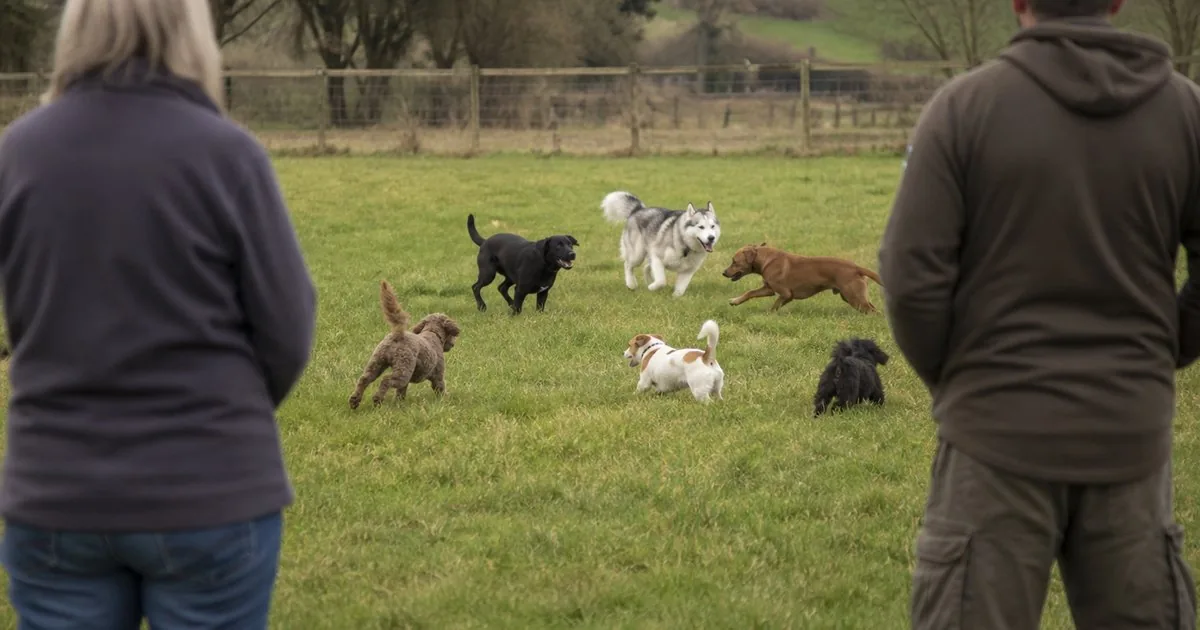
A socialisation group is a controlled setting where dogs learn to be around other dogs. Sometimes they interact directly, sometimes they just share the same space.
A lot of people picture socialisation as letting every dog off the leash to “sort it out” among themselves. A well-run group looks different. Dogs are grouped by level and age, by how they interact and by what each team is working towards. Sometimes they work side by side with no contact at all. Other times they do exercises with the others around, or have short, closely supervised interactions.
In a good group, dogs learn to share a space without the pressure of having to say hello. You work on distance and attention to the handler, then on moving calmly and taking breaks. For puppies, play can be part of the programme, but you break it up before it gets one-sided or too intense. For a sensitive adult, success might be looking at another dog and then turning back to you on its own.
The instructor watches for the subtle signals: stiffness, looking away, freezing, hiding. They also look out for chasing that won't stop, repeated mounting, blocking the other dog's movement, vocalising, or a dog that can't disengage. Stepping in early heads off conflict, and owners learn on the spot how to read what's going on.
Socialisation isn't about a dog that loves everyone. The goal is a dog that copes around others, stays safe and can choose what suits it.
A group is worth it for puppies that need guided experiences, adults practising neutrality around other dogs, and dogs that get on well enough for closely supervised play.
Socialisation doesn't require turning all the dogs loose together. A fearful dog learns nothing good from intense exposure; usually it just gets more scared.
Every participant gets assessed first. The groups and the distances between dogs are set based on that.
Exercises alternate with breaks, and the session ends before anyone is worn out or a conflict starts.
The plan changes based on what you see in the dog. Play where the roles never swap, blocking or relentless chasing, hiding next to its person, or barking nonstop while it can't focus on anything all show you how your dog is coping.
Bring safe gear and rewards. Tell the instructor how your dog has got on with other dogs so far, and stick to the group's health requirements to the letter.
Look at the instructor first: they need to be able to read interactions between dogs. The venue needs a space where a dog can retreat. There are rules for greetings and for resources. Each dog's level gets checked at the start, and exercises begin with a warm-up and build gradually.
The group is a place for training and for watching dogs, a long way from a free-for-all. Two of the best signs of progress are a dog that turns back to its handler unprompted and a dog that takes a break on its own.
A group won't guarantee the dogs become friends, and some dogs need one-to-one work at a distance. Risks to talk through beforehand: conflict and heightened fear. There are also transmissible diseases, and a dog learning to bully others in play.
How a service is organised responsibly, how to recognise quality, where the limits are and what to ask before you pay - explained once, for all services.
This page explains the service, it does not sell it. Some of these we run ourselves, others happen at a veterinary practice, a grooming salon, or with people we work alongside.
Frequently asked questions
We don't recommend it for fearful dogs that would be exposed too intensely, or for dogs that need one-to-one work at a distance. It makes most sense for puppies that need guided experiences, adults practising neutrality, and compatible dogs in closely supervised play.
Bring safe gear and rewards. Explain how your dog has got on with other dogs so far, and follow the group's health requirements.
Ask what the instructor watches for: play with no role swaps, blocking or chasing, hiding next to its person, barking while the dog can't focus. A careful instructor keeps an eye on breathing rate and gait as well, plus coordination.
It won't guarantee the dogs become friends, and some dogs need one-to-one work at a distance.
The group is a place for training and observation, a long way from a free-for-all. Checking in with the handler and taking breaks voluntarily are goals worth working towards.
Activities and burning energy
Mental stimulation games give your dog's brain something to do. The dog searches, solves problems, tells objects apart a...
In Nose Work and scent games your dog searches for food or a target odour. It gets to use its nose, one of the most powe...
In recreational mantrailing the dog follows a person's trail, starting from a scent article. Everything is set up to mat...
Recreational agility uses obstacles and simple sequences to work on coordination and communication with your dog, plus p...
Canine fitness uses controlled exercises that help the dog get to know its own body and build balance, strength and mobi...
Swimming can give your dog exercise in water, play or conditioning. Before your dog goes in, check how well it swims, wh...
Write to us about what is actually happening with your dog. We will tell you which kind of service would help - and, if that is the case, that you need none of them.