Nose Work and scent games
Nose Work and scent games give the dog the chance to search for food or a target odour and to use one of its main natura...

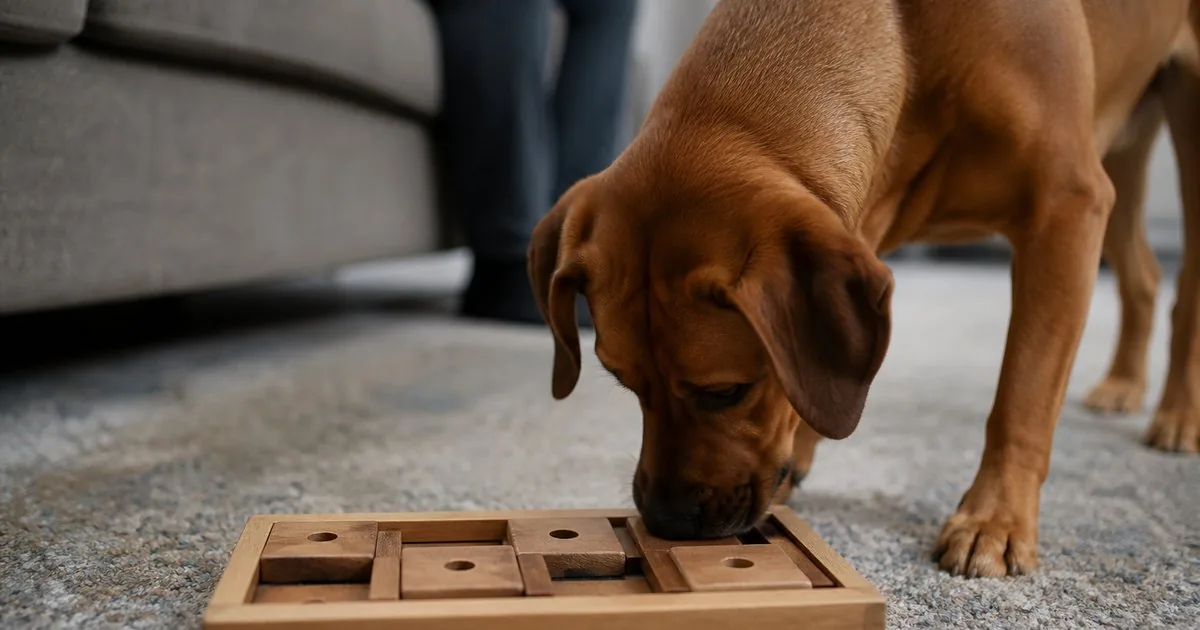
Mental stimulation games use searching, problem solving, discrimination and self-control to give the dog cognitive activity.
Mental stimulation can be built into life at home, in the yard or on a walk. Search games, solving tasks, learning new behaviours, discriminating between objects and using food creatively all give the dog control and variety. They are useful on days with bad weather, during recovery, or for dogs that cannot do intense physical exercise.
The difficulty has to be measured out. If a puzzle is too hard, the dog may give up, chew the object or become frustrated. You start easy and let the animal discover the solution. Help is offered before the frustration builds. Toys and objects are chosen according to size and chewing style, and are used under supervision where there is a risk of them being destroyed or swallowed.
The activities can include searching for food in the grass, safe cardboard boxes, simple scent trails, choosing between containers, touching a target, fetching an object or learning the names of toys. Expensive equipment is not needed. The quality comes from adapting the exercise and from the human taking part.
A good mental game is not an intelligence test. It does not compare dogs and does not set them up to fail. It offers a problem easy enough for the animal to find a solution and gain confidence.
This subcategory can be relevant in situations such as days with limited exercise, dogs that enjoy solving tasks, and puppies, adults or seniors with the difficulty adapted to them.
A hard puzzle is not better just because it keeps the dog busy for a long time; frustration and repetitive attempts can reduce the enjoyment.
choosing an easy level to begin with; showing how to get at the reward.
increasing one difficulty at a time; stopping after successes and alternating with rest.
Signs such as scratching or biting the object, vocalising, giving up quickly and restlessness after the game can show how the animal is experiencing the situation.
The owner's preparation includes safe objects and supervision, suitable rewards, a space without competition, and adjustments for mobility and eyesight.
More useful criteria are the chance to succeed, variety, objects that are big and tough enough, assessment of the level of training, and a warm-up with gradual progression.
Games can support self-control and learning, but the criterion has to be built so that the dog understands how it can succeed.
they do not replace walks and social contact; unsafe objects are not left out unsupervised. Among the risks to be discussed are swallowing pieces, resource guarding, frustration and eating too much food.
How a service is organised responsibly, how to recognise quality, where the limits are and what to ask before you pay - explained once, for all services.
This page explains the service, it does not sell it. Some of these we run ourselves, others happen at a veterinary practice, a grooming salon, or with people we work alongside.
Frequently asked questions
It can make sense above all for days with limited exercise, dogs that enjoy solving tasks, and puppies, adults or seniors with the difficulty adapted to them.
Useful information includes safe objects and supervision, suitable rewards, a space without competition, and adjustments for mobility and eyesight.
You watch for scratching or biting the object, vocalising, giving up quickly, restlessness after the game, the rhythm of the breathing and the gait, and the coordination.
they do not replace walks and social contact; unsafe objects are not left out unsupervised.
Games can support self-control and learning, but the criterion has to be built so that the dog understands how it can succeed.
Activities and burning energy
Nose Work and scent games give the dog the chance to search for food or a target odour and to use one of its main natura...
Recreational mantrailing means following a person's trail from a scent article, in a setting adapted to the level of the...
Recreational agility uses obstacles and simple sequences for coordination, communication and physical activity, without...
Canine fitness uses controlled exercises for body awareness, balance, strength and mobility, adapted to the purpose and...
Swimming can provide exercise in water, play or conditioning, but it calls for an assessment of each dog's ability, of t...
An educational walk combines exploring with simple exercises in orienting, leash walking, waiting and handling the encou...
Write to us about what is actually happening with your dog. We will tell you which kind of service would help - and, if that is the case, that you need none of them.