Canine fitness
Canine fitness uses controlled exercises for body awareness, balance, strength and mobility, adapted to the purpose and...

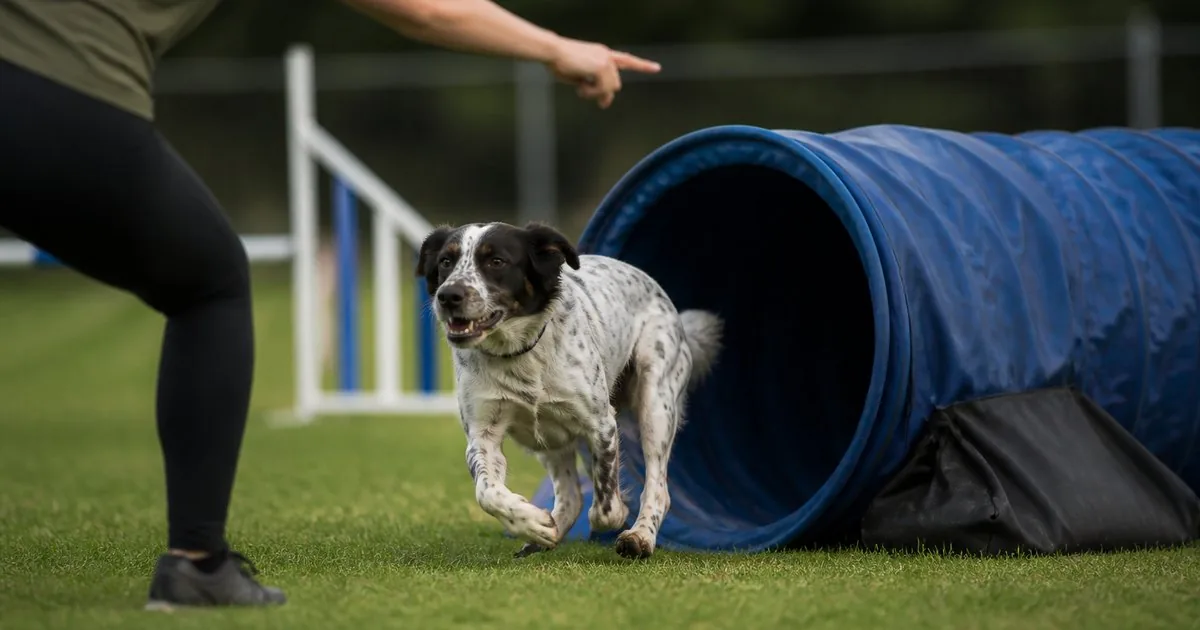
Recreational agility uses obstacles and simple sequences for coordination, communication and physical activity, without the pressure of competitive performance.
Agility combines obstacles, direction, speed and communication. In its recreational form, the emphasis can be on confidence, coordination and teamwork rather than on time. Obstacles are introduced one at a time and at a low level of difficulty. The dog learns to pass between the wings, through the tunnel, over low bars or across stable surfaces before it does full sequences.
Jumps and rapid changes of direction put demands on the body. The height, the number of repetitions and the type of obstacle are adapted to age, build, experience and state of health. Puppies must not be rushed into repetitive impact, and dogs with orthopaedic problems need professional advice.
Surfaces have to give grip, and the equipment has to be stable. The dog is not pulled, pushed or frightened over an obstacle. The wish to take part is built up, and stopping at the first signs of tiredness protects both the body and the dog's confidence.
Agility can be a wonderful activity for very different dogs, but it does not suit all of them in the same form. Sometimes basic and coordination exercises are more useful than a fast course.
This subcategory can be relevant in situations such as dogs clinically fit for exercise, teams that want variety and cooperation, and animals motivated by dynamic exercises.
Obstacles should not be set high from the very first session, nor repeated to exhaustion for a video clip or a quick result.
a physical assessment and getting used to the surfaces; teaching the obstacles separately.
short, clear sequences; cool-down and recovery days.
Signs such as hesitation at an obstacle, uncontrolled landings, a loss of speed and avoiding the course after repetitions can show how the animal is experiencing the situation.
A preparation sheet should cover a surface with grip, stable obstacles, rewards and a plan adapted to size and experience.
More useful criteria are technique before speed, low heights, a warm-up, an instructor who can stop the exercise, assessment of the level of training, and a warm-up with gradual progression.
Agility combines training with physical conditioning; directional work and precision have to be built without asking the body for more than it can sustain.
not all obstacles suit all dogs; puppies and dogs with medical conditions need restrictions. Among the risks to be discussed are falls, joint or muscle injuries, fear of the equipment and overheating.
How a service is organised responsibly, how to recognise quality, where the limits are and what to ask before you pay - explained once, for all services.
This page explains the service, it does not sell it. Some of these we run ourselves, others happen at a veterinary practice, a grooming salon, or with people we work alongside.
Frequently asked questions
It can make sense above all for dogs clinically fit for exercise, teams that want variety and cooperation, and animals motivated by dynamic exercises.
Useful information includes a surface with grip, stable obstacles, rewards and a plan adapted to size and experience.
You watch for hesitation at an obstacle, uncontrolled landings, a loss of speed, avoiding the course after repetitions, the rhythm of the breathing and the gait, and the coordination.
not all obstacles suit all dogs; puppies and dogs with medical conditions need restrictions.
Agility combines training with physical conditioning; directional work and precision have to be built without asking the body for more than it can sustain.
Activities and burning energy
Canine fitness uses controlled exercises for body awareness, balance, strength and mobility, adapted to the purpose and...
Swimming can provide exercise in water, play or conditioning, but it calls for an assessment of each dog's ability, of t...
An educational walk combines exploring with simple exercises in orienting, leash walking, waiting and handling the encou...
Hiking with a dog means walking natural trails together, prepared for the terrain, the weather, the duration and unexpec...
Running alongside a dog is a repetitive and demanding activity that has to be introduced gradually, after assessing age,...
Dog trips and camps bring together activities, travel and accommodation for one or more days, in an environment differen...
Write to us about what is actually happening with your dog. We will tell you which kind of service would help - and, if that is the case, that you need none of them.