Recreational agility
Recreational agility uses obstacles and simple sequences for coordination, communication and physical activity, without...

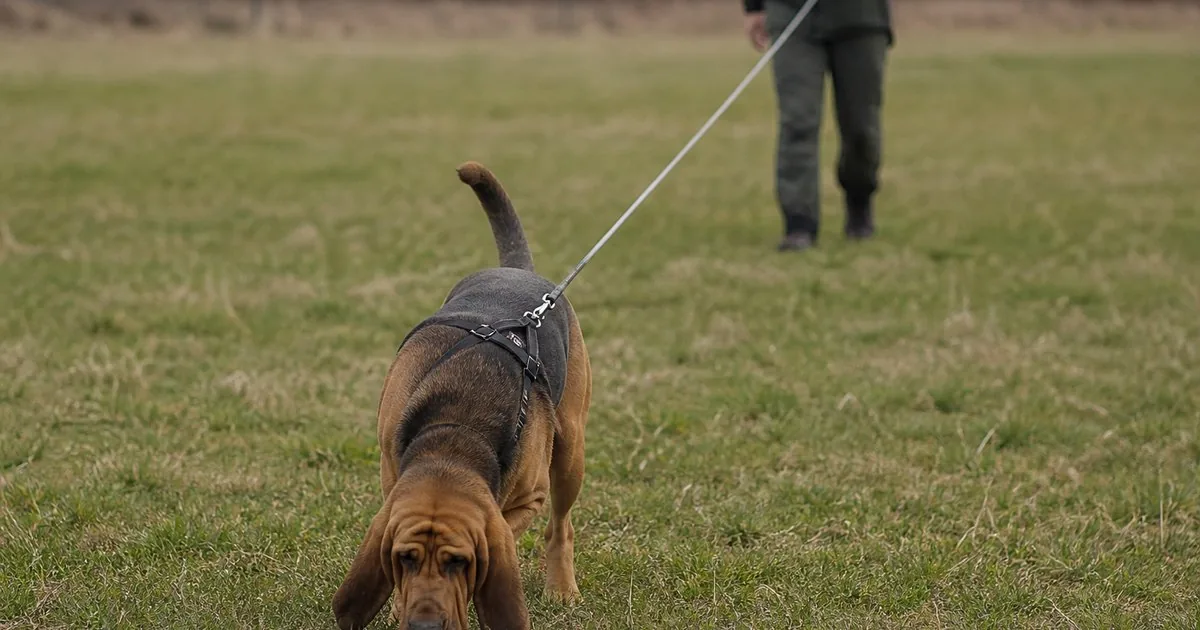
Recreational mantrailing means following a person's trail from a scent article, in a setting adapted to the level of the team.
Recreational mantrailing means following a person's scent, usually starting from a scent article and continuing along the route that person took. The dog works in a harness and on a long line, and the handler goes along without dictating every choice. The activity makes use of the nose, initiative, problem solving and the cooperation between dog and human.
Beginners work short, clear trails, with a motivating “missing person" and a positive ending. The difficulty can be raised through the age of the trail, its length, changes of direction, surfaces, junctions and the environment, but not all the variables are increased at once. The dog has to understand the task and succeed often enough to keep its motivation.
Mantrailing is not a free walk, nor a test of strength. The handler has to learn line handling, positioning, safety at crossings and reading behaviour. Trails are set in places where this is allowed, without putting the participants, the traffic or the public at risk.
The recreational form must not be presented as an operational qualification. Real search work involves selection, standards, continuous training, assessments and being part of a competent structure. As a recreational activity, it remains valuable for what it offers the dog and the team.
It is most useful in contexts such as dogs that enjoy working with their nose, teams interested in a cooperative activity and animals that can work on their own, away from the group.
A recreational activity does not automatically turn the dog into an operational search and rescue dog and does not justify using it in real cases.
introducing the scent article and the start; short trails with a clear success.
increasing the age and the difficulty; analysing the dog's body language, and recovery.
Signs such as losing the direction and searching widely, frustration when help comes late, tiredness after difficult ground and a change in motivation on finding the person can show how the animal is experiencing the situation.
To reduce improvisation, a dedicated harness and long line, a reward at the end, a properly handled scent article, and footwear and visibility for the handler all have to be prepared.
More useful criteria are trails adapted to the team, road safety, a missing person briefed not to call the dog, breaks between exercises, assessment of the level of training, and a warm-up with gradual progression.
Mantrailing is in itself a working and training discipline, in which the handler learns to read the dog's initiative without artificially steering it along the trail.
it is not an operational deployment; dogs with medical problems need the trail adapted. Among the risks to be discussed are a tangled line, traffic, dangerous ground and confusion caused by too much help.
How a service is organised responsibly, how to recognise quality, where the limits are and what to ask before you pay - explained once, for all services.
This page explains the service, it does not sell it. Some of these we run ourselves, others happen at a veterinary practice, a grooming salon, or with people we work alongside.
Frequently asked questions
It can make sense above all for dogs that enjoy working with their nose, teams interested in a cooperative activity and animals that can work on their own, away from the group.
Useful information includes a dedicated harness and long line, a reward at the end, a properly handled scent article, and footwear and visibility for the handler.
You watch for losing the direction and searching widely, frustration when help comes late, tiredness after difficult ground, a change in motivation on finding the person, the rhythm of the breathing and the gait, and the coordination.
it is not an operational deployment; dogs with medical problems need the trail adapted.
Mantrailing is in itself a working and training discipline, in which the handler learns to read the dog's initiative without artificially steering it along the trail.
Activities and burning energy
Recreational agility uses obstacles and simple sequences for coordination, communication and physical activity, without...
Canine fitness uses controlled exercises for body awareness, balance, strength and mobility, adapted to the purpose and...
Swimming can provide exercise in water, play or conditioning, but it calls for an assessment of each dog's ability, of t...
An educational walk combines exploring with simple exercises in orienting, leash walking, waiting and handling the encou...
Hiking with a dog means walking natural trails together, prepared for the terrain, the weather, the duration and unexpec...
Running alongside a dog is a repetitive and demanding activity that has to be introduced gradually, after assessing age,...
Write to us about what is actually happening with your dog. We will tell you which kind of service would help - and, if that is the case, that you need none of them.