Swimming for dogs
Swimming can give your dog exercise in water, play or conditioning. Before your dog goes in, check how well it swims, wh...

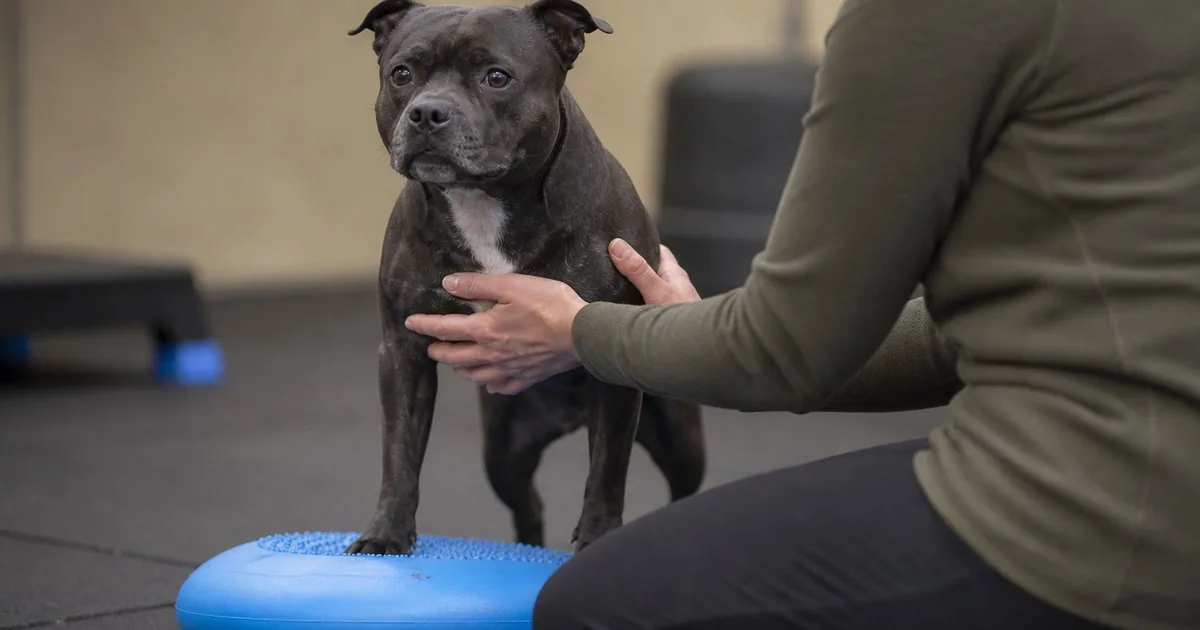
Canine fitness uses controlled exercises that help the dog get to know its own body and build balance, strength and mobility. You pick the exercises based on the goal and on the dog's condition.
In fitness work the dog learns to control its body and keep its balance. It builds strength and flexibility and learns to be aware of each leg on its own. Exercises can include controlled positions, shifting weight from one leg to another, walking over poles on the ground or low step-ups. There are also turns, backing up and work on stable or slightly wobbly surfaces. What matters is doing them correctly, with only a few reps, but good ones.
Fitness isn't the same as medical rehab, though people often mix them up. For a healthy dog it can be general conditioning or something to support a sport. For a dog that's injured, in pain, recovering from surgery or living with neurological or orthopaedic conditions, the exercises are set by the vet and the rehab specialist.
Position matters a lot. A movement done wrong and repeated over and over locks compensations in instead of fixing them. That's why it helps to film, watch the dog from the side and change the surface when needed. Hold the reward where it guides the dog without making it twist its body for no reason.
Progress doesn't mean rushing onto wobbly equipment. Control on the ground comes first. A short, regular programme that fits the dog is worth more than flashy exercises done now and then.
Fitness work earns its place with healthy dogs that need conditioning, sport dogs in training and seniors who can do exercises a vet has approved and adapted to them.
A dog holding a tough position on a wobbly object looks great in photos, but that doesn't make it useful. The form, length and purpose of the exercise count for more than how impressive it looks.
First decide what you want to achieve and assess how your dog moves now. Teach the positions on a stable surface.
Raise the difficulty gradually. Watch for tiredness and how your dog recovers after each session.
Watch the muscles during the exercise. Trembling, compensating with other legs, refusing a position or stiffness after the session all show you how your dog is handling the effort.
You'll need a non-slip surface and stable equipment. Bring small treats, since there'll be lots of short reps. Mention up front any pain or previous procedures.
You can spot a serious programme by its precise technique and its few but good reps. Whoever works with the dog keeps an eye on body alignment and builds in breaks. The dog's level gets checked at the start, and after a warm-up the difficulty builds gradually.
Fitness uses training principles to get movements the dog offers willingly. The physical goal of each exercise needs to be clearly defined, though. Otherwise you end up teaching a trick and nothing more.
Fitness doesn't replace physiotherapy. Therapeutic exercises are set by professionals trained for it. Risks to talk through: falling off the equipment and making pain worse. There's also overloading a joint.
The same programme won't suit every dog. Say no when the format doesn't fit yours, and base the call on its body and condition right now.
How a service is organised responsibly, how to recognise quality, where the limits are and what to ask before you pay - explained once, for all services.
This page explains the service, it does not sell it. Some of these we run ourselves, others happen at a veterinary practice, a grooming salon, or with people we work alongside.
Frequently asked questions
No. It makes most sense for healthy dogs that need conditioning, sport dogs in training and seniors who can do exercises a vet has approved and adapted.
You need a non-slip surface and stable equipment, plus small treats. Mention any pain or previous procedures.
Look for muscle trembling, compensating with other legs, refusing a position, stiffness after the session. Keep an eye on breathing rate and gait too, plus coordination. If none of that shows, the session was pitched right.
It doesn't replace physiotherapy, and therapeutic exercises are set by competent professionals.
Fitness uses training principles to get voluntary movement. The physical goal has to be defined properly and kept separate from simply performing a trick.
Activities and burning energy
Swimming can give your dog exercise in water, play or conditioning. Before your dog goes in, check how well it swims, wh...
On an educational walk the dog gets to explore, and you slip in simple exercises along the way: checking in with you, wa...
Hiking with your dog means heading out on natural trails together, ready for the terrain and the weather. You need to kn...
Running with your dog is repetitive and hard on the body. Bring it in gradually, once you've looked at the dog's age and...
On a dog trip or camp you take your dog away from home for one or more days. There's travel and somewhere new to stay, w...
A socialisation group is a controlled setting where dogs learn to be around other dogs. Sometimes they interact directly...
Write to us about what is actually happening with your dog. We will tell you which kind of service would help - and, if that is the case, that you need none of them.