Dog trips and camps
Dog trips and camps bring together activities, travel and accommodation for one or more days, in an environment differen...

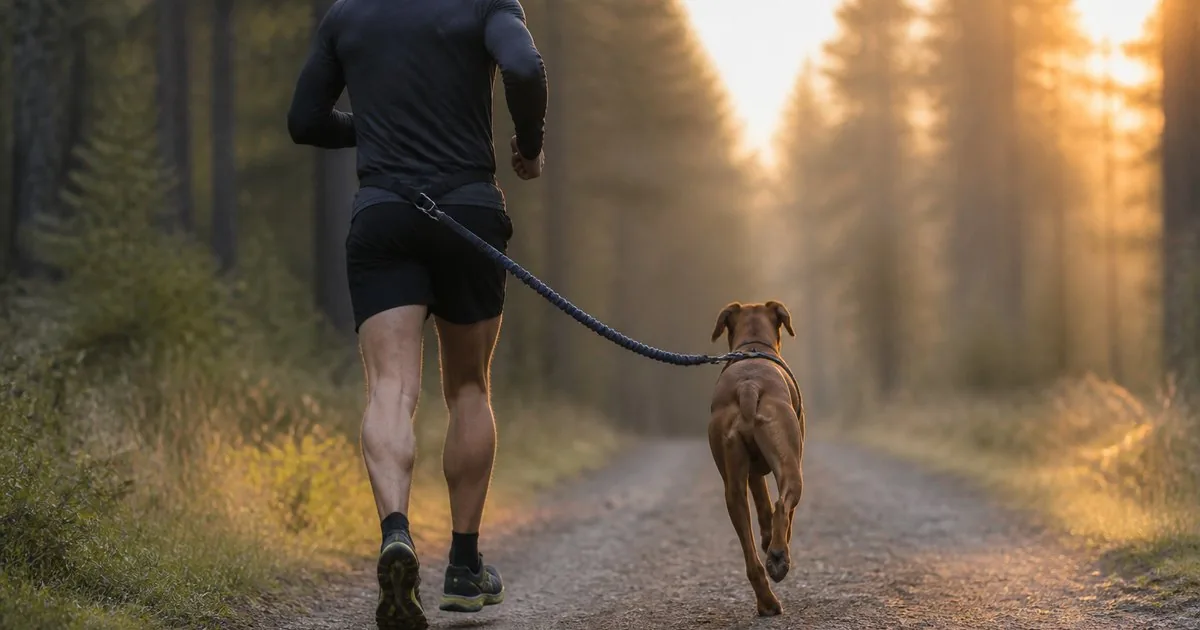
Running alongside a dog is a repetitive and demanding activity that has to be introduced gradually, after assessing age, health and physical condition.
Running can be done alongside the dog on a leash, in a pulling setup, or in adapted recreational forms. It is a repetitive activity and more demanding than walking, which is why it has to be introduced gradually. Before a regular programme, a health assessment matters, especially for growing dogs, seniors, overweight dogs, dogs with a build that can make breathing harder, or dogs with an orthopaedic history.
The dog must not be made to keep to the human's pace if it shows that it wants to slow down, looks for shade, falls behind or changes its gait. The surface and the temperature are decisive. Asphalt can get very hot, and running on hard ground increases the repetitive load. Cool hours and safe routes are preferable.
The equipment has to allow movement without rubbing and without unsuitable pressure. For pulling, a system designed for that activity is used, not an improvised one. The dog has to learn cues for starting, slowing down, stopping and changing direction before it takes on complicated routes.
The programme includes a warm-up at walking pace, the running part and a gradual cool-down. Rest days and complementary activities reduce the monotony. The aim is not a distance record, but an activity both partners can do safely and enjoy.
This subcategory can be relevant in situations such as adult dogs clinically fit for exercise, people who can keep to a pace adapted to the animal, and teams already used to controlled walking before they start running.
A dog's enthusiasm does not prove that its joints, muscles and cardiovascular system are ready for the distance chosen.
a conversation with the vet where there are risk factors; alternating walking with short runs.
increasing the volume gradually; recovery days and monitoring of the body.
Signs such as a change in stride, falling behind, panting out of proportion to the effort and stiffness afterwards can show how the animal is experiencing the situation.
A preparation sheet should cover a harness suited to the activity, water and a safe route, protection from the temperature, and a progression plan.
More useful criteria are a surface and pace adapted to the dog, a warm-up, stopping at the first signs of discomfort, assessment of the level of training, and a warm-up with gradual progression.
Training helps with changing pace, stopping and positioning, but technical work cannot make up for a lack of physical conditioning.
it is not suitable for puppies as sustained exercise; fixed distances are not used without individual adaptation. Among the risks to be discussed are repetitive injuries, burnt pads, overheating and pulling or imbalance between human and dog.
A good decision about running with your dog does not start from the idea that the same format has to work for everyone.
How a service is organised responsibly, how to recognise quality, where the limits are and what to ask before you pay - explained once, for all services.
This page explains the service, it does not sell it. Some of these we run ourselves, others happen at a veterinary practice, a grooming salon, or with people we work alongside.
Frequently asked questions
It can make sense above all for adult dogs clinically fit for exercise, people who can keep to a pace adapted to the animal, and teams already used to controlled walking before they start running.
Useful information includes a harness suited to the activity, water and a safe route, protection from the temperature, and a progression plan.
You watch for a change in stride, falling behind, panting out of proportion to the effort, stiffness afterwards, the rhythm of the breathing and the gait, and the coordination.
it is not suitable for puppies as sustained exercise; fixed distances are not used without individual adaptation.
Training helps with changing pace, stopping and positioning, but technical work cannot make up for a lack of physical conditioning.
Activities and burning energy
Dog trips and camps bring together activities, travel and accommodation for one or more days, in an environment differen...
Socialisation groups create controlled settings in which dogs can learn to be around others, with or without direct inte...
Mental stimulation games use searching, problem solving, discrimination and self-control to give the dog cognitive activ...
Nose Work and scent games give the dog the chance to search for food or a target odour and to use one of its main natura...
Recreational mantrailing means following a person's trail from a scent article, in a setting adapted to the level of the...
Recreational agility uses obstacles and simple sequences for coordination, communication and physical activity, without...
Write to us about what is actually happening with your dog. We will tell you which kind of service would help - and, if that is the case, that you need none of them.