Running with your dog
Running alongside a dog is a repetitive and demanding activity that has to be introduced gradually, after assessing age,...

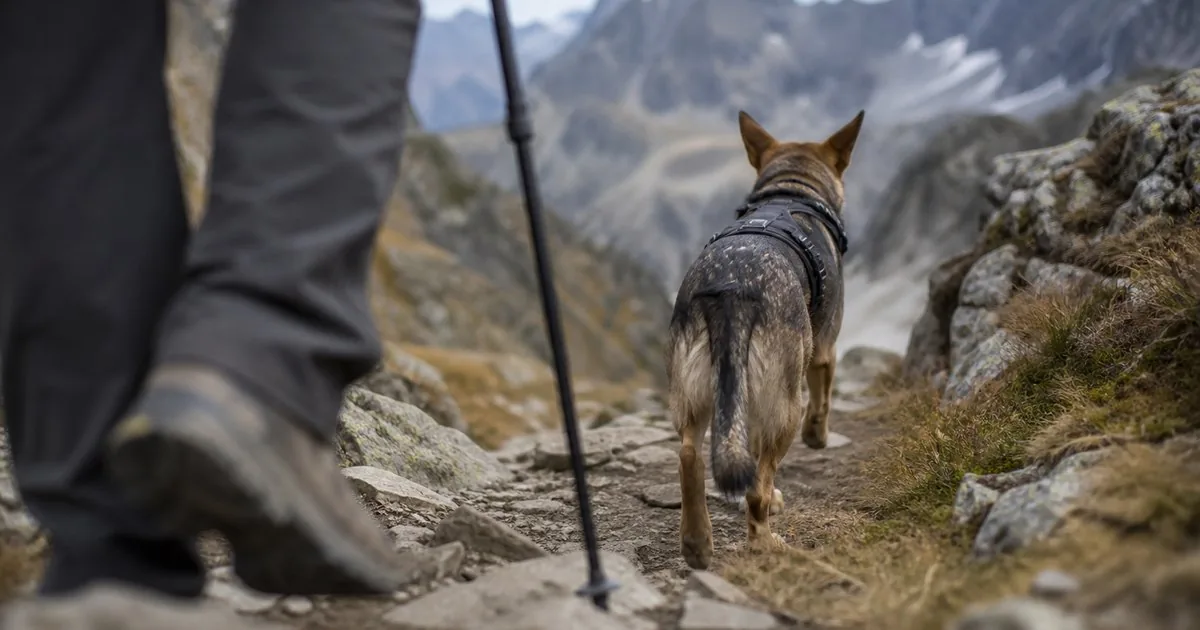
Hiking with a dog means walking natural trails together, prepared for the terrain, the weather, the duration and unexpected encounters.
A hike offers movement, smells, varied ground and time spent together. For many dogs it is a valuable activity, but the route has to be chosen on the basis of real fitness, not the enthusiasm at the trailhead. The distance, the elevation gain, the temperature, access to water, the type of ground and the option of turning back are all important.
A dog that only does short walks in town is not automatically ready for a whole day in the mountains. Fitness is built up step by step. You start with easy routes, watch the recovery and increase the duration and difficulty gradually. Breaks are taken before the animal is exhausted. Water is offered regularly, and feeding and treats are adapted to the plan set for the dog.
In natural areas there can be wildlife, livestock, guarding dogs, cyclists, runners and exposed sections. Keeping the dog on a leash or a long line protects the dog, the wildlife and the other people out there. A good recall does not justify letting the dog off in any location. Local rules have to be respected.
Before the route, parasite prevention is checked with the vet, and after coming back the body is examined. The pads, the spaces between the toes, the nails and the places where ticks can attach deserve particular attention. The dog has to be allowed to rest, and persistent stiffness, lameness or apathy needs an assessment.
It can be considered above all for healthy dogs gradually accustomed to exercise, families who want activity in nature, and teams able to manage the leash and the recall.
A long hike is not suitable just because the dog looks enthusiastic at the start; endurance, the paws and temperature regulation all have to be taken into account.
choosing the route to suit the level; checking the weather and the access.
breaks, water and control of the pace; checking the paws and the recovery after getting back.
Signs such as slowing down, looking for shade, lameness and a loss of interest in exploring can show how the animal is experiencing the situation.
A preparation sheet should cover water and a bowl, a leash and spare equipment, identification and a first aid kit, and information about the route.
More useful criteria are a group of manageable size, a plan for wildlife and unknown dogs, adapting to the temperature and the surface, assessment of the level of training, and a warm-up with gradual progression.
Behaviours for recall, waiting, passing under control and handling the leash all increase safety, but they do not replace planning the route.
you do not start straight away with long distances; some conditions mean the exercise has to be limited. Among the risks to be discussed are getting lost or escaping, paw injuries, overheating and encounters with dangerous animals or plants.
A good decision about hiking with dogs does not start from the idea that the same format has to work for everyone.
How a service is organised responsibly, how to recognise quality, where the limits are and what to ask before you pay - explained once, for all services.
This page explains the service, it does not sell it. Some of these we run ourselves, others happen at a veterinary practice, a grooming salon, or with people we work alongside.
Frequently asked questions
It can make sense above all for healthy dogs gradually accustomed to exercise, families who want activity in nature, and teams able to manage the leash and the recall.
Useful information includes water and a bowl, a leash and spare equipment, identification and a first aid kit, and information about the route.
You watch for slowing down, looking for shade, lameness, a loss of interest in exploring, the rhythm of the breathing and the gait, and the coordination.
you do not start straight away with long distances; some conditions mean the exercise has to be limited.
Behaviours for recall, waiting, passing under control and handling the leash all increase safety, but they do not replace planning the route.
Activities and burning energy
Running alongside a dog is a repetitive and demanding activity that has to be introduced gradually, after assessing age,...
Dog trips and camps bring together activities, travel and accommodation for one or more days, in an environment differen...
Socialisation groups create controlled settings in which dogs can learn to be around others, with or without direct inte...
Mental stimulation games use searching, problem solving, discrimination and self-control to give the dog cognitive activ...
Nose Work and scent games give the dog the chance to search for food or a target odour and to use one of its main natura...
Recreational mantrailing means following a person's trail from a scent article, in a setting adapted to the level of the...
Write to us about what is actually happening with your dog. We will tell you which kind of service would help - and, if that is the case, that you need none of them.