
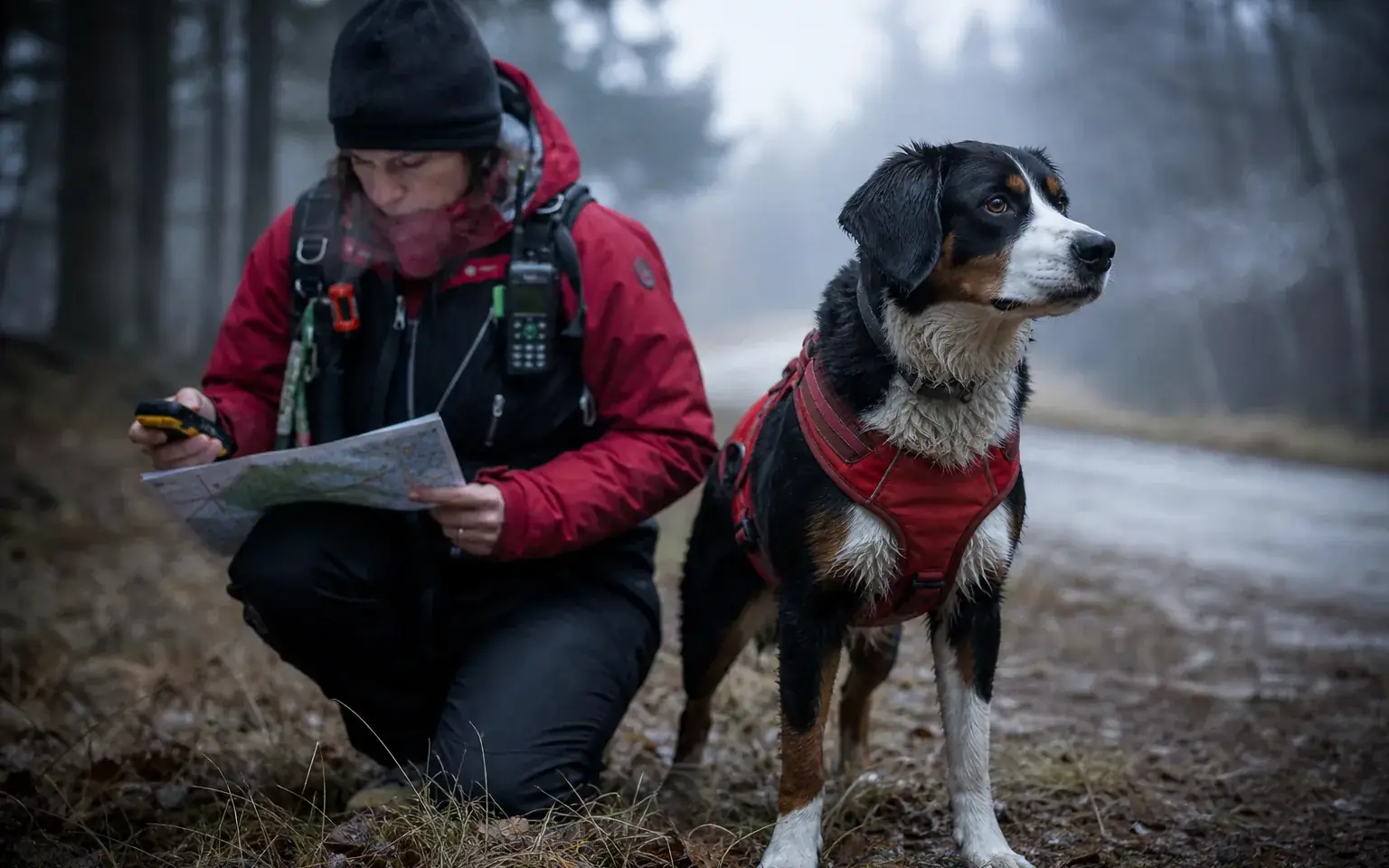
Search and Rescue Dogs
How dogs find missing people
A search with dogs works like this: the team receives the alert and information (last known location, time, an object carrying the person's scent), the coordinator divides the area into sectors, and the canine teams cover them systematically. The mantrailing dog follows the person's individual scent; the area dog scans the air for the scent of any living person. When it finds someone, the dog alerts, usually by barking, and calls its handler.
In short
An operation, step by step
Below we explain each stage and, just as importantly, how a person's scent actually behaves in the field - the part the films don't show. For context, go back to the guide on search and rescue dogs.
1. The call and the information
It all starts with information. The team learns the missing person's last known location, the time they were last seen, the probable direction of travel, their physical and mental state and any risks (terrain, weather). If an object worn by the person can be obtained - a jacket, a pillow, a key - it becomes the scent article for the mantrailing dogs.
2. Sectoring the area
The coordinator divides the search area into sectors, based on the terrain, the available resources and how likely the person is to be there. Each canine team is assigned a sector and covers it methodically, so that no part is left unchecked and effort is not needlessly duplicated.
3. Deploying the dog: two methods
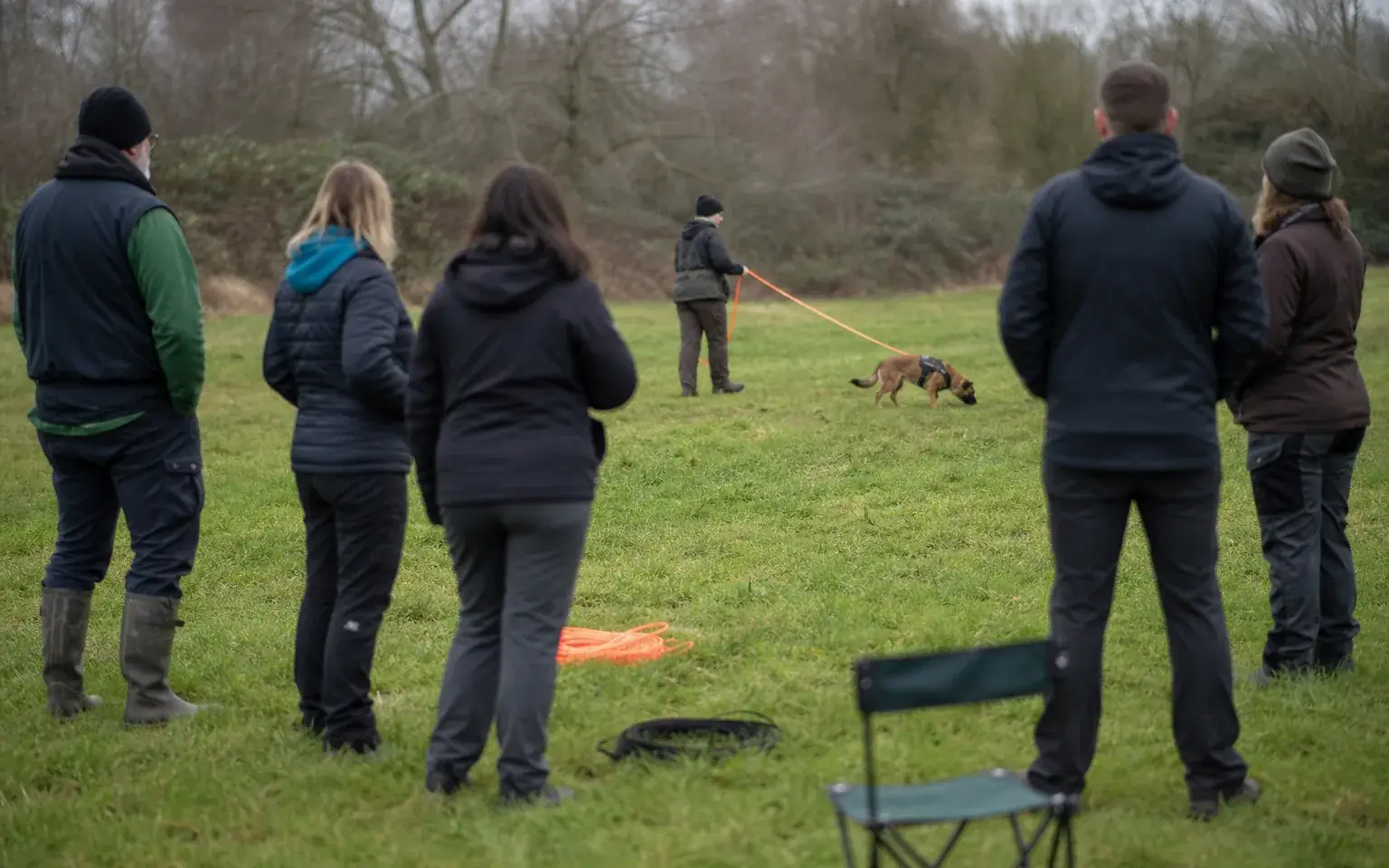
- Mantrailing (individual trail): the dog starts from the scent article and follows that person's exact route, even through places where many other people have passed. Useful when there is a clear starting point.
- Area search: the dog scans the sector freely, "reading" the air, and reacts to the scent of any living person. Useful when there is no scent article or starting point.
4. Scent theory, in plain language
A person constantly sheds skin cells, moisture and scent molecules into the environment. These don't stay put: they are carried by the wind and form, downwind, a "scent cone" that widens with distance. The dog doesn't go in a straight line towards the person - it first enters the edge of the cone, then follows it towards the source, towards the increasing concentration.
Temperature and sun move the air vertically (thermal currents): in the morning and evening scent behaves differently than at midday. This is why a good dog is trained in all kinds of conditions, and the handler learns to "read" the wind as much as the dog.
5. The alert and the find
When the dog locates the person, it signals - most often by sustained barking next to the casualty, sometimes by returning to the handler and leading them to the spot. The handler confirms and informs the coordinator. From this moment the medical and extraction teams take over.
What affects success
Wind, temperature, humidity, the type of terrain and the age of the trail completely change the difficulty of a search. We have explained these effects in detail in our articles on how scent behaves depending on the weather and on how long a trail lasts. The technical differences between disciplines are detailed in the guide on types of search.
Coordination and technology
Behind the dogs there is careful coordination: sector maps, GPS to track the covered routes, radio communications between teams and a coordinator who gathers the information and decides the next steps. Technology does not replace the dog's nose - it puts it to intelligent use, without wasting precious time.
Frequently asked questions
Frequently asked questions
01
How do dogs find missing people?
Through scent, not sight. A mantrailing dog starts from an object worn by the person and follows their exact route, distinguishing the individual scent. An area dog scans the air within a sector and signals the airborne scent of any living person. On finding, the dog alerts, usually by barking, and calls its handler.
02
How far can a dog smell a person?
It depends on wind, temperature, humidity and terrain. In favourable conditions, an area dog can detect a person from tens or even over a hundred metres away. Scent travels as a cone, carried by air currents, and the dog works the area methodically to move into this cone.
03
What affects the success of a search?
Wind, temperature, humidity, the type of terrain and the age of the trail. A fresh trail on damp, shaded ground lasts much better than an old one on hot asphalt. This is why training is done in conditions as varied as possible.
04
Does the dog work alone or with the handler?
As a team. The dog does the scent work, while the handler reads its signals, manages the sector and communicates with the coordinator. In mantrailing the dog leads on a long line; in area search it often works free while the handler directs it and marks the covered zones.
Want to understand the differences between disciplines?
Read the guide on types of search: mantrailing, area, rubble and more.