Photo sessions during training
Photos taken during training capture your relationship with the dog, your technique and how far you've come, without the...

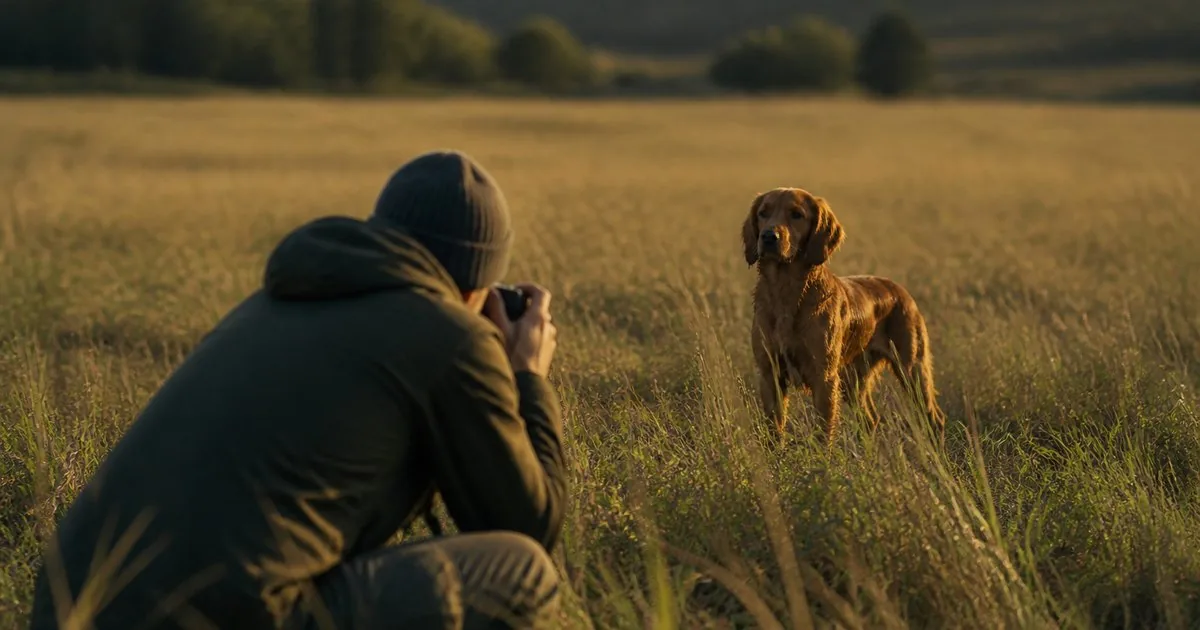
A professional shoot gets you good-quality pictures of your dog, on his own or with the family, in a studio or outdoors.
Good photos keep memories. They can also help with adoptions, educational projects or showing off a working team. A good session runs at the dog's pace. He isn't a prop you arrange in the frame, so don't make him hold an uncomfortable position for the sake of a shot.
Before the session, tell the photographer about your dog: how he behaves, how his recall is, how he reacts to equipment and to strangers. Agree on the location and the kind of pictures you want. With a shy dog, the photographer can work from further away with the right lens. For a reactive dog, pick somewhere quiet at a time when there's not much traffic. The leash can stay on. You either work it into the picture or edit it out later, and safety doesn't suffer.
Flashes and lights come in gradually, and so do backdrops or new sounds. The dog gets breaks, water and time to sniff around. You okay the treats. If loud noises scare him, the photographer doesn't use them to get him to look at the camera.
The contract covers the length of the session, the delivery date, how many photos you get, the editing, usage rights, publication, and your consent for pictures you appear in. At events, every participant's consent counts, especially if the photos end up in promotional material.
A decent photographer won't promise you that any dog will sit still. Shots taken while the dog is moving or playing often show who he really is better than a stiff pose.
It's most worthwhile if you want keepsakes, if your dog is relaxed around someone new, or if the session can be adapted to him with distance and movement.
No photo is worth restraining your dog, dressing him in a costume he hates, or repeating a pose until he's worn out.
Talk to the photographer about your dog's personality and his limits. Decide on the location and how long the session lasts.
Let him get used to the camera and the space. Shoot in short bursts with breaks in between.
Watch your dog. Avoiding the lens, panting or lip licking, freezing, or wanting to wander off and explore or get away all tell you how he's finding the session.
Bring his treats and a few familiar things, safe gear, your rules on how the pictures can be used, and some notes on how sensitive he is to lights or people.
Look for a photographer who doesn't call or touch your dog without asking you first. They avoid flash where it's not appropriate, leave a spot where the dog can get away, and ask your permission before publishing anything. A clear description of the session and safety rules you can find easily count too.
It helps if your dog can hold a stay, look to you or touch a target. Photography can also catch the way he moves naturally, though, without rigid obedience.
Not every dog can hold a fixed pose, and his safety comes before the shot you had in mind. Risks to talk through up front: escape, stress, run-ins with other dogs at the location, unauthorised use of the pictures.
Don't assume the same kind of session works for every dog. One will settle in a studio, another is only relaxed outside on ground he knows. Pick the format that suits your dog.
How a service is organised responsibly, how to recognise quality, where the limits are and what to ask before you pay - explained once, for all services.
This page explains the service, it does not sell it. Some of these we run ourselves, others happen at a veterinary practice, a grooming salon, or with people we work alongside.
Frequently asked questions
Mostly if you want keepsakes, if your dog is relaxed around someone new, or if the session can be adapted to him with distance and movement.
Bring his treats and familiar things, safe gear, your rules about the pictures, and notes on how sensitive he is to lights or people.
Watch for avoiding the lens, panting or lip licking, freezing, wanting to explore or get away. It matters that he has somewhere to retreat to, how wound up he gets and whether he can still take breaks.
Not every dog can hold a fixed pose. His safety comes before the shot you wanted.
It helps if he can stay, look to you or touch a target. But photos can also catch how he moves naturally, without rigid obedience.
Retail and events
Photos taken during training capture your relationship with the dog, your technique and how far you've come, without the...
A dog's birthday can be a get-together with friends, a special outing or a quiet day in. Pick what suits him.
A dog event might be a group walk, a demo, an activity, an educational meet-up or a fun competition.
A pet taxi is a booked ride for your dog: to the vet, the groomer, a boarding kennel, training or anywhere else he needs...
Renting a field gets you temporary use of a fenced or kitted-out space for exercises, activities or one-to-one work with...
Seminars and workshops teach you, in a classroom or out in the field, about training, behaviour, health, sport and dog c...
Write to us about what is actually happening with your dog. We will tell you which kind of service would help - and, if that is the case, that you need none of them.