Online support after training courses
Online support offers clarification and feedback between sessions, usually based on a plan already agreed and on video r...


The advice helps the family organise the resources, the spaces, the walks and the interactions so that each dog has safety and individual time.
Life with several dogs can be enjoyable, but it needs management. The relationships are not stable at every moment; age, maturing, illness, resources and changes in the house can all alter the interactions. The family has to notice the tensions and not wait for a serious conflict.
Feeding separately, individual resting areas, controlled access to toys and the option of separation are all normal measures. There is no need for the animals to share everything. Being fair does not mean they get things at exactly the same moment, but that each one's needs are met without competition.
Walks can be done together only if the person can control the group. Sometimes individual training is needed before they go out in pairs. Each dog also needs separate time with its human, not only life in the group.
Where there are conflicts, the context and the health are looked at. Pain can reduce tolerance. The dogs are separated safely and are not forced to “make up". Punishing after an incident can increase the tension. A professional plan sets out the prevention and the gradual reintroduction, where that is appropriate.
This subcategory can be relevant in situations such as families bringing in a new dog, homes where tension appears over food or attention, and owners who cannot walk the group safely.
Dogs should not be made to share everything, nor left to settle access to resources between themselves through conflict.
analysing the relationships and the incidents; separating food and rest.
individual work; controlled reintroductions and monitoring.
Signs such as a fixed stare and blocking, following, avoiding a room, and tension when someone approaches a person or objects can show how the animal is experiencing the situation.
To reduce improvisation, gates and separate areas, an individual schedule, a medical history for each dog, and shared rules within the family all have to be prepared.
More useful criteria are management before training, individual attention, no punishment for the dog that communicates discomfort, clear goals and usable materials, and examples adapted to everyday life.
Individual training provides behaviours for recall, waiting and moving away, but it does not replace barriers and management when the risk is real.
some animals may need to be kept apart long term; serious conflicts need a competent assessment. Among the risks to be discussed are fights over resources, redirected bites, children caught between dogs and chronic stress.
How a service is organised responsibly, how to recognise quality, where the limits are and what to ask before you pay - explained once, for all services.
This page explains the service, it does not sell it. Some of these we run ourselves, others happen at a veterinary practice, a grooming salon, or with people we work alongside.
Frequently asked questions
It can make sense above all for families bringing in a new dog, homes where tension appears over food or attention, and owners who cannot walk the group safely.
Useful information includes gates and separate areas, an individual schedule, a medical history for each dog, and shared rules within the family.
When the recommendations concern one particular dog, you watch for a fixed stare and blocking, following, avoiding a room, tension when someone approaches a person or objects, fewer situations in which the dog has to be forced, and more predictable responses from the family.
some animals may need to be kept apart long term; serious conflicts need a competent assessment.
Individual training provides behaviours for recall, waiting and moving away, but it does not replace barriers and management when the risk is real.
Services for owners
Online support offers clarification and feedback between sessions, usually based on a plan already agreed and on video r...
A monthly subscription can include regular sessions, activities, a review of progress and an updated plan once a basic c...
Courses for future owners set out the responsibilities, the costs, the stages of development and the decisions that need...
First aid workshops teach owners to recognise an emergency, reduce the risks and get the dog to veterinary services.
These courses help people notice the posture, the movement, the gaze, the tension and the subtle changes through which a...
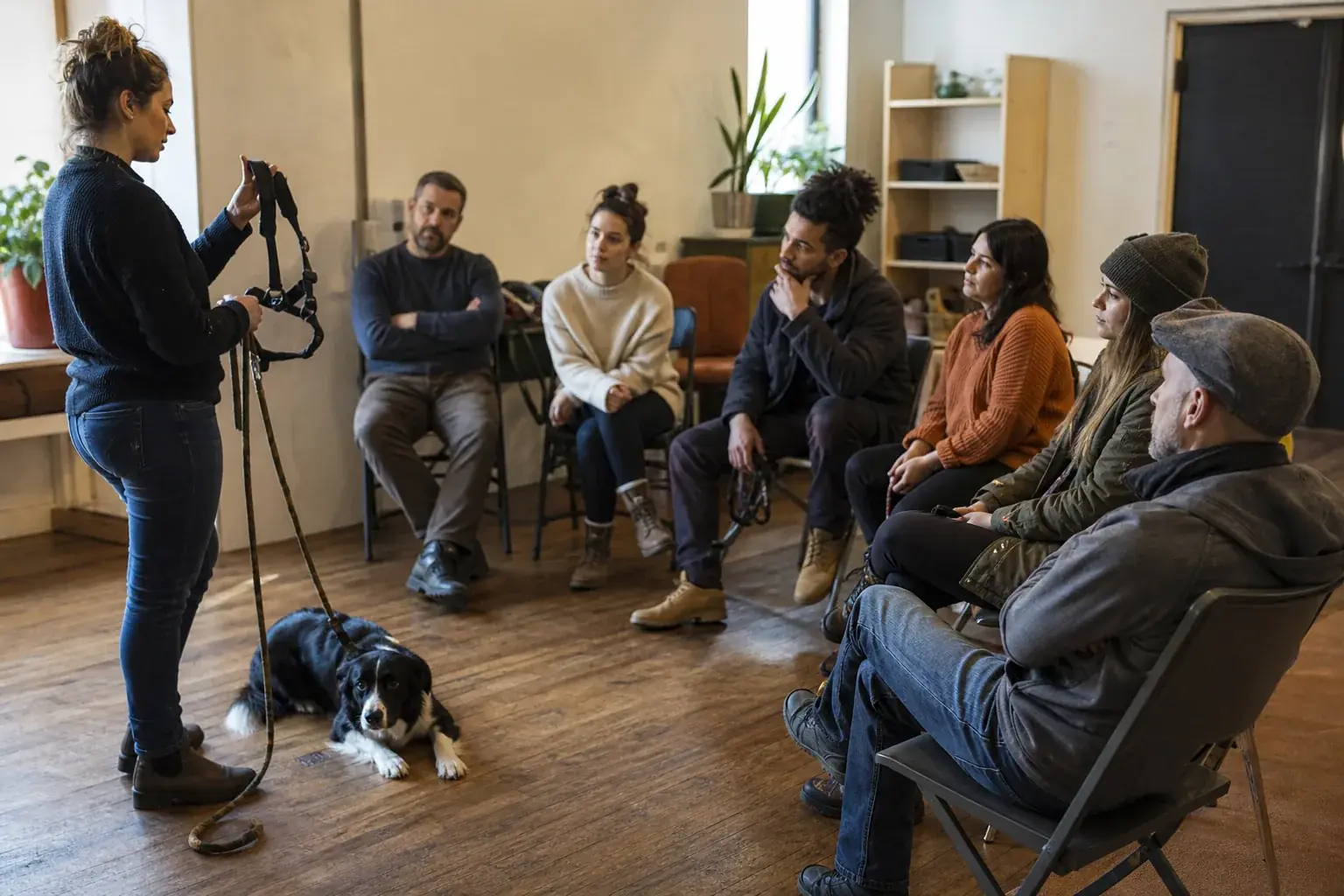
Advice on equipment looks at the purpose, the build, the behaviour and the environment in order to choose the right harn...
Write to us about what is actually happening with your dog. We will tell you which kind of service would help - and, if that is the case, that you need none of them.