Personalised activity plans
A personalised plan spreads exercise, scent work, training, play and rest across the week according to the dog and the f...

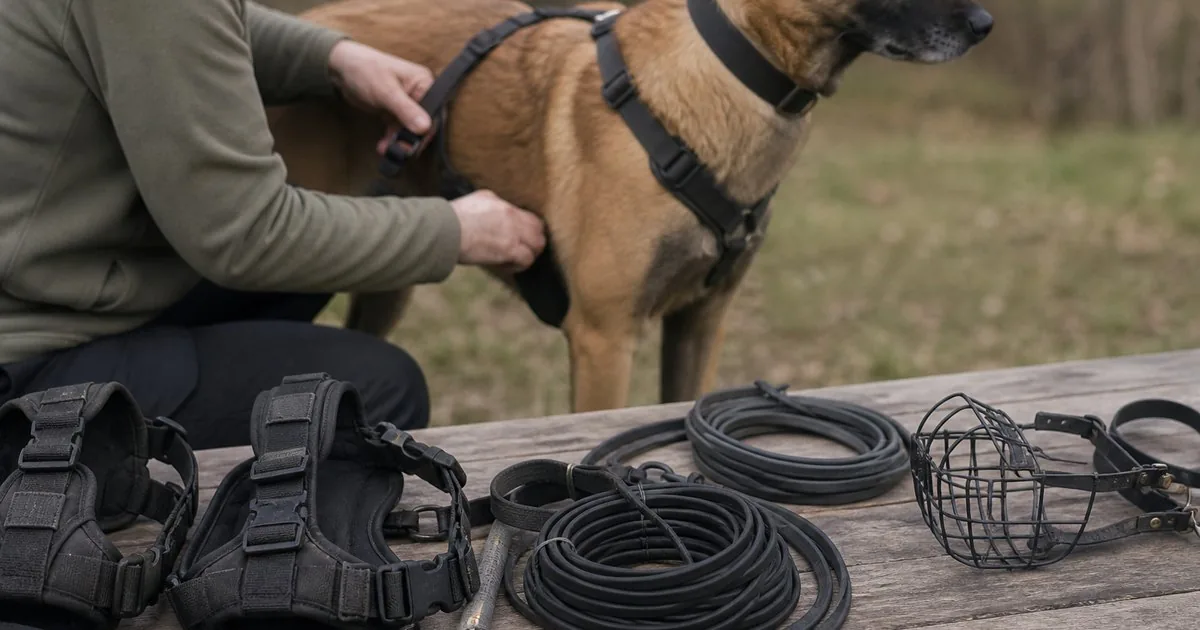
Advice on equipment looks at the purpose, the build, the behaviour and the environment in order to choose the right harness, collar, leash, muzzle or crate.
The collar, the harness, the leash, the long line, the muzzle, the transport crate and the toys are all tools. No piece of equipment solves a behaviour problem on its own, and the wrong choice can cause discomfort or risk. The advice starts from size, build, activity, behaviour and purpose.
A harness has to be adjusted so that it does not slip, does not rub and allows movement. The collar has to be checked regularly, especially with puppies or after changes in weight. For dogs at risk of escaping, redundancy can be used, with two suitable attachment points. The clips, the stitching and the straps are inspected before going out.
The length of the leash changes how it is used. A very short leash can keep constant tension on the dog, while a long line calls for technique so that it does not wrap round things or hurt your hands. A retractable leash can be right in some contexts and wrong in others; the owner has to understand the control it gives and the risks.
A muzzle can be a safety tool and must not be presented as a punishment. The model has to allow panting, taking treats and, where relevant, drinking. The conditioning is done gradually. Putting the muzzle on by force only at the moment of a difficult situation can increase the resistance.
For the car, the crate or the restraint system is chosen to suit the dog and the vehicle. The equipment has to be tested before the journey. Good advice explains both the advantages and the limits of the product, without selling the idea that an object replaces training.
It can be considered above all for puppies that grow fast, dogs at risk of escaping, and teams starting on walks, transport or specific activities.
No product solves pulling, reactivity or fear on its own, and a popular piece of equipment can be wrong for a particular body or purpose.
measuring and watching the movement; establishing the context it will be used in.
trying on and adjusting; instructing the owner and rechecking periodically.
Signs such as the skin rubbing, an altered gait, trying to get out of the harness, and freezing when the muzzle or the crate is brought out can show how the animal is experiencing the situation.
Beforehand you need information and resources such as correct measurements, photographs of the dog's build where that helps, a description of the activity, and a history of escaping and of sensitivities.
More useful criteria are the advantages and limits explained, the stitching and fastenings checked, no pressure to buy something unnecessary, clear goals and usable materials, and examples adapted to everyday life.
Good equipment supports training through safety and comfort, but behaviour is built through consequences, practice and management, not through the object itself.
equipment does not replace training; medical or restrictive devices call for competent advice. Among the risks to be discussed are the dog getting its head out of the equipment, breathing or panting being restricted, clips breaking, and injuries from using the long line incorrectly.
A good decision about advice on choosing equipment does not start from the idea that the same format has to work for everyone.
How a service is organised responsibly, how to recognise quality, where the limits are and what to ask before you pay - explained once, for all services.
This page explains the service, it does not sell it. Some of these we run ourselves, others happen at a veterinary practice, a grooming salon, or with people we work alongside.
Frequently asked questions
It can make sense above all for puppies that grow fast, dogs at risk of escaping, and teams starting on walks, transport or specific activities.
Useful information includes correct measurements, photographs of the dog's build where that helps, a description of the activity, and a history of escaping and of sensitivities.
When the recommendations concern one particular dog, you watch for the skin rubbing, an altered gait, trying to get out of the harness, freezing when the muzzle or the crate is brought out, fewer situations in which the dog has to be forced, and more predictable responses from the family.
equipment does not replace training; medical or restrictive devices call for competent advice.
Good equipment supports training through safety and comfort, but behaviour is built through consequences, practice and management, not through the object itself.
Services for owners
A personalised plan spreads exercise, scent work, training, play and rest across the week according to the dog and the f...
Travel advice organises the documents, the transport, the accommodation, the health matters, the equipment and the behav...
The aim is to build the dog's association with the crate, the vehicle, movement and short safe periods of waiting, step...
The advice helps the family organise the resources, the spaces, the walks and the interactions so that each dog has safe...
Online support offers clarification and feedback between sessions, usually based on a plan already agreed and on video r...
A monthly subscription can include regular sessions, activities, a review of progress and an updated plan once a basic c...

Write to us about what is actually happening with your dog. We will tell you which kind of service would help - and, if that is the case, that you need none of them.