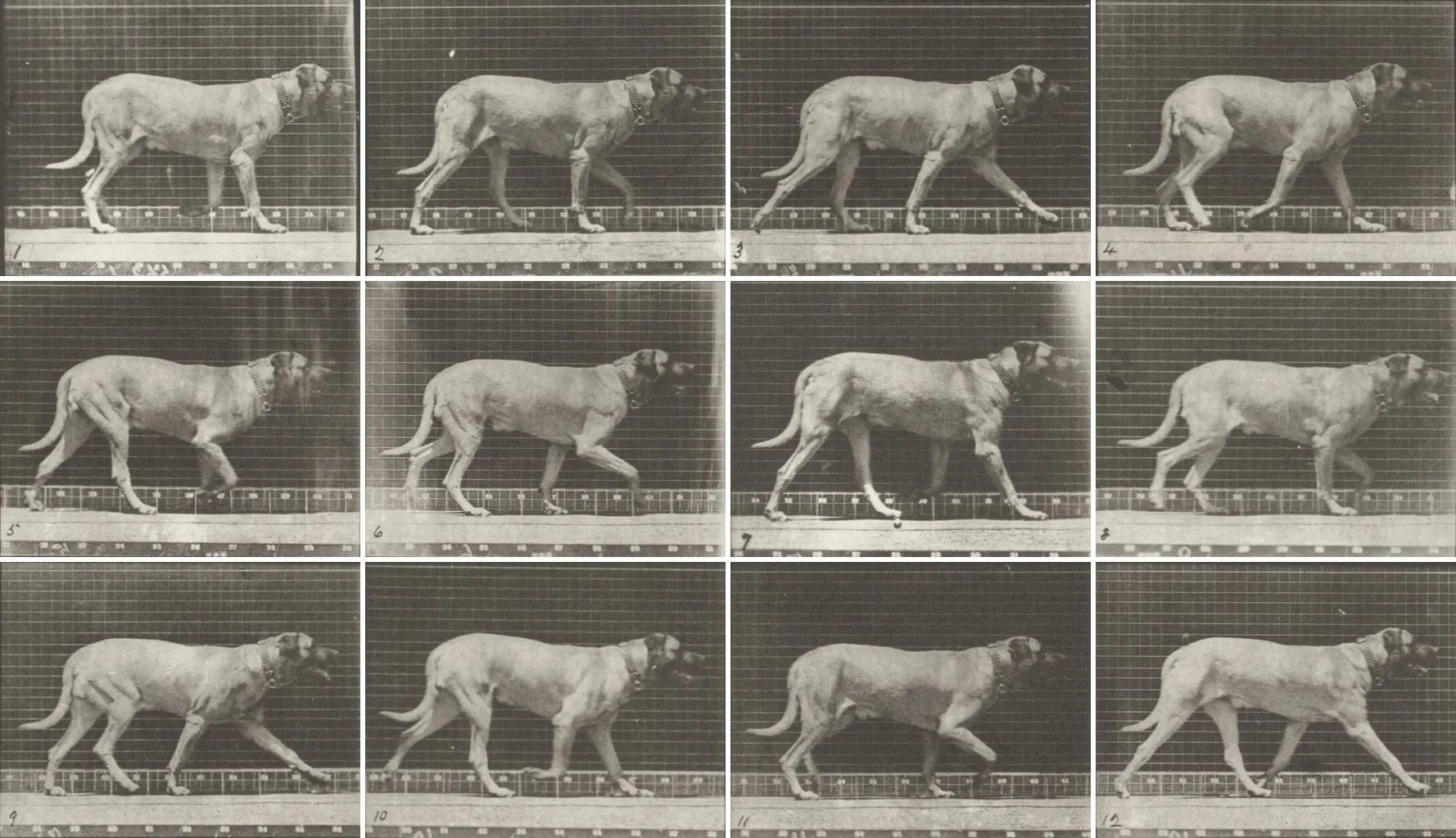
The walk
The walk is a four-beat gait: all the limbs land in turn, and for each limb the stance phase lasts longer than the swing phase. Alternately two and three limbs are on the ground. Dogs use a “lateral sequence” walk: a hind limb is followed by the forelimb on the same side.
A common confusion: the walk described as “diagonal pairs moving together” — that is the definition of the trot, not of the walk.
The trot
The trot is a two-beat gait: the right and left diagonals alternate in supporting the weight, that is the right forelimb moves together with the left hind limb, then the reverse. The hind limb of the diagonal touches the ground slightly before the forelimb, although they look simultaneous. Between the two diagonals there are brief moments of suspension.
The pace
The pace is also a two-beat gait, but with the lateral pairs: the two limbs on the same side support the weight alternately. In dogs it often appears in tired, overweight or untrained animals, which prefer the pace to the trot.
The canter (slow gallop)
The canter is an asymmetric three-beat gait: one hind limb, then a diagonal pair that touches the ground together, then the “leading” forelimb; suspension appears only at high speeds. It is often slower than the trot, but it passes easily into the transverse gallop: when the diagonal splits (the hind limb touches the ground before the forelimb), the gait becomes four-beat.
The leading limb: in the canter, the forelimb that is not part of the diagonal; in the gallop, the forelimb that touches the ground just before suspension. On a circle, the dog almost always leads with the forelimb on the inside of the circle; on a straight line it changes leads to rest its limbs or before turning.
The transverse gallop
Four beats and a single suspension: the hind pair, then the fore pair, in the same left-right order (for example left hind, right hind, left fore, right fore). The suspension comes after the leading forelimb leaves the ground. It is the “normal” gallop, that of the horse and the large ungulates; dogs and the other carnivores use it too.
The rotary gallop
Four beats and two suspensions, with a limb order that “rotates”: right hind, left hind, extended suspension, left fore, right fore, gathered suspension. The suspensions follow the lift-off of the second hind limb and the lift-off of the second forelimb. It is the dog's fastest gait, but also the most tiring: flexion and extension of the spine greatly lengthen the effective stride, compensating for the relatively short limbs. A greyhound can reach about 60 km/h.
What the animation shows and what it does not
The order in which the limbs touch the ground and the division into beats are those of veterinary anatomy. The stance durations drawn in the strip are a teaching scheme (the sources consulted give no numerical values for the duty factor), and the animated silhouette is a simplified drawing, not a biomechanical simulation. Real gait depends on conformation, age, fitness and weight.