Smell
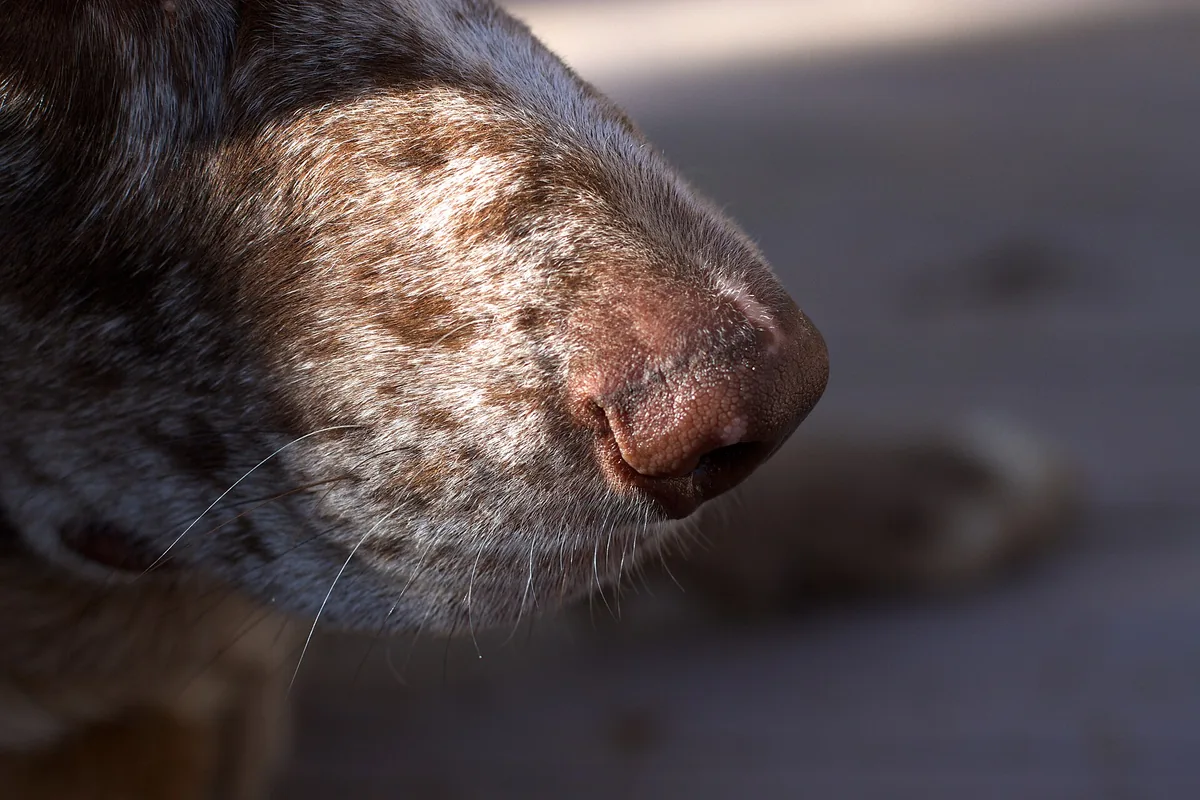
Sniffing in bursts of 4-7 per second, nostrils that take separate samples, the exhaled jet to the side, the olfactory recess isolated from breathing, hundreds of millions of sensory neurons and 1,094 receptor genes: the full path is described on the page “Journey of a scent”.
Sight
Neitz, Geist and Jacobs (1989) tested three dogs behaviorally and showed that their color vision is dichromatic: two types of cone pigments, with calculated peak sensitivity at about 429 and 555 nm. The dog does not see “in black and white”, but it distinguishes fewer hues than a (trichromatic) human.
Behind the retina, in the choroid, lies the tapetum lucidum, a reflective layer that sends light back through the photoreceptors and stimulates them a second time; hence the eyeshine in dim light.
Hearing
The pinna is mobile, and the dog can move the left and the right ear independently to locate sounds; the shape and size of the pinna differ greatly between breeds, which also changes the signals it can send with its ears. The often-quoted number of ear muscles was not found in a verifiable source; Sisson (1914) lists in the dog the scutularis, the anterior auricular muscles, the helicis, the antitragicus and the parotidoauricularis, besides “other auricular muscles”. For the range of audible frequencies we have not yet read the primary source (Heffner 1983), only its reproduction in Mason 2024.