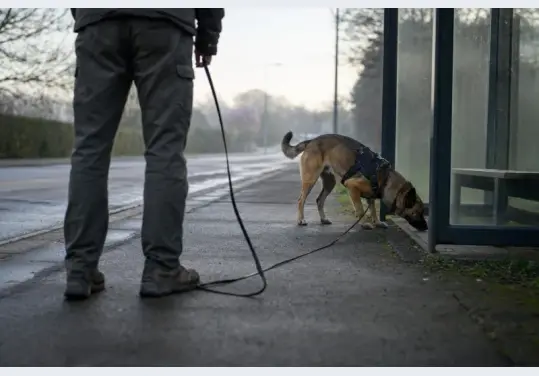
The IRO mantrailing test: what exam day actually looks like
You have passed the BH. At training your dog runs hour-old trails of half a kilometre and takes the junctions without you checking your watch, and someone in the gro...


The game “I Ask. I Wait. I Respect. – The Park Adventure” runs free in the browser at joc.mantrailing.ro/en and takes about twenty minutes. What stays with the child afterwards depends less on the game and more on the adult sitting next to them. A child aged 4 to 8 does not carry a rule from the screen into the park on their own: they need someone to ask the right question at the right moment and, on the next walk, to do exactly what they saw in the game.
This guide is for that adult: parent, grandparent, kindergarten teacher, primary school teacher. It does not repeat what the project is or where the three words come from; that is covered in our article about the project “Ask. Wait. Respect the Dog.”. This one is about how to use the game: what happens in each of the five encounters of the main adventure, what to ask at each one, what to do when the child gets it wrong, what the dog role is for, how it works in a classroom, and how to move the rules from the drawn park into the real one.
A few choices make the difference between “we played a game” and “we learned something”.
The park map has five numbered encounters, in order. Three of them give a badge piece: I ASK, I WAIT and I RESPECT. Nothing is locked and any encounter can be played at any time, but on the first run the order matters, because each scene picks up where the previous one stopped. Below, what happens in each one and what you can ask. The questions are the very ones the game offers teachers in classroom mode.
1. Running to the dog. The child sees a dog next to its owner and runs towards it. The question has only YES and NO: is it okay to run to the dog and pet it? If the child picks YES, this is the only encounter in the game where Toby actually bites: briefly, on the hand, with no wound, and the explanation says straight away that Toby warned first, that he is not a bad dog and that the owner is not to blame either. We did that on purpose: a child has to understand that a hand reaching out without asking can get bitten, and that the fault is not the dog’s. What you can ask: “How do you think Toby felt when the child ran at him?” and “What does a scared dog do?”. If the scene upset them, do not skip past it: name what happened (“Toby said stop, but the hand kept coming”) and move on to the second encounter, where the right way is shown.
2. I ask the owner. The child has stopped far away. How do they ask? The right answer is to ask quietly: “May I pet him?”. The other two, reaching out a hand and shouting “Hey, dog! Come!”, each have their own consequence. The most useful part comes next: the owner answers at random, differently every time. They may say “Yes, you can pet him, but let him come to you”, they may say “No, he is tired today” or “Better stay away”. After a “No”, the right answer is “Okay, thank you!”, with no begging and no creeping closer “just a little”. This is where the I ASK piece is earned. What you can ask: “What do we do when the owner says No?” and, above all, “The owner said Yes. Can we do anything we like with the dog?”. The answer to that second question is the subject of the next encounter.
3. The dog decides. The owner said “Yes”. The child stands still, hands down, and now the dog chooses: he may come over to sniff, stay by his owner, watch from a distance, turn his head away or back off. The game says clearly that whatever the dog chooses is fine. The child only gets a question if Toby backs away: follow him, call his name again and again, or stay put and leave him alone? This is where the I WAIT piece is earned, and the rule reads: “The owner said Yes, but the dog said No with his body.” What you can ask: “How does a dog say No without words?” and “How do we feel when someone says No to us?”.
4. Petting gently. Toby came over on his own and is sniffing the child. How do we pet him? Five options, one of them right: slowly, on the side, as the owner said, with the child’s face away from the dog’s face. The tight hug, the face next to his, the hand on the head and the kiss on the head each have a consequence, and on a second mistake of the same kind Toby reacts differently: he backs away, growls, snaps at the air or leaves for his owner. The child sees that the same gesture can have more than one outcome. This is where the I RESPECT piece is earned. At home, practise on a stuffed dog: “Show me where we pet. Where does your face stay?”. What you can ask: “Why don’t we hug dogs, although we hug people?” and “What do we do if the dog leaves while we are petting him?”.
5. What the dog’s body says. Six short situations, one after another: Toby turns his head away, takes two steps back, hides behind his owner, stands stiff, growls softly, pulls on the lead. They all mean the same thing, “I want space”, and all have the same right answer: we stop and call an adult. Growling gets its own explanation: it is talking, not meanness, and it is not punished. This encounter gives no badge piece, but it is the one worth spending more time on: after it, the child can “read” a dog. What you can ask: “Which signs show that a dog wants space?” and “Does a moving tail always mean a friendly dog?”.
After every wrong answer the same thing happens, and it helps to know in advance what is coming, so you do not step in too early. The action stops with “Stop! We stop here.”, just before the gesture has consequences. Then comes the screen “The dog’s perspective”: Toby drawn large, his state (scared, unsure, does not like it, wants space), his thought in the first person, and the list of signals his body is showing. Each signal can be tapped, and the game marks the spot on Toby where it shows: the turned head, the low tail, the ears pulled back. Next comes the rule, spoken by the child character (“I was wrong. I ran to the dog…”), and the “Try again” button, which rewinds the scene back to the question.
What you do meanwhile: at first, nothing. Let them hear Toby’s thought and tap the signals. Only after “Try again” ask what they would do differently, in their own words, before they tap. The game keeps no score, compares no children and never says “wrong again”. Do not add any of the three yourself. A mistake in the game is where the rule gets learned, not a test of courage or cleverness.
The second time you play, choose “Change role” on the map and then “I am the dog”. The same encounter is now seen through Toby’s eyes: a child is running at you, what do you do? The child chooses what the dog does: takes a step back, hides behind the owner, stands stiff, turns his head away. Every choice is accepted, because the dog is allowed to say “No”. There are 21 such moments in the game, and they do something explanations cannot: the child feels what “I want space” means before learning to recognise it in someone else. The question to ask afterwards: “When you were Toby, what would you have liked the child to do?”.
On the map, “All encounters” opens the full list. The 17 encounters outside the main adventure have no order and give no badge pieces; they are separate situations of three to four minutes each. The best time to play them is not “in sequence” but on the evening something similar happened: you saw a dog tied up outside a shop, a dog asleep in the shade, a child barking at a dog. Grouped, to help you find them:
“I am afraid of dogs” is worth playing with every child, not only the fearful ones: a friend who is petting the dog shouts “Come on, he’s good!”, and the lesson is that the other child’s fear counts, and that nobody goes near a dog just so a friend will not laugh.
The two mini-games start from the map and need no preparation. “The dog traffic light” shows a situation and asks for a colour: green, we can interact calmly; yellow, we stop and call an adult; red, we do not approach. A round has 8 situations out of 12, so it changes from one game to the next. After a few rounds, play it without a screen: “The neighbours’ dog is asleep on the stairs. Which colour?”. “Be a tree” practises what the child does when a strange dog comes towards them: no running, no screaming, no waving arms, no staring into the dog’s eyes, hands close to the body and, at the end, standing still for five seconds with a finger held on the screen. This is the mini-game to repeat in the living room too, with you as the dog that comes over, sniffs, gets bored and leaves.
Teacher mode starts from the game’s opening screen, under “For teachers”, or by opening joc.mantrailing.ro/en?teacher=1 directly. On a projector, every question comes with a voting panel: press “+” next to each option to count raised hands, then “Reveal the answer”. The “Why?” button explains the right answer, “Show the consequence” plays the most-voted wrong option, complete with the dog’s perspective, and “See the dog’s perspective” shows it at any time. Nothing moves on by itself: the animation waits until the class is ready. When the owner answers or the dog decides, you pick the option, so the class can see that the same situation can unfold in different ways. Under every question are the “Discussion questions”, the ones you saw above.
A 30-minute activity that works: encounters 1, 2 and 3 in teacher mode, with a vote and a discussion at each, then “The dog traffic light” with the whole class. A second activity: encounters 4 and 5, then “Be a tree” played physically, with all the children standing. The game has subtitles, high contrast, large text, a reduced-motion option, and can be driven from the keyboard: 1 to 4 pick an answer, Enter confirms, M mutes the sound, Esc goes back. The game can also be placed on a school’s website, on request.
The rules move from the game to the park on the first walk, and the adult moves them, not the child. Children this age copy what they see: if you reach out to a dog without asking, the game was for nothing. So, at the first dog with an owner you meet: stop far away, let the child say the three words, ask the owner out loud, take a “No” with an “Okay, thank you!”, and if the answer is “Yes”, keep your hands down and wait for the dog to come to you. Afterwards, however it ended, one single question: “What did the dog say with his body?”.
The same rules apply to the family dog. A dog that is sleeping, eating or has its toy is left alone at home too; a child who understands that with Toby understands it with their own dog. The child stays under an adult’s eye: no learned rule replaces a parent who is in the room.
At the end of the main adventure, once the child has all three pieces, the game shows the rules they learned. There are ten, in the game’s own words, and they are worth printing:
What age is the game for? 4 to 8: short sentences, icons on every answer, a voice for all the text. Older children enjoy it in the dog role and make good discussion partners in teacher mode.
How long does it take? One encounter, three to five minutes. The main adventure, with its five encounters, around twenty minutes. It does not have to be finished in one day: progress is saved in the browser.
Does the child need to read? No. Everything on screen is also spoken, with different voices for the narrator, the child, the dog and the owner. The voice can be turned off under “Accessibility”.
Does it cost anything? Does it need an account or personal data? No. The game is free, needs no account and sends no information anywhere. Progress is saved only on the device it is played on.
My child got scared in the first encounter. What do I do? The bite scene is short and there is no wound, and the explanation follows immediately. Talk about what Toby said beforehand, then jump to the second encounter or to “The dog decides”: nothing is locked, and it can be played in any order.
Is there a Romanian version? Yes, with the same content, at joc.mantrailing.ro/ro.
The game is part of the educational project “Ask. Wait. Respect the Dog.”, run by Mantrailing.ro together with EcoJunior.ro, alongside presentations in schools and kindergartens, demonstrations with accredited trainers and rule posters. If you teach and want the project in your classroom, the sign-up steps are on the project page. And if you are a parent, you already have everything you need: a child, twenty minutes, and a game that lets them get it wrong where it does not hurt.
See also on the site:
Articles
You have passed the BH. At training your dog runs hour-old trails of half a kilometre and takes the junctions without you checking your watch, and someone in the gro...
More than 3.67 million dogs in RECS, Romania's registry of owned dogs, are recorded as mixed-breed or "common breed". If uncontrolled breeding stopped today, the fir...
Around October, handlers who started mantrailing in the summer notice something odd. The dog has "improved" overnight. Forty-minute trails it lost at the first junct...
Events


