In a park, the entire situation can unfold in just a few seconds. A child notices a dog, runs towards it and reaches out to pet it. Sometimes the child jumps off a bicycle or scooter directly in front of the dog. Other times, they shout, bark playfully, wave their hands or bring their face close to the dog’s muzzle.
To the child, these gestures may express curiosity and affection. To the dog, however, the same behaviour may feel surprising, uncomfortable, frightening or difficult to escape.
The problem is not that the child does not love animals. In most cases, no one has taught them how to approach a dog correctly.
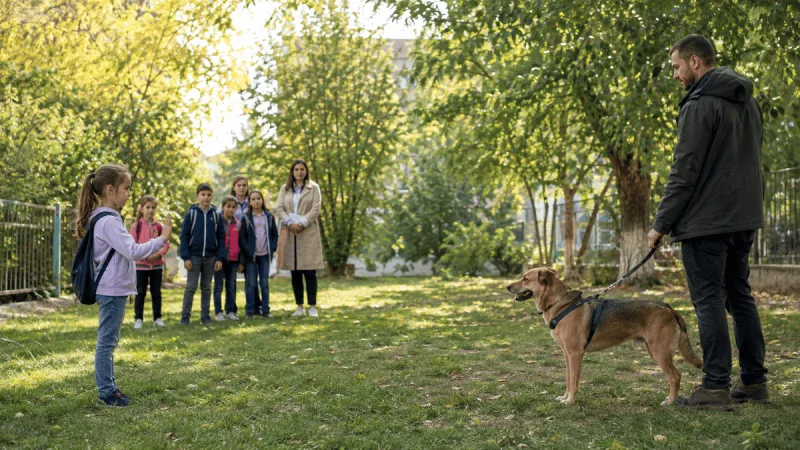
This need inspired the educational project “Ask. Wait. Respect the Dog.”, organised by Asociatia Drumetii Montane through Mantrailing.ro and EcoJunior.ro.
Three simple words that can change an interaction
The main message of the project can be remembered by every child:
Ask.
Before approaching a dog, I identify the owner, keep my distance and ask for permission.
Wait.
Asking does not automatically mean that I can approach. I remain where I am and wait for the owner’s answer and instructions.
Respect the dog.
Even when the owner says “yes”, the dog may still say “no”. If the dog turns its head away, retreats, hides, stiffens its body or growls, I stop.
The owner’s permission allows us to attempt an interaction. The dog decides whether it wants to participate.
A dog is not a toy
Children need to understand that dogs have emotions, preferences, fears and personal boundaries. A dog may want to play on one day and prefer to be left alone on another.
Dogs also communicate through more than barking or tail movement. Their entire body provides information.
A dog that turns its head away, retreats or becomes physically tense may be asking for space. Growling should not be treated as a challenge or as behaviour that a child should punish. It is an important warning.
The correct response is to stop the interaction and ask an adult for help.
Another important lesson is that a wagging tail does not always mean that a dog is happy or ready to interact. Children should not be expected to evaluate unfamiliar dogs by themselves. The safer rule is simple: ask the owner and wait.
Prevention must be practised
The project does not aim to turn children into canine behaviour specialists. It also does not try to convince them to pet every dog they meet.
The objective is more practical: every child should know what to do in order to remain safe around dogs.
For this reason, school activities are not designed as presentations in which children sit and listen for 45 minutes. The rules are transformed into games, demonstrations and practical exercises.
The Dog Traffic Light
Children receive different scenarios and choose the appropriate colour:
- Green – the owner has allowed the interaction, the dog appears relaxed and voluntarily approaches the child;
- Yellow – we are not sure what the dog is communicating, so we stop and ask an adult for help;
- Red – the dog is eating, sleeping, growling, hiding, trying to leave or is tied up without its owner nearby. We do not approach.
The game teaches children that when they are unsure, the safest decision is to stop.
Be a Tree
Another practical lesson teaches children what to do when an unfamiliar dog approaches them.
The child should not run, scream, hit the dog, wave their arms or stare directly into the dog’s eyes.
Their feet become the “roots” and remain still. Their hands stay quiet and close to the body, while their voice remains calm.
A tree does not run. A tree does not scream.
It is a simple exercise that children can practise in the classroom and remember whenever they encounter an unfamiliar dog.
The rule that is never negotiable
One of the most important rules of the project is:
“My face stays away from the dog’s face.”
Children should not place their face close to a dog’s muzzle, kiss the dog, lean over it, hug it around the neck or take photographs with their face pressed against the dog’s head.
This rule also applies to the family dog, even if the dog is gentle, well trained and has been petted by the child hundreds of times.
A dog may be tired, startled, uncomfortable or experiencing pain. Respecting its personal space remains important during every interaction.
What does this project have to do with mantrailing?
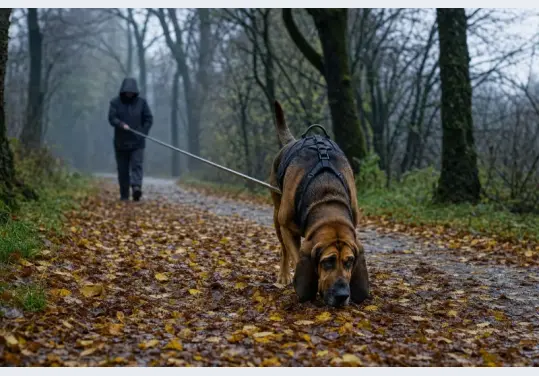
Mantrailing teaches us to observe the dog, respect its working rhythm and understand the extraordinary role that scent plays in the way dogs experience the world.
Humans discover their surroundings primarily through sight. For dogs, the nose is one of the main tools used to identify people, animals, routes and changes in the environment.
During project activities, children may take part in demonstrations and games that show how scent works and why dogs can detect information that people cannot see.
This helps children understand that a dog is not simply an animal to be petted. It is a living being that experiences the world in a complex way that is very different from our own.
We are looking for accredited dog trainers across Romania
To bring these lessons to as many communities as possible, the project aims to develop a national network of accredited dog trainers, teachers, volunteers and educational institutions.
Accredited dog trainers can participate as volunteers or contribute to locally organised activities such as:
- presentations in schools, kindergartens and after-school programmes;
- demonstrations of canine body language;
- practical exercises for children;
- demonstrations involving scent and the canine sense of smell;
- meetings with parents;
- educational and community events;
- supervised child-dog interaction scenarios.
The objective is not to promote a particular trainer or a single training method. We want the same clear rules of prevention and respect to reach children throughout the country.
Accredited dog trainers who would like to join the project can find additional information and the registration form here:
https://www.mantrailing.ro/ro/dresaj-canin/intreb-astept-respect-cainele
How can a school participate?
Starting in September, teachers, educators and representatives of schools, kindergartens and after-school programmes can organise educational activities through the EcoJunior.ro network.
Teachers can register their institution, generate the required educational partnership and prepare activities together with the project team and the collaborators available in their area.
Information for educational institutions and the participation process are available here:
https://www.ecojunior.ro/comunicate-de-presa/intreb-astept-respect-cainele-proiectul-care-ii-invata-pe-copii-sa-interactioneze-in-siguranta-cu-cainii
Loving dogs begins with respecting them
A child does not need to pet every dog they meet in order to prove that they love animals.
Sometimes, the most meaningful form of respect is keeping a safe distance. At other times, it means asking for permission, waiting for an answer and accepting a “no”.
Through education, practical exercises and community involvement, we can help children become more responsible and create safer interactions between people and dogs.
Ask. Wait. Respect the Dog.
Before every touch. Every time.