Six in the morning, a patch of white foam on the floor, and an hour later the dog eats his breakfast as if nothing happened. Another house: the dog brings up yellow liquid on an empty stomach, several mornings in a row. A third: he has vomited four times since last night, will not look at food and is lying with his chin on the floor, staring at nothing. The first two usually have a simple explanation and can be talked through with your vet on the phone or at the next check-up. The third cannot wait. This page shows you how to tell them apart, what to write down, what your vet will ask and what not to do at home. What you will not find is something to give him "to settle his stomach": with a vomiting dog, the vet first wants to know why, and the answer comes from feeling his belly, sometimes from an X-ray.
When vomiting cannot wait until tomorrow
- he is trying to vomit and nothing comes up, or only a little froth; he is restless, pacing, drooling, and his belly is swelling as you watch. In a big, deep-chested dog (German Shepherd, Great Dane, setters, Labradors too), this is what a twisted stomach looks like. Head for the nearest open clinic and phone from the car, because minutes count here;
- he is vomiting fresh red blood or something that looks like coffee grounds (digested blood), or his stool is black as tar;
- he has vomited more than two or three times in a few hours and cannot keep even water down;
- a puppy under six months or an old dog is vomiting and not eating. In puppies, vomiting with foul-smelling diarrhoea means parvovirus until shown otherwise;
- he is flat and will not get up; his gums are pale, yellowish or tacky, his eyes look sunken, and a pinch of skin on the back of his neck does not spring back;
- his belly hurts: he stands hunched, groans when you lift him, or lies with his chest on the floor and his bottom in the air;
- he may have swallowed something: a sock, a broken toy, a corn cob, a bone, string or thread (look under his tongue too), fruit stones; or he got at chocolate, grapes, raisins, sugar-free chewing gum, your medicines, rat poison, antifreeze;
- an unspayed bitch is vomiting and drinking a lot 4 to 8 weeks after a season, with or without discharge. Pyometra needs emergency surgery;
- the vomiting comes with trembling, heavy drooling, disorientation or fits: poisoning until shown otherwise;
- he has been vomiting for more than 24 hours, even if only now and then, or has eaten nothing for a day.
If you are heading to the clinic, take the packaging of whatever you think he ate and a photo of the vomit. On the phone, say how many times he has vomited, since when, what came up and whether he is drinking. A small dog can dehydrate in a single afternoon.
What to watch for and note at home
Vomiting has dozens of causes, from a meal wolfed down too fast to kidney disease. The vet sorts them by the history, and you are the one holding the history.
Vomiting or regurgitation? People mix them up all the time. Vomiting takes effort: he tenses, his belly heaves several times, often he drools and swallows repeatedly first, then up comes partly digested food, frequently with bile. Regurgitation is effortless: he lowers his head and the food just drops out, undigested, sometimes in a tube shape, a few minutes after eating, with no heaving. Repeated regurgitation points to the oesophagus, and that means a different set of tests. If you are not sure what you saw, film it next time. Ten seconds of video shortens the consultation.
What came up. Undigested or digested food, yellow-green liquid, white froth, blood, bits of toy, grass, hair, worms. Take a photo, yes, even of vomit.
When. The time and how it relates to meals (straight after, a few hours later, in the morning on an empty stomach, at night), and how many times in 24 hours. Yellow vomit in the morning, in an otherwise healthy dog fed once a day, usually comes from the stomach being empty too long. Your vet may suggest splitting his ration, but that is their call, once everything else has been ruled out.
The rest of the dog. Whether he is eating, drinking, weeing, passing stools, and what the stools look like. Note too whether he has been drinking more than usual for a few weeks. In a dog over eight, vomiting plus heavy thirst calls for blood tests, not patience. Add his weight to the notes, and what his belly looks like.
What he could get at. The bin, party leftovers, the compost heap, broken toys, socks, garden stones, houseplants, a handbag with chewing gum and medicines in it. Ask everyone in the house what they gave him. Children usually know, if you ask without telling them off.
His history. Vaccinations, last worming, any current treatment (some cause nausea), known conditions, operations, the last time he vomited like this and what it turned out to be.
In training we see dogs who, after a trail, gulp cold water too fast with a stomach full of air from panting and bring up a little froth. Once, in an otherwise healthy dog, it is nothing to panic about. Twice a week is a different conversation.
What you see and what the vet thinks of first
| What you see |
First ideas |
When to see the vet |
| One vomit with food; he is bright and eats afterwards |
Ate too fast, too much or something unsuitable |
If it happens again the same day |
| Yellow liquid in the morning on an empty stomach; otherwise well |
Bile on an empty stomach |
Book an appointment; note mealtimes until then |
| White froth a few times; bright dog |
Empty stomach; a productive cough mistaken for vomiting |
If it repeats or a cough appears |
| Retching with nothing coming up; swollen belly; restless |
Twisted stomach (bloat) |
Now, on the way to the clinic |
| Repeated vomiting plus diarrhoea, in a puppy |
Parvovirus; worms; foreign body |
Today |
| Repeated vomiting, pain, cannot settle |
Foreign body; pancreatitis |
Today |
| Vomiting plus heavy thirst, older dog |
Kidneys; liver; hormonal disease |
Appointment in the next few days, with blood tests |
| Vomiting, thirst, unspayed bitch after a season |
Pyometra |
Today |
| Vomit with blood or like coffee grounds |
Ulcer; foreign body; poisoning; clotting disorder |
Today |
The table helps you put some order on what you are seeing. The diagnosis is made by the vet, with a hand on the dog's belly.
What the vet will check
- The questions. The ones above, plus anything you have filmed or photographed.
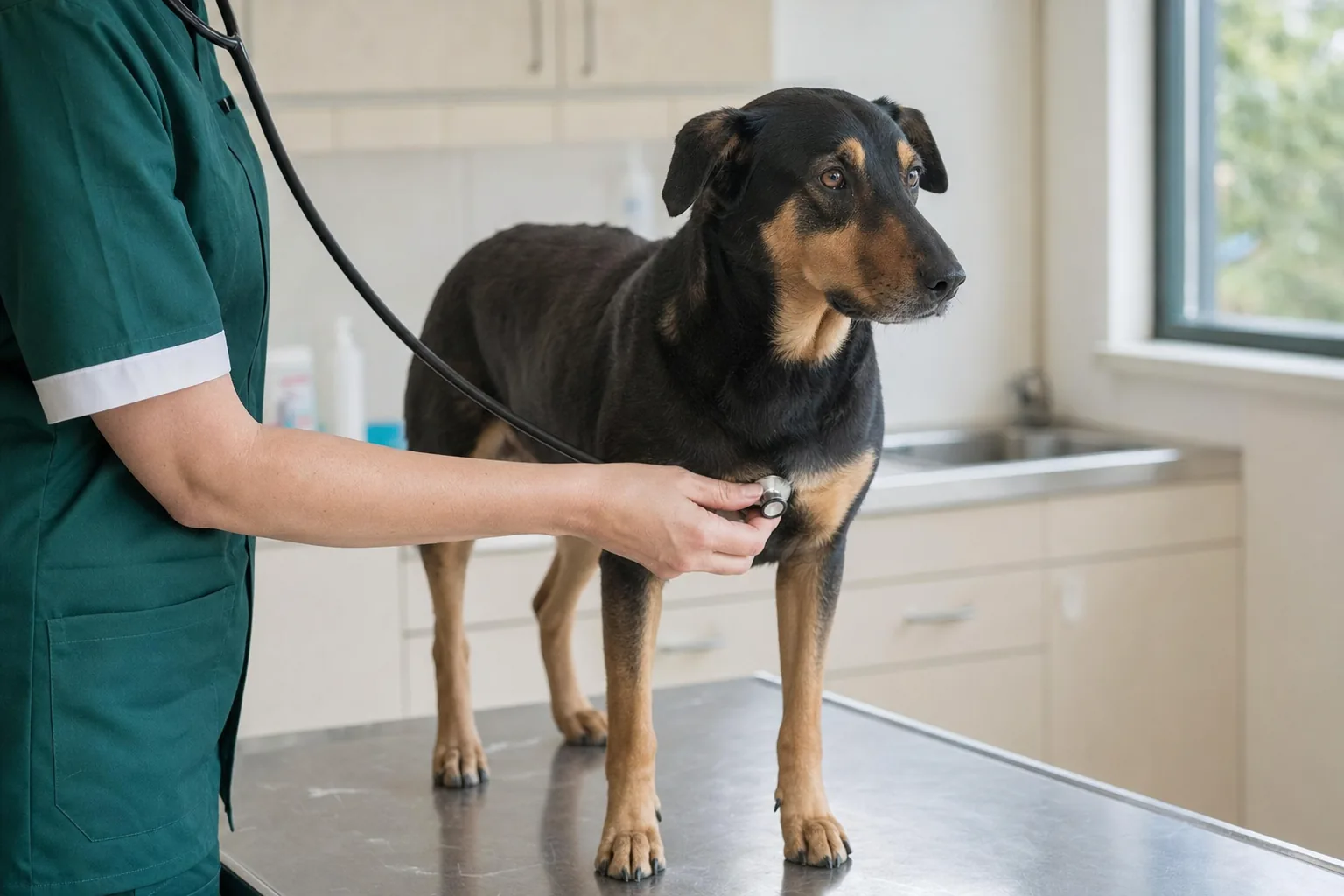
- The physical exam. Temperature; gums (colour, how moist they are, how quickly colour returns after pressing); the skin pinch; a slow, careful feel of the abdomen for pain, a lump, swollen loops of gut or a stomach full of gas; the mouth and under the tongue, looking for a thread; lymph nodes; heart and lungs; the scales.
- Blood tests. A full blood count; biochemistry for kidneys, liver, blood sugar and protein; electrolytes, which vomiting throws off quickly; a pancreas test when the picture fits. In puppies, a quick parvovirus test on a stool sample.
- Urine. How concentrated it is tells the vet a lot about the kidneys and how dehydrated he is.
- Imaging. An abdominal X-ray shows a foreign body, gas or a twist; ultrasound shows the pancreas, the walls of the stomach and gut, the womb in females, the liver and kidneys. When a plain X-ray does not settle it, sometimes a contrast X-ray or an endoscopy follows, and an endoscope can also remove the object.
- The plan. For simple acute vomiting in an adult: a short break from food, set by the vet according to weight and age (not in young puppies), water little and often, then a bland transition diet in small portions, with a recheck at 24 to 48 hours. If he is dehydrated, fluids on a drip, either with daily visits or as an inpatient. Anti-sickness medication, if needed, comes after the vet has ruled out a foreign body, because with a blockage it would hide the one sign you can see. A foreign body comes out by endoscopy or surgery. A twisted stomach needs stabilising and emergency surgery. A chronic condition (kidneys, liver, pancreas, gut) means long-term treatment and diet.
Before you leave, ask when and with what to restart food, and which signs should bring you back the same day. Type them into your phone while you are still with the vet.
What not to do at home
- Do not try to make him sick with salt, with bathroom-cabinet solutions or with a finger down his throat. Some swallowed substances do more damage on the way back up, and salt in quantity is a poison in its own right. If he has swallowed something dangerous, ring and go; clinics have controlled ways of doing it.
- Do not give human medicines for nausea, pain or "for the stomach". They are not made for dogs, and some harm them directly.
- Do not give leftover veterinary anti-sickness medicine from an old episode or another pet before he has been seen. If there is a foreign body, he stops vomiting but the object stays inside, and you can no longer see anything.
- Do not take his water away completely. If he brings water back up as well, ring the vet. If he keeps it down, offer a little and often. A full bowl gulped in one go comes back up two minutes later.
- Do not force him to eat "to keep his strength up". No milk, no fatty leftovers, no bones.
- Do not pull on string or thread hanging from his mouth or from under his tail. The thread may be caught in the gut, and pulling can saw through the intestine from the inside, with no anaesthetic, on your kitchen floor. Cut only what is hanging out, level with the skin or the lips, and go to the clinic.
- Do not wait with a swollen belly, not even an hour. A twisted stomach kills within hours.
- Do not blame it all on grass. Plenty of dogs eat grass and vomit afterwards. When the vomiting keeps happening, the grass is a detail in the diary and the cause lies somewhere else.
- Do not leave an unspayed bitch on "let's see tomorrow" when she is vomiting and drinking a lot a few weeks after a season.
Occasional vomiting
A healthy dog does vomit now and then, once every few months, for no obvious reason and with no after-effects. If you have noted the dates, you already have the answer to the vet's "how often?". Once the episodes become weekly, even if each one looks trivial, you are dealing with a chronic symptom. It gets investigated before he starts losing weight.
A dog who vomited once and is asking for food an hour later is not a case. One who has vomited twice a week for the past month is a case nobody has opened yet. If you do not have a regular vet, our page on related services helps you choose a practice.
The information on this page is educational and does not replace an examination. For full details and a diagnosis, consult your dog's own veterinarian.