Five in the morning, the dog whines at the door and doesn't make it outside. That's one situation. Here's another: an adult dog, bright and happy, who for three days has been passing soft stool streaked with mucus, four or five times a day, and straining at the end with nothing more to show for it. And a third: a three-month-old puppy who was sick once in the night and now has watery diarrhoea with a smell you won't forget. The first usually sorts itself out within two days. The second means taking a stool sample to the practice. The third means ringing your own vet this morning, before you've had your coffee. This page covers how to tell them apart, what to write down and what happens at the appointment. What it won't tell you is what to give him. Without tests we don't know, and your vet can't know over the phone either.
When to ring the vet today rather than tomorrow
In adult dogs, most bouts of diarrhoea come from something they ate and are over quickly. This list is for the rest:
- blood in the stool: bright red and plenty of it (more than a few streaks at the end), or black, sticky and shiny like tar; black means digested blood, coming from the stomach or the small intestine;
- watery, foul-smelling diarrhoea in a puppy under six months or one that hasn't finished its vaccinations, especially if it's vomiting and lying flat: parvovirus moves in hours;
- vomiting and diarrhoea together, and water won't stay down;
- a dog who won't get up, with pale or tacky gums, sunken eyes, and skin at the scruff that stays tented when you let go;
- a belly that's hard, swollen or sore to the touch; a hunched dog, or one in the "prayer position" with chest on the floor and bottom in the air;
- stool like raspberry jam that turns up out of nowhere in a small or medium dog; acute haemorrhagic diarrhoea can dehydrate him within hours;
- any chance he got into the bin, rat poison, your own tablets or something he could swallow (socks, toys, a corn cob);
- diarrhoea in an old dog, in one with a known condition (kidneys, heart, diabetes) or in one on daily medication;
- soft stool for more than two days in an otherwise healthy adult, or diarrhoea that keeps coming back every few weeks.
On the phone, say what order things happened in and how long since he last ate or drank. Bag up a stool sample if you can. And keep size in mind: a two-kilo puppy has nothing in reserve. What would be a rough day for an adult Labrador is dehydration by evening for him.
What to watch and write down at home from day one
Your vet reads diarrhoea by its pattern, and the only person who sees that pattern is you, in the days before the appointment. Grab a notebook or the notes app on your phone and start at the first soft stool.
The stool. How many times a day and how much each time. Consistency: soft but formed, porridge, or water. Colour: brown, yellow, green, black, red, or grey like clay. Then anything else in it: shiny mucus, blood, undigested bits, worms, string, plastic, grass, splinters of bone. Take a photo. Vets look at photos of poo all day long, nobody will laugh at you, and a picture shows what you can't describe.
Which kind of diarrhoea. There are two broad patterns. The first is a large amount, not very often, and the dog loses weight. That points to the small intestine. The second is little and often, with mucus and straining, sometimes a few drops of fresh blood at the end. That's the large intestine, colitis. Colitis looks scarier and is usually the milder of the two. The quiet pattern with weight loss is the one to take more seriously.
The rest of the dog. Is he eating? Drinking, and how much? Peeing as usual? Being sick? Playing or lying about? Warm ears tell you nothing about a temperature. The only reading that counts is a rectal thermometer, and anything over 39.2 °C is a fever. If you have scales, weigh him on day one and day three. On a small dog, 200 grams gone will show on the scales before it shows on him.
Everything he ate in the last 72 hours. His usual food and any change (from what to what, how suddenly). New treats, scraps from the table, bones. Whatever he hoovered up in the park or the bin, compost, water from puddles or a lake. That list alone explains a lot of acute diarrhoea.
The background. When he was last wormed and with what. His vaccinations (bring the card). Contact with other dogs, kennels, trips, any recent upheaval like a house move or visitors. Medication he's on now. If you have more than one dog, note who else has a soft stool and who doesn't.
The sample. About the size of a walnut, fresh, from the day of the appointment, in a bag or a clean pot, kept cool until you leave. If the diarrhoea has been going on a while or the vet suspects Giardia, you may be asked for samples from three different days, because parasites don't turn up in every stool.
Until you get there: water whenever he wants it, a warm quiet spot, frequent trips outside with you and a bag right behind him. Everything else you decide with the vet.
The common causes at a glance
| What happened |
What it usually looks like |
When to see the vet |
| Ate something he shouldn't: rubbish, fatty scraps, a sudden change of food |
Soft to watery, dog bright, no blood, clears in 24–48 hours |
If it hasn't cleared in two days or another sign appears |
| Parasites (worms, Giardia) |
Soft stool on and off, sometimes greasy or with mucus; puppy with a pot belly; slow weight loss |
Over the next few days, with a stool sample |
| Stress: kennels, house move, visitors |
Colitis: little and often, mucus, sometimes streaks of blood, a day or two after the event |
If it lasts more than two days |
| Virus in an unvaccinated puppy (parvovirus) |
Watery, bloody, foul smell; vomiting; puppy flat and off his food |
Now |
| Acute haemorrhagic diarrhoea |
Sudden red jelly, dog subdued, usually a small or medium breed |
Today |
| Pancreatitis, often after a fatty meal |
Vomiting, painful belly, hunched posture, yellowish stool |
Today |
| Food intolerance, inflammatory bowel disease |
Soft stool that keeps coming back for weeks; weight loss; itchy skin in some dogs |
Book an appointment, and don't leave it for months |
| Partly blocked foreign body |
Repeated vomiting, small amounts of watery diarrhoea, pain, can't settle |
Today |
Use the table to get your bearings and nothing more. On day one, very different causes produce the same watery stool, and only the history and the tests tell them apart.
What the vet does at the appointment
- Asks questions. The same ones as above. With your diary in hand this takes two minutes and doesn't rely on what you remember from three in the morning.
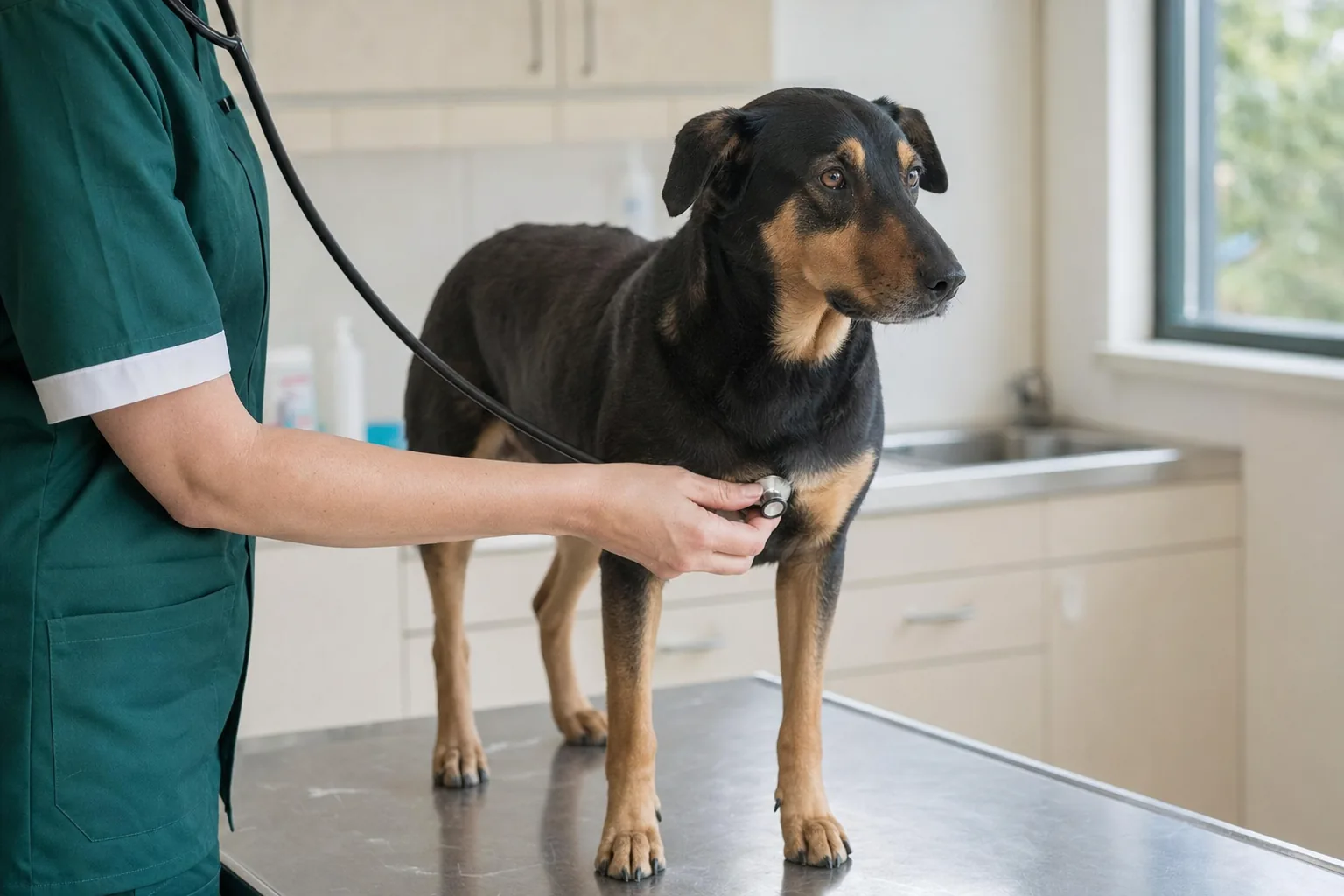
- Examines him. Temperature, gums (colour, how moist), the skin at the scruff, pulse. A feel of the belly for pain, thickened loops of gut, gas or a mass. A listen to the gut, a trip to the scales, and sometimes a rectal exam, which also gets a sample.
- Tests the stool. Flotation for worm eggs, a quick test for Giardia, and in puppies with the right signs a quick test for parvovirus. One negative sample doesn't rule out parasites, so the test is sometimes repeated.
- Blood tests, if he's dehydrated, flat, feverish or this isn't the first episode: a full blood count and biochemistry (kidneys, liver, proteins, electrolytes), sometimes a pancreas test. When episodes keep coming back with no explanation, the vet may also look for hormonal conditions that mimic a gut problem.
- X-ray or abdominal ultrasound, if the examination or the history raises questions: a foreign body, intussusception, pancreatitis, a thickened gut wall.
- The plan. For an adult with simple acute diarrhoea: rehydration, at home or on a drip depending on how much he's lost; a transition diet the vet works out for your dog's weight, in small frequent meals; worming if the test calls for it; a check-up at 48 hours. For puppies and severe cases: hospitalisation, fluids and monitoring. Chronic diarrhoea is a longer road, with an elimination diet over several weeks, targeted tests and sometimes ultrasound with biopsies.
Before you leave, ask two things and write the answers down: which signs mean you come straight back today, and how to move him back onto his normal food.
What not to do at home, however tempting
- Human medicines. Nothing for diarrhoea, for pain or "for the stomach". Some harm dogs outright. Others stop the diarrhoea and keep inside exactly what needed to come out, whether that's a toxin or an infection.
- Leftover medication from an old illness or another dog. Most diarrhoea doesn't need it, and when it does, the vet picks the product and the amount.
- Withholding food without talking to the vet in puppies, small dogs or old dogs. A two-kilo puppy can go hypoglycaemic within hours. Whether he goes without food, and for how long, is the vet's call, based on his weight and age.
- Taking his water away. He's losing water at the other end, and dehydration is the real danger. If he brings water back up, ring the vet.
- Diets off the internet. Milk, cheese, fatty meat, table scraps, and for a dog who is vomiting, not even chicken and rice. A transition diet makes sense for a bright adult, on your vet's advice. If he could have pancreatitis or a foreign body, any food you give at home makes things harder.
- Waiting until tomorrow when you see blood, when he's vomiting as well, when he's lying flat or when he's a puppy.
- Another sudden food change to fix the first one. Switching foods takes 7–10 days, with a little more of the new one each day, slowly enough that you never see a difference in the stool.
- Leaving it in the garden or the park. If it's Giardia or worms, you're contaminating the place where your dog and everyone else's play.
- Supplements, herbal teas or the neighbour's remedy before the appointment. They can mask the signs or delay a diagnosis that matters.
When it keeps coming back
People say a dog has "a sensitive stomach" when he has one bout a month with good weeks in between. What he really has is a cause nobody has found yet. It might be a parasite slipping past the tests, an intolerance to a protein in his food, or sometimes inflammatory bowel disease creeping in slowly. Keep the diary from the first episode and take it to the vet with dates. Two episodes written down tell more than six recalled from memory. If the vet suggests an elimination diet, it runs for eight weeks and "near enough" doesn't count: one treat slipped to him by a child during a game ruins the trial.
An adult with straightforward diarrhoea is back on his feet in two or three days, and you're left with a diary to open next time. If you don't have a regular vet yet, our page on related services helps you choose a practice now, rather than at five in the morning with the dog at the door.
The information on this page is educational and does not replace an examination. For full details and a diagnosis, consult your dog's own veterinarian.