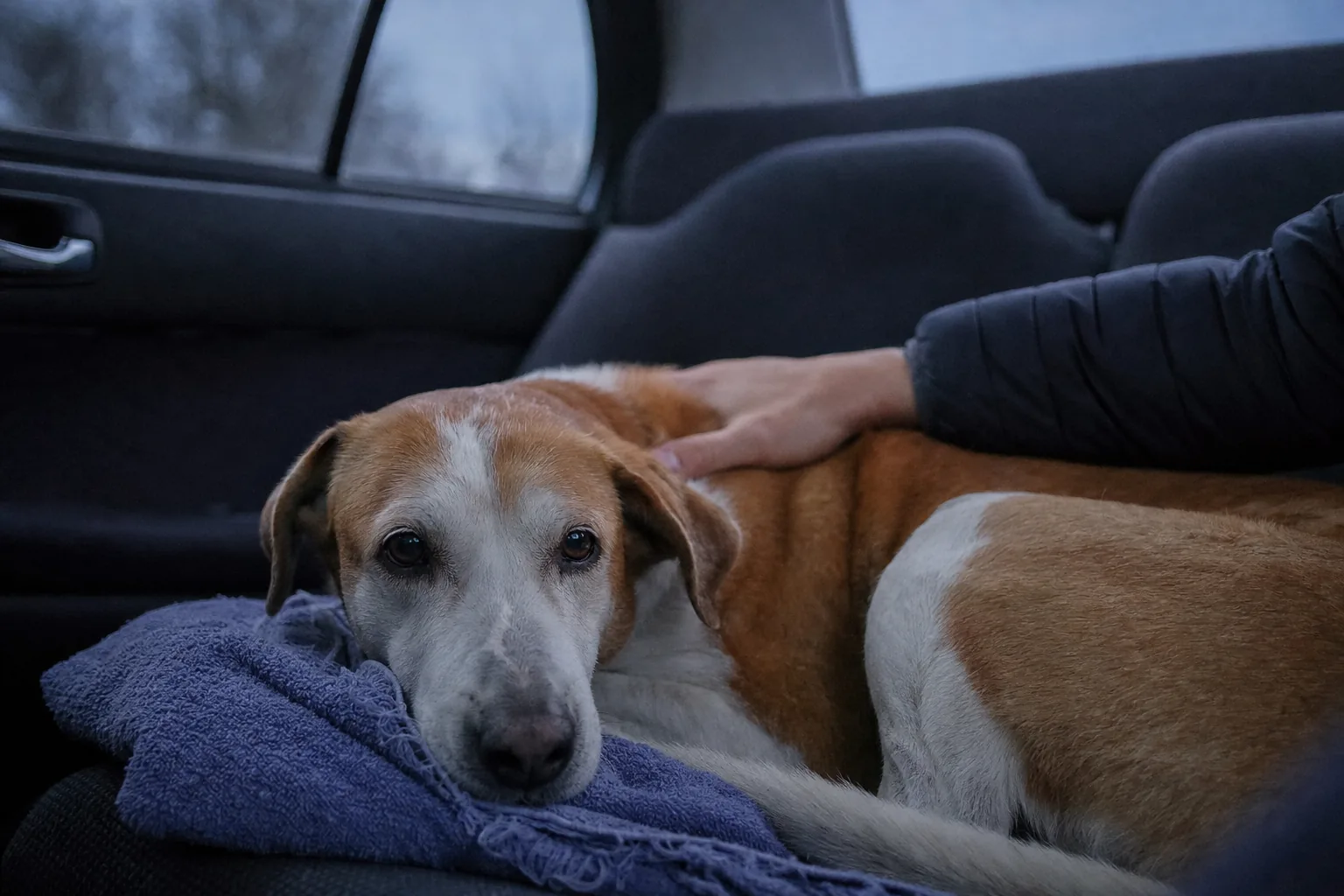
Emergency. Take the source away, gather the packaging and the leftovers and call your own vet or an emergency clinic now, even if he seems fine: with chocolate, grapes or rat bait the signs come hours or days later, and the stomach can only be emptied in the first hour. Do not make him sick yourself, do not give milk, oil or food and do not pull on a thread hanging from his mouth.
Noticed something different about your dog? Go straight to their vet.
Call your own vet or the nearest clinic with an emergency service now, and set off. Do not ask a group what to do: every answer you wait for there is time lost for the dog.
- The same sign, dozens of causes. A dog that vomits may have eaten grass or may have an object stuck in the gut. From two lines you typed, nobody can tell which. The vet feels the abdomen, takes the temperature, runs tests.
- Nobody on the internet sees your dog. They see a photo and a story. A diagnosis comes from an examination and investigations, not from a resemblance to someone else's dog.
- In groups you hear from the people whose dog "got better on its own". Those for whom it ended badly rarely post again. What you read there is a selection, not a statistic.
- Doses are calculated by weight and species. Human medicines that look harmless, paracetamol or ibuprofen, are toxic to dogs. "I gave mine half a tablet" is the most dangerous advice you can get.
- Hours matter. With a twisted stomach, a poisoning or a urinary blockage, the time spent asking online is exactly the time that decides the outcome.
- The vet is accountable for what they say. They have your dog's record, history, vaccinations, past treatments. An anonymous account has none of that and answers for nothing.
Use this page to know what to observe, what to note and what to ask at the appointment, not to treat at home. If you still have doubts after a consultation, ask another vet or a specialist (dermatologist, internist) for a second opinion, not a group. And if you do not have a regular vet yet, find one now, while your dog is healthy: how to choose a veterinary clinic.
Half past ten on a Sunday night. Half a bar of dark chocolate was left on the table, and your eleven-kilo beagle is now standing by the chair licking the foil. Or the fruit bowl holds nothing but the bare grape stalk. Or you caught the last second of a sock, an apricot stone or a chunk of rubber ball going down. In all three cases the next ten minutes matter more than anything that follows. And the most useful thing you can do in them sounds odd: do not try to sort it out yourself. Gather, estimate, call. Below is exactly what to do now, what to tell the vet on the phone and what the next few hours usually look like.
The first 10 minutes, step by step
- Get him away and gather what is left. The wrapper, the pieces, the pill box, the rodent bait packet, the broken plant. If he has already vomited, the vomit goes in a bag. All of it comes with you to the clinic.
- Work out how much he ate, worst case. The bar was 100 grams, 30 are left: count 70. You do not know how many tablets were in the box: count it full. The vet works from the dog's weight and the largest possible amount. An optimistic guess does more harm than a gloomy one.
- Call now, not when the signs show. Your own vet or, if nobody picks up, an out-of-hours clinic. With chocolate, signs come at 6 to 12 hours. With grapes, the kidneys fail at one to three days. With rat bait, bleeding starts at three to five days. A dog wagging his tail ten minutes later tells you nothing about what is coming. And for many substances the window in which the vet can get the poison back out of the stomach is the first hour. Two at most.
- Do not make him sick on your own initiative. Not with salt, not with a finger down his throat, not with a recipe from a Facebook group. Salt in quantity is a poison for dogs in its own right. Badly induced vomiting can end up in the lungs. And with caustic substances, petroleum products or sharp objects, whatever burned and cut on the way down burns and cuts on the way back up. If the vet decides vomiting will help, they tell you what to do or do it at the clinic, with a drug that works within minutes and under their eye.
- Do not give him anything "to neutralise it". No milk, no oil, no bread, no charcoal off the barbecue, no food. Some of those speed absorption up.
- With objects, two rules. If a thread, a strand of wool or a ribbon hangs from his mouth or from under his tail, you do not pull: the thread may be caught in the gut, and pulled, it saws through it. If he is choking (cannot breathe, paws at his mouth, gums going blue), open his mouth and take the object out only if you can see it and grab it easily. Otherwise you leave that very second, with someone else phoning from the car.
- Set up the trip. Lead, blanket, the packaging, his health record, one person driving and one beside the dog. In the car he lies down and stays warm. If he is sick, no telling off; bag it.
What happens if you wait
Chocolate makes the dog restless; he drinks a lot, vomits, has diarrhoea, then the heart races and skips beats, tremors arrive and, in bad cases, seizures. Grapes and raisins bring vomiting in the first hours, then lethargy and, in the dogs who react (not all of them, and there is no way to know in advance which), kidney failure. The sweetener in chewing gum and "sugar-free" products crashes the blood sugar within 30 to 60 minutes: weakness, staggering, seizures. Rat bait gives whole days of looking perfectly healthy, then blood from the nose, in the urine or into the chest. After antifreeze he seems drunk in the first hours, then seems to have recovered, then the kidneys shut down; the antidote only works if given in the first hours. A lodged object means repeated vomiting, a painful belly, no stool at all, lethargy, usually within one to three days. All of that is why the call happens now, not tomorrow.
What to tell the vet and what they do
On the phone
- What he ate or swallowed. Read the product name and the ingredients list off the packaging. With chocolate it matters whether it was dark, milk, cocoa powder or baking chocolate. With gum and sweets, look for the sweetener in the ingredients. With rodent bait, the active ingredient and the colour of the pellets. With medicines, the name, the strength and how many are missing.
- How much: the worst-case estimate from step 2.
- When: the time, as precisely as you can.
- The dog's weight and age. Do not know the weight? Weigh yourself holding him, then without him.
- What you see now: vomiting, drooling, restlessness, tremor, lethargy, pale gums, fast breathing. Or nothing, and you say "nothing".
- Other illnesses and medicines, whether she is pregnant, whether he has had stomach trouble before.
- How far you are from the clinic.
With that, the vet decides within two minutes: you come in now, you watch him at home, or there is something to do on the spot with them on the line.
At the clinic
- A quick look at everything: pulse, breathing, gum colour, temperature, how alert he is. In a dog who is seizing or struggling to breathe, the rest waits.
- Emptying the stomach, if the substance went down recently, is not caustic or oily, and the dog is awake and able to swallow. An injection or a drug dropped into the eye or nose, effect within minutes, and the vet sees with their own eyes what comes up.
- Binding the toxin in the gut, for some substances, with a product that stops it crossing into the blood. Sometimes repeated.
- A drip, to support the kidneys and dilute what has already reached the blood. With grapes and antifreeze it is the main part of treatment and runs for days.
- Blood tests matched to the substance: kidneys for grapes and antifreeze, blood sugar for the sweetener, clotting for rat bait, liver for some plants and medicines. Repeated at intervals.
- The antidote, where there is one: for anticoagulant rat bait, for antifreeze in the first hours, for some medicines. For chocolate and grapes there is no antidote; there is only support.
- With objects: an X-ray, sometimes with contrast, or an ultrasound scan, to see where it is and whether it is moving. Many small, smooth objects pass on their own within two to four days, and the vet tells you what to look for in the stool. Threads, sharp objects, batteries and magnets are not waited out. Whatever stays put or blocks comes out by endoscope, if it is still in the stomach, or by surgery.
- Monitoring, from a few hours to a few days. With rat bait, treatment runs for weeks, with check-up blood tests.
- At discharge, which signs to watch, what he eats, when you come back. Write it down while you are still there, because at home you will not remember.
How to prevent the next time
A dog who has swallowed something dangerous once will do it again. Not out of spite. To him, the meal was there and it was good.
What is dangerous and when the signs show
| Food or substance |
Why it is dangerous |
When signs usually appear |
| Chocolate, cocoa (the darker, the worse) |
Heart and nervous system: restlessness, vomiting, racing heart, tremor, seizures |
6 to 12 hours |
| Grapes, raisins, sultanas, juices or cakes containing them |
Kidney failure in some dogs, unpredictably |
Vomiting within hours, kidneys in 1 to 3 days |
| The sweetener in chewing gum, sweets, "sugar-free" peanut butter and baking, some toothpastes |
Blood sugar crash, then the liver |
30 to 60 minutes |
| Onion, garlic, leek, chives (raw, cooked, powdered) |
Destroy red blood cells: pale gums, dark urine, weakness |
1 to 5 days |
| Alcohol, raw yeast dough |
Intoxication, dangerous bloating from fermentation |
1 to 2 hours |
| Macadamia nuts |
Weakness in the hind legs, tremor, fever |
Up to 12 hours |
| Human medicines: anti-inflammatories, painkillers, antidepressants, blood pressure or slimming tablets, iron vitamins |
Stomach, kidneys, liver, nervous system, depending on the product |
Hours |
| Antifreeze (car coolant) |
Kidneys; the sweet taste draws him in; antidote only in the first hours |
"Drunk" within hours, then kidneys in 1 to 3 days |
| Rat and mouse bait |
Internal bleeding with anticoagulant types; seizures and brain swelling with others |
3 to 5 days, or hours, depending on type |
| Slug and snail pellets |
Violent tremor, seizures, fever |
1 to 3 hours |
| Plants: lily of the valley, oleander, azalea, sago palm, tulip or daffodil bulbs |
Heart, liver or stomach, depending on the plant |
Hours |
| Cooked bones, large fruit stones, corn cobs |
Block or perforate the gut |
1 to 3 days |
| Socks, toys, thread, ribbons, hooks, batteries, magnets |
Blockage, cutting or chemical burn of the gut |
Hours to days |
The list is not complete and it is no substitute for a dose calculation. The amount that does nothing to a German shepherd can kill a chihuahua, and with grapes there is no "safe" amount for anyone. When you are not sure, you call.
In the house
- A bin with a heavy lid, or shut inside a cupboard. The bin is source number one: bones, corn cobs, foil with chocolate traces, greasy napkins.
- An empty worktop when you leave the kitchen. A medium-sized dog reaches any worktop. A motivated one reaches the table too.
- Medicines, the dog's own included, in a closed cabinet, up high. To a dog a blister pack or a plastic bottle is a toy that rattles, and he has it open with his teeth in two minutes. Tomorrow morning's tablets do not live on the bedside table.
- Guests' bags on the coat hook, not on the floor. That is where the gum, the sweets, the tablets and the chocolate are.
- Holidays have their own calendar: Christmas and Easter chocolate, raisins in festive baking, grapes in autumn, raw dough on baking days. On those days the dog is in a room where nothing sits on the table.
- The plants in the table do not live in the house or garden, or live where he cannot reach.
- Garage and larder: antifreeze wiped off the floor at once and kept in a closed container; rodent bait never where the dog can get to it, and the packet kept for as long as the bait is down, so you know what to read out on the phone.
- Socks, underwear, children's toys, sewing thread: put away. Socks are among the objects most often removed by surgery from young dogs.
On the street and in the park
- Teach him the swap. He hands over what is in his mouth and gets something better from you, every single time, with no telling off and a cheerful word. The dog who has learnt that opening his mouth means confiscation swallows fast. The one who has learnt it means a piece of cheese spits things out on his own.
- A "leave it" practised on boring things, indoors, for weeks on end, before you need it on a chicken leg found under a bench.
- For dogs who scavenge with passion, a basket muzzle, taught patiently with good treats, is safety equipment. It lets him pant, drink and take treats, and it takes away the one "pleasure" that can kill him.
- Eyes on the ground wherever rodent bait is laid (around blocks of flats, by the bins, near warehouses) and wherever people leave food out for cats.
Two things to save in your phone
Your own vet's number and an out-of-hours clinic in your town, with the address. And the dog's weight, in his contact card. On the evening the chocolate bar disappears, you do not want to be hunting for a phone number or a figure.
Frequently asked questions
What dog owners search for most often on the internet about this problem, with the short answer. The answers are a guide only: the decision belongs to your dog's own vet, after an examination.
What do I do if my dog ate chocolate?
Gather the wrapper, work out how many grams are missing in the worst case and call the vet straight away with the dog's weight, the type of chocolate (dark is far more dangerous than milk) and the time. The vet calculates the risk and tells you whether to come in now to have the stomach emptied, which is only possible in the first hour, two at most. Signs appear at 6 to 12 hours; if you wait for them, the window has gone.
What are dogs not allowed to eat?
Chocolate and cocoa, grapes and raisins, the sweetener in chewing gum and sugar-free products, onion, garlic and leek, alcohol and raw dough, macadamia nuts, cooked bones, large fruit stones and corn cobs. Add everything that is not food but smells good: human medicines, antifreeze, rat or slug bait. The table on this page gives the signs and how soon they appear.
My dog ate grapes. Is it serious?
It can be. Grapes and raisins cause kidney failure in some dogs, with no safe amount and no way of knowing in advance whether yours is one of them. Call at once: if under two hours have passed, the vet can empty the stomach, and then come a drip and kidney blood tests for two or three days. Vomiting in the first hours and lethargy are the early signs.
Can I make my dog sick at home?
Not on your own initiative. Salt is toxic in itself, a finger down the throat does not work and earns you a bite, and badly induced vomiting can end up in the lungs. With caustic substances, petroleum products and sharp objects, vomiting does more harm. The vet decides on the phone whether it is worth it and, if so, tells you how or induces it at the clinic with a drug that works within minutes.
My dog swallowed a sock or a toy. Will it pass on its own?
Sometimes, if it is small and smooth for the size of the dog, and the vet tells you what to watch for in the stool over two to four days. But socks are among the objects most often removed by surgery from young dogs. Call, describe the object and the dog's size, and the vet decides whether you come in for an X-ray or to have the stomach emptied. Repeated vomiting, a painful belly and no stool at all mean a blockage: then you go.
The information on this page is educational and does not replace an examination. For full details and a diagnosis, consult your dog's own veterinarian.