Your dog is four and until yesterday he ate everything you put down. Today he sniffed the bowl and walked off, for the second meal in a row. He's drinking, following you round the house, wagging his tail. Perhaps yours is a twelve-year-old who has been leaving half his food for two weeks and has lost weight without being on a diet. Or a three-month-old puppy who has skipped a meal, and you don't know whether it's safe to wait. People search for "dog not eating but drinking water", and behind it sits one question: is this serious or not? This page covers which signs settle it today, what to note before the appointment, and what your own vet will do. You won't find recipes to tempt his appetite here. For a nauseous dog, they can do harm.
When not eating is serious and you ring today
A healthy, cheerful adult dog skips the odd meal. Two days without food is no longer a fluke. Ring the same day, however many meals he has missed, if:
- he vomits more than once, has bloody diarrhoea or black, tarry stool;
- he retches with nothing coming up, his belly is swollen and tight, he can't settle and he's drooling: that is an emergency this minute, not today, because a twisted stomach in big, deep-chested breeds kills within hours;
- he isn't drinking at all, or the opposite, drinking far more than usual and weeing a lot;
- he's a puppy under 4 to 6 months or a very small dog and has missed a whole meal: their blood sugar drops fast, and a floppy, sleepy, trembling puppy needs a vet within the hour;
- he's listless, hiding, not getting up to greet you, breathing hard or panting for no reason;
- his gums are pale, whitish or yellowish;
- he stands in the "prayer position", chest down and bottom up, or groans when you lift him, which means belly pain;
- he wants to eat, comes to the bowl, then drops the food, chews on one side or yelps: mouth, teeth or throat;
- she's an unspayed bitch 4 to 8 weeks after her season and is drinking a lot or has discharge from the vulva; a womb infection won't wait;
- you know or suspect he has swallowed something: a bone, a toy, a sock, something from the bin, one of your medicines, chocolate, grapes, chewing gum;
- he has visibly lost weight, at any age;
- he's old and hasn't eaten for more than a day.
If none of that fits, and he's bright, drinking, passing normal stool and has been skipping meals for less than 24 hours, you can watch him until tomorrow. After 24 hours without food in an adult, or 12 in a puppy, ring anyway.
What to watch and note at home
Appetite can be measured. "He's not eating much" tells your vet nothing they can use. For two or three days, write down:
What you offered and how much he ate, as a share of the portion: all, half, none. Then everything he got outside the bowl: treats at training, bits under the table, from the children, whatever he hoovered up on the walk. Plenty of dogs "who won't eat" are getting the day's food from somewhere else.
Water. In the morning put a measured amount in the bowl, a litre say, and in the evening see how much has gone. A dog drinks roughly 50 to 60 ml per kilo per day. Over 100 ml per kilo is too much and a sign of illness in its own right, even if everything else looks fine.
Vomit and stool. How often, what colour, any blood, mucus or bits of something. Photograph them. It's unpleasant, but the appointment goes much faster.
Energy. Note whether he comes to greet you, whether he plays or hides, whether he flinches when you lift him or touch his belly, whether he trembles. A nauseous dog licks his lips a lot and swallows on nothing.
Mouth. Lift the lip and look: pink or pale gums, broken teeth, a new smell, something wedged in the roof of the mouth. Press gently on the gum: in a healthy dog the colour comes back in under two seconds.
Dehydration. Gently lift the skin on the back of his neck. In a hydrated dog it drops straight back; if it stays up like a tent, he's dehydrated. Dry, tacky gums say the same.
Weight. Weigh him now and then once a week: step on the scales holding him and subtract yourself.
What has changed. A new bag of the same food (it may be rancid), a new brand, a metal bowl that clanks, the bowl moved somewhere else, a heatwave, a bitch in season in the building, a new dog at home, a house move, you more stressed than usual, a medicine started recently, yesterday's vaccination. Dogs go off their food for reasons we'd think trivial.
What it might be, in brief
| What you see besides not eating |
Where it points |
| Bright dog, drinking normally, eats treats and table food, refuses only the bowl |
Habit: he has learnt something better follows. Fixable, once your vet has ruled out the rest |
| Comes to the bowl, wants it, then drops the food or backs off |
Pain in the mouth, teeth or throat; sometimes neck or back pain when he bends down |
| Licks his lips, swallows on nothing, drools, eats grass, vomits |
Nausea: stomach, pancreas, something swallowed, poisoning |
| Drinks a lot, wees a lot, losing weight |
Kidneys, diabetes, womb infection in bitches, other internal disease; blood tests |
| Listless, feverish, big lymph nodes, runny nose, cough |
Infection; in puppies, also the diseases we vaccinate against |
| Stiff, slow to get up, won't bend down to the bowl |
Bone, joint or spinal pain |
| Heatwave, a bitch in season nearby, a move, loud noises, a new dog |
Stress or heat; usually passes in 1–2 days if all else is normal |
| New medication, recent vaccination |
Sometimes an expected reaction; ask the vet who prescribed it |
| Older dog eating less and less, for weeks |
Chronic illness, teeth, a nose that no longer smells well, cognitive decline; check-up with bloods |
Almost every illness starts with a full bowl left untouched, so not eating on its own doesn't tell you what's wrong. The table helps you judge how quickly to ring. The diagnosis is your vet's job.
What your vet will do
- Questions. Since when, what and how much he last ate, what else he gets, vomiting or diarrhoea, how much he drinks, access to bins, bones, medicines or plants, whether he's neutered, when her last season was, what medication he's on. With your diary this takes two minutes.
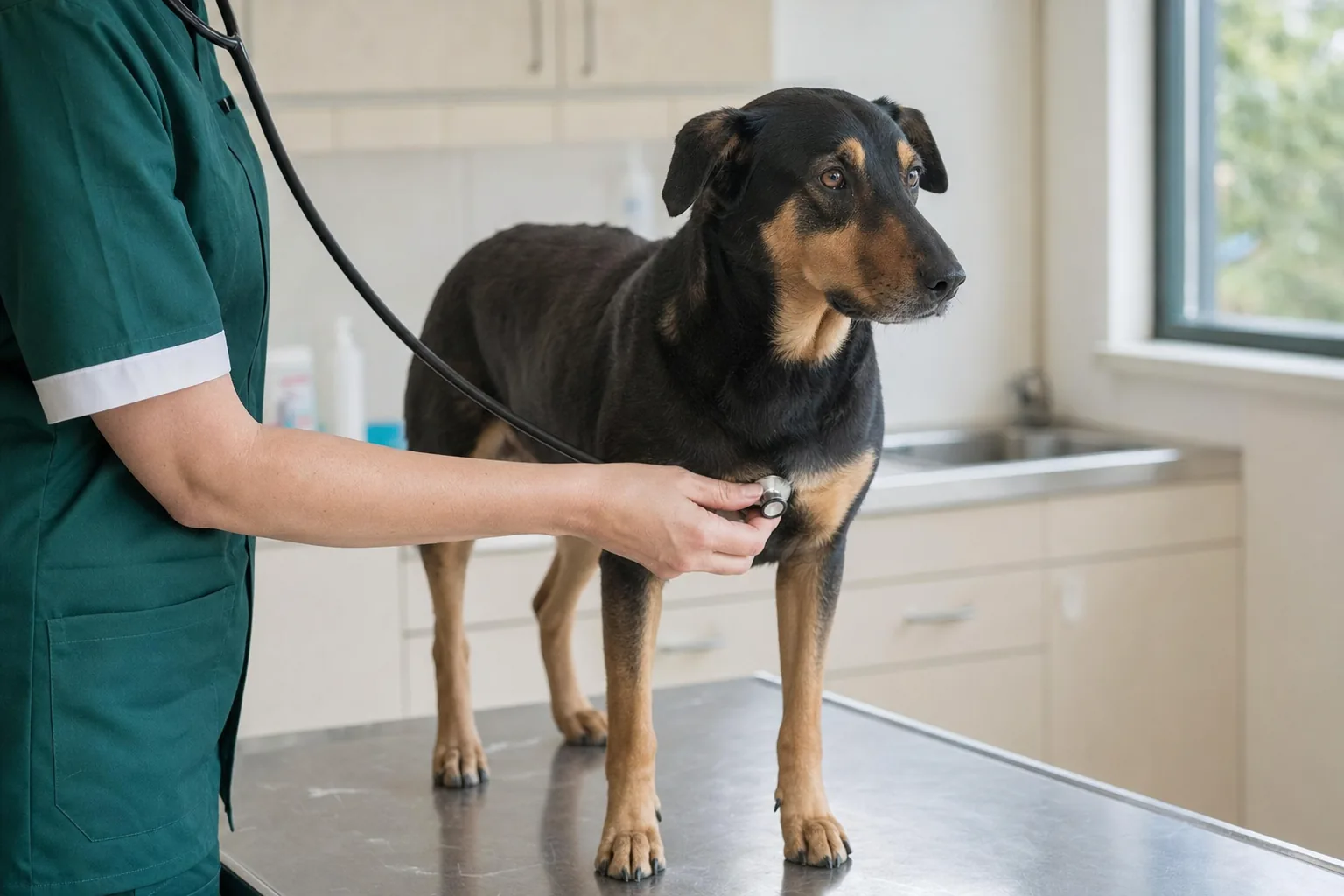
- Examination. Temperature, weight compared with the last visit, gum colour and how fast it returns, hydration, lymph nodes, heart and lungs. A careful feel of the belly (pain, masses, thickened gut, a full stomach), a look at the mouth, teeth and throat, sometimes a rectal exam.
- Blood tests. When he's been off food for more than a day or he's old, a full blood count and biochemistry are nearly always the first step: liver, kidneys, glucose, proteins, electrolytes, signs of infection or inflammation. If pancreatitis is suspected, a specific pancreas test as well.
- Urine, for kidneys, diabetes and infection.
- Imaging. An abdominal X-ray if something swallowed or a dilated stomach is suspected; ultrasound for the organs, womb, pancreas, gut and free fluid. A chest X-ray in older dogs or ones with a cough.
- Stool test, if he has diarrhoea or is a puppy.
- The plan. It depends entirely on the findings. It might mean a drip for dehydration, treatment for nausea or pain chosen by the vet, a stay in hospital for monitoring, surgery for a swallowed object or an infected womb, or treatment of the underlying disease. Your vet will also tell you when and how to start feeding again: usually small, easily digested, lukewarm meals several times a day, and if needed an appetite stimulant they prescribe.
- If everything comes back normal. That happens a lot and it's good news. The conversation then turns to habits: fixed mealtimes, the bowl lifted after 15 minutes whatever is left, nothing between meals, training and play treats taken out of the daily ration. A healthy dog won't starve himself next to a full bowl. That rule applies only once your vet has said "healthy".
Before you leave, ask which signs to watch for at home, when to ring if he still won't eat tomorrow, and how to feed him over the first few days.
What not to do at home
- "Let's see" with a puppy, a small dog or an old one. Their reserves are small, and a day without food throws them off balance. In a healthy adult, 24 hours is as long as you watch; after that, a vet.
- Force-feeding. A nauseous dog fed by force can inhale food into his lungs, and the bowl becomes linked to fear for months.
- Ham, cheese, roast fat, food cooked with onion and garlic "to get him going". Lots of fat can trigger pancreatitis in a dog who already feels rough, onion and garlic are toxic, and he learns that refusing the bowl brings ham.
- Medicines from your own cupboard for nausea, pain or "tummy". Many common human ones are toxic to dogs.
- Three different foods in a week. Each sudden change piles diarrhoea on top of the original problem, and you can no longer tell cause from effect.
- Bones or milk "to get something into him". Bones can cause blockages, and cow's milk gives many adult dogs diarrhoea.
- Taking his water away. Even a dog who's vomiting gets small, frequent sips until you've spoken to your vet. They decide whether and for how long he goes without.
- Telling him off, or keeping him by the bowl "until he eats". It fixes neither nausea nor habit.
- Taking comfort in "but he's happy". A happy dog who hasn't eaten for two days still hasn't eaten for two days.
If your vet says "healthy" and he's still fussy
Two meals a day at fixed times. The bowl goes down for 15 minutes, then you pick it up without comment until the next meal. Nothing in between: no treats, no table scraps, nothing from the children. When you play or teach him something, the treats you reward him with come out of his daily ration. Feed the same food rather than something new every day, at room temperature or slightly warmed, not cold from the fridge. If the metal bowl clanks, swap it for a ceramic one. A little exercise before meals helps. Most healthy dogs settle into the rhythm in three or four days. If he still isn't eating on day five, go back to your vet, because something has been missed.
An untouched bowl is the first thing a sick dog tells you, and often the only thing he says clearly. Your own vet reads the rest from the tests. If you don't have one yet, our related services page helps you choose a practice.
The information on this page is educational and does not replace an examination. For full details and a diagnosis, consult your dog's own veterinarian.