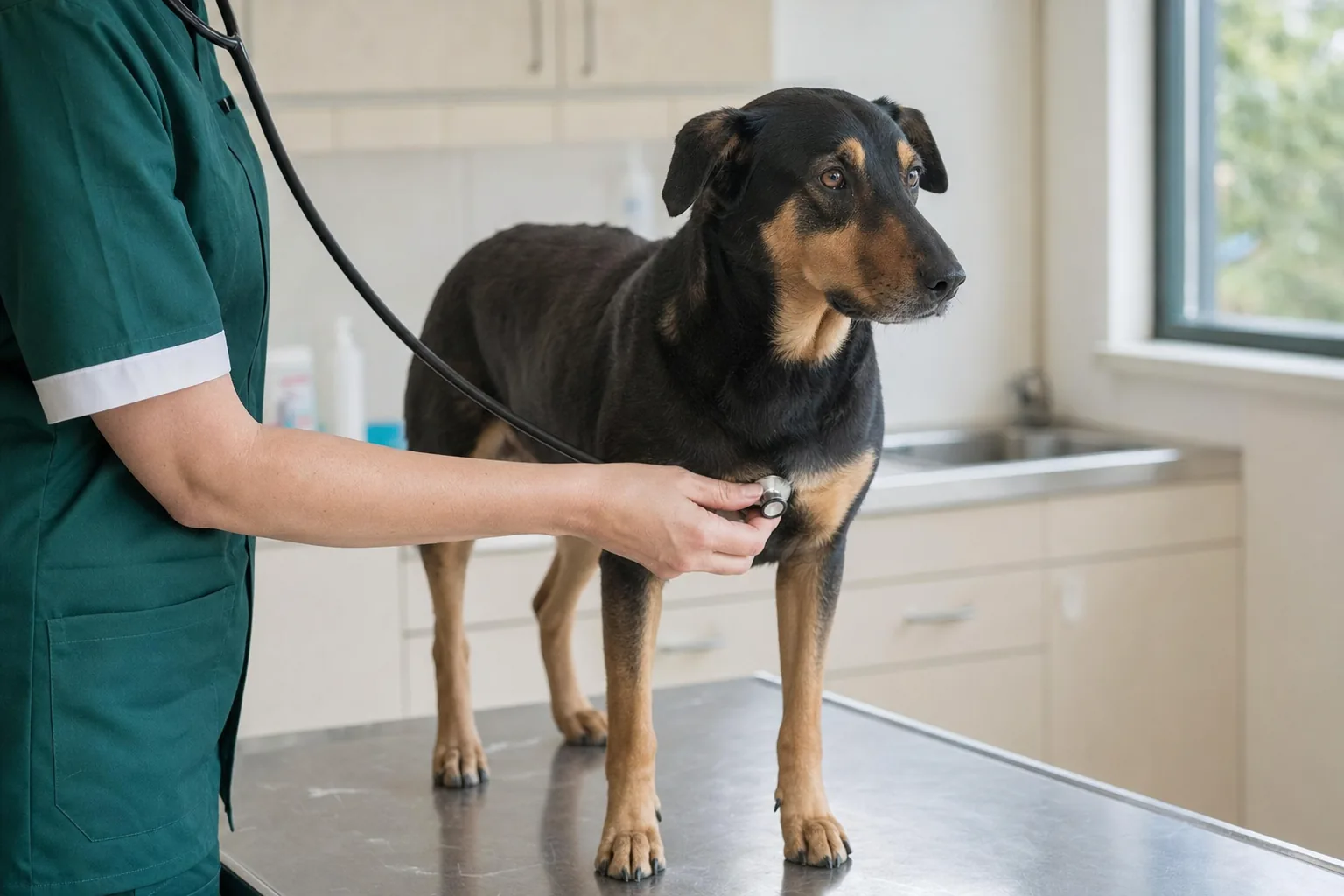
Your spayed seven-year-old bitch has been asking to go out every hour for three days. On the walk she squats ten times and manages a few drops each time, and this morning the patch on the snow was pink. Or you have a male who stands with his leg cocked for ages and produces very little, keeps licking himself and has started weeing indoors, something he has not done since he was four months old. Everyone thinks "urinary infection" first, and quite often that is what it is. The trouble is that bladder stones give exactly the same picture, so does the prostate in entire males, and in older dogs so can a growth in the bladder. This page covers what to watch for two days, how to bring a sample worth testing, and what your own vet will do with it.
When to ring the vet today
Simple cystitis is sore and miserable, but it does not kill overnight. A handful of situations look the same in the first few hours and are something else entirely:
- a male straining and passing only drops, or nothing at all, restless, unable to settle, maybe vomiting. A stone can block the urethra and the bladder keeps filling with nowhere to empty. This is not a "first thing tomorrow" problem. It is a matter of hours;
- a dog with a temperature, flat, off his food, vomiting, or flinching when you touch his back just behind the last rib, where the kidneys sit. The infection may have climbed that far;
- an unspayed bitch drinking a lot, weeing a lot and looking flat a few weeks after her season, with or without discharge from the vulva. The womb may be infected, and that is no longer cystitis;
- a lot of blood, clots, or red urine that does not clear from one walk to the next;
- a puppy or an old dog who has not passed any urine in 12–24 hours;
- a dog who collapses or is breathing hard on top of any of the above.
When you ring, say what you have seen and when he last passed urine normally. If you already have a sample, take it with you.
What to watch and write down at home
"Peeing a lot" covers two quite different things, and which one you are seeing decides which tests come next.
Often, and only a little. The bladder is irritated. The dog feels the urge every few minutes, squats and passes a small amount, sometimes with effort. That is how cystitis, stones and an inflamed urethra look.
Often, and plenty of it. Here the body is making a lot of urine because the dog is drinking a lot: big puddles, the water bowl empty twice a day, accidents at night. That is how diabetes, kidney disease, some hormonal problems or an infected womb tend to show. There can be an infection on top, but it follows from the main problem rather than causing it.
Two days of watching will tell you which camp your dog is in.
Count and measure. How many trips a day and how much each time: drops, a small puddle, a puddle the size of a dinner plate. Measure what he drinks over 24 hours with a measuring jug. For a 10 kg dog, more than a litre a day is a lot.
Colour. Pale yellow and clear is normal. Pink, red, brown, cloudy, with strands or sediment: write it down every walk. Take a photo of the patch on snow or concrete with something beside it for scale.
Smell. Cystitis urine usually smells stronger, heavy and slightly sweet, and you notice it from the doorway.
Posture. Squats and stays down, gets up and squats again, whimpers, looks back at his belly. If a male holds his leg up for 20 seconds and nothing comes, note the time.
Licking. More attention than usual to the vulva or prepuce, drips on the bed, red skin around the area.
Leaking without knowing. A wet bed in the morning, drips when he gets up from sleep, no squatting at all. That is incontinence. It is common in middle-aged spayed bitches and it can be treated, just not the same way as an infection.
History. When he last had something similar and what he was given, whether he is neutered, when her last season was, what he eats, whether stones or crystals have turned up on previous tests, whether he drinks from puddles.
A urine sample that tells the truth
Your vet wants fresh urine. At home, take it on the first walk of the morning with something clean and shallow (a small plastic tray, a ladle washed with no detergent left on it), slipped under the stream once it has started. Pour it into a clean jar with a lid, write the time on it and get to the clinic within the hour. If you cannot, keep it in the fridge for a few hours, never the freezer. Nothing scooped off the floor, and nothing left standing in a bowl since last night. For some tests the vet will want to take the sample directly from the bladder anyway; more on that below.
What it might be, going by the signs
| Possible cause |
What you usually see |
Who gets it more often |
| Bacterial cystitis |
Often and little, straining, cloudy or pink urine, licking |
Bitches, especially spayed or older ones |
| Bladder stones or crystals |
Same signs, sometimes more blood, repeat episodes |
Some small breeds; males can block |
| Enlarged or inflamed prostate |
Straining to wee and to pass faeces, drops of blood between wees |
Entire males over 5–6 years |
| Growth in the bladder or urethra |
Blood that keeps coming back, straining, an "infection" nothing clears |
Older dogs, some terrier breeds |
| Incontinence |
Wet bed, drips during sleep, no straining or licking |
Spayed bitches, old dogs |
| Illness that drives thirst (kidneys, diabetes, hormones) |
Drinks a lot, wees a lot in large amounts, loses or gains weight |
Middle-aged and older dogs |
| Infected womb (pyometra) |
Drinks a lot, flat, sometimes discharge, 4–8 weeks after a season |
Unspayed bitches, usually over 6 |
What your vet will check
- Questions. Your two days of notes (often and little, or often and plenty), colour, water intake, neutered or not, past episodes. Half the testing plan comes out of those answers.
- Examination. Feeling the bladder (full, painful, something hard inside) and the kidneys, temperature, gums. In males, a rectal exam to check the prostate. In bitches, a look at the vulva: one tucked away in folds of skin keeps infections going.
- Urinalysis. Specific gravity, which shows whether the kidneys are concentrating urine. A dipstick for blood, protein, glucose and pH. The sediment under the microscope, where cells, bacteria and crystals show up. It takes a few minutes and everything starts from here.
- Culture and sensitivity. The sample goes to the lab, the bacteria are grown for a few days and tested against antibiotics. Current guidelines ask for a culture especially with repeat infections, ones that have not cleared, males and dogs with other illness. For culture, your vet will prefer to draw urine straight from the bladder with a fine needle through the belly wall, guided by ultrasound. It takes seconds and the dog barely notices. The sample comes out clean, free of the bacteria that live on the skin.
- Bladder ultrasound, often during the same appointment. It shows stones, how thick the wall is, any growth, the prostate. X-rays pick up many stones but not every type.
- Blood tests when the dog is drinking a lot, has a temperature, is older, or the infection keeps returning: kidneys, liver, glucose, a full blood count, sometimes hormones.
- Treatment. For simple cystitis, a course chosen on the test results, usually short, with a check at the end. For stones it depends on the type: a special diet that dissolves them, or surgery. Prostate problems get the prostate treated, incontinence gets the incontinence treated. By the third infection your vet will be looking for the reason it keeps coming back, because there nearly always is one underneath.
Before you leave, ask when the urine test should be repeated. With many infections the post-treatment check is the only way to know it has really gone.
What not to do at home
- Leave the leftover antibiotics in the cupboard, whether they are from last time, another dog or yourself. The dose will almost certainly be wrong, the bug may be different, and one or two tablets before the sample is taken can make the culture come back falsely negative. Then the infection returns and nobody knows what to treat it with.
- Do not stop the course on day two because the signs have gone. The signs go before the bacteria do. Your vet sets the length and you finish it.
- Do not cut his water to reduce accidents. Water dilutes the urine and flushes the bladder; without it everything gets worse.
- Do not tell him off for weeing indoors. He cannot hold it. All he learns from being scolded is to hide when he goes, and then you lose the very information you need.
- Do not wait a week with a male who is straining. Stones do not pass by themselves and the bladder has a limit.
- Cranberry, bicarbonate, herbal teas and "urine acidifiers" are not treatment. The evidence is weak or absent, and some of them push urine pH the wrong way for the type of stone your dog has.
- Do not switch to a shop-bought "urinary diet" without a test. The right food depends on which crystals or stones he has, and the wrong one can encourage a different type.
- A sample off the kitchen tiles or the grass, or one left in a warm room for hours, is no use. Bacteria multiply in the jar and the result lies.
What helps every day
Fresh water in several places around the house, and trips out often enough that he is not holding urine for hours. A bladder that empties regularly looks after itself. In long-coated bitches, keep the hair around the vulva short and wipe the area after wet walks. If he has had stones, stick to the food your vet recommended with no "just this once" from the table, and plenty of water, because dilute urine is half the prevention. And ask for a urine test at the annual check-up even if you have noticed nothing. Crystals and silent infections show up there months before they show up on the carpet.
Signs started today, and the dog is bright, eating and passing urine, even if often? You have time to collect a decent sample and go first thing tomorrow. With a male straining and nothing coming out, you do not have that time. If you do not have a regular vet yet, our page on related services will help you choose a practice.
The information on this page is educational and does not replace an examination. For full details and a diagnosis, consult your dog's own veterinarian.