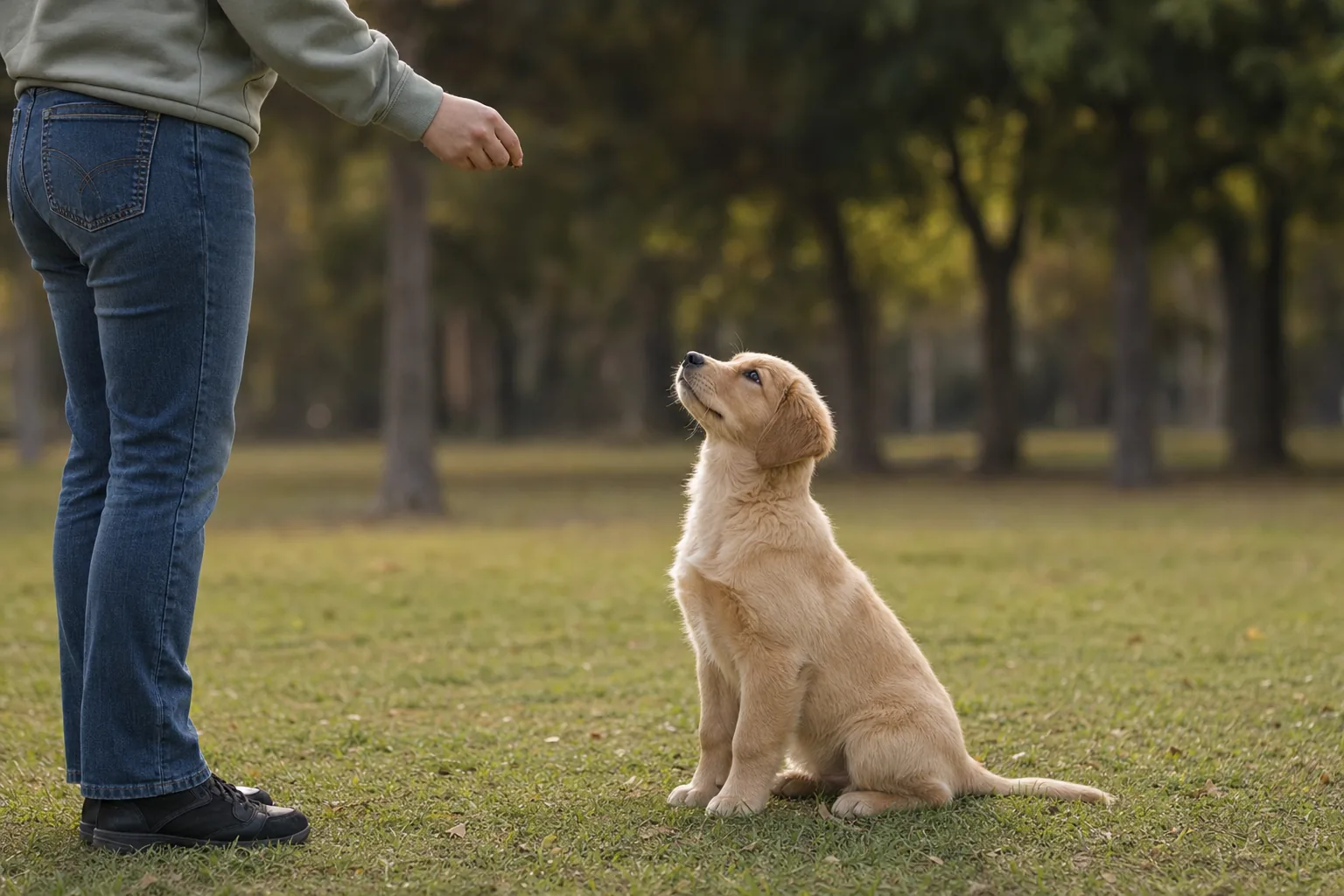
The puppy is ten weeks old. You took him out five times today and he still went indoors three times. Or you have an eight-month-old who spends twenty minutes outside, walks back in and goes on the hall rug, same spot every time. Or you adopted an adult a week ago who was described as "house-trained", and he has wet the sofa twice. All three come down to the routine and to how much fuss you make of him outside. And the fix is the same for all of them: take him out more often than you think he needs, praise him and give him something tasty right there, within two seconds, and give him no chance to go where he should not.
The exercise, step by step
A dog has no idea that "indoors" is wrong and "outdoors" is right. He knows where people were delighted with him and where it felt comfortable. And a soft rug in the hall, three metres from a door he cannot open, feels very comfortable indeed. House-training means offering the right spot so often that he never needs the rug, and turning every success out there into a small celebration until he would rather use the grass.
1. The outing routine
Take him out without waiting for him to ask: the moment he wakes, daytime naps included; fifteen to twenty minutes after every meal and after a long drink; after any game lasting more than five minutes; last thing before bed. In between, at fixed intervals. At 8 to 10 weeks, every hour he is awake. By three months, every two hours; by four months, every three. A healthy adult can hold on for four to six hours during the day. For the first week, set alarms on your phone, because your memory is not a routine.
2. An outing that does the job
Take him out on the lead to the same spot every time and stand still for five minutes: no chatting, no games, no phone. As he starts, say one calm word ("go wee") so he links it to what he is doing. Within two seconds of him finishing, praise him in a happy voice and give him a tasty treat from your own pocket. If you have to go back inside for it, by the time you return he has forgotten what it is for. Then five minutes of walking or play. If nothing has happened after five minutes, go back in with him on the lead or pop him in his pen for ten minutes, then try again.
This is the bit almost everyone gets wrong: once he has been, you do not head straight back inside. If weeing means the walk is over, he learns to hold on for as long as he can so he gets more time outside, and then goes indoors two minutes after you get back. That is where the classic "he wees inside even though I take him out" comes from.
3. Supervision indoors
Between outings, the puppy is always in one of three places: where you can see him (easiest with the lead clipped to your belt around the house), in a crate or pen of the right size, or outside. The right crate is big enough for him to stand, turn round and stretch out. Any bigger and he makes himself a toilet corner. The signs that he is about to go: nose down and sniffing, circling, suddenly stopping mid-game, heading for the door or whining. At any of those, outside, carried if need be.
4. When there is an accident
If you catch him in the act, a short "oops" with no telling-off, pick him up and go out. If he finishes outside, celebrate as if he had won something: praise him warmly, give him a tasty treat on the spot, enjoy it together. Find it afterwards and you do nothing. No words, no looks, no "lesson". Clean it with an enzymatic cleaner, one that breaks the urine down. Bleach and ammonia-based products smell like urine to his nose and mark the spot as a toilet, so leave them in the cupboard. A half-cleaned spot is an invitation, and his nose finds it long after yours has given up.
5. The diary
For one week, note on paper or on your phone: the time, inside or out, wee or poo, and what happened in the twenty minutes before. After seven days a pattern shows. Every accident a quarter of an hour after a meal? Go out sooner. All of them on the mat by the door? He wanted out and did not know how to tell you. All of them while you were working in the other room? Too much space, too soon. The diary corrects your routine. The dog has nothing to correct.
A bell hung from the door handle gives him a way to ask. At first you touch it with his paw before every outing, then he does it himself, and the door opens straight away. Plenty of dogs pick it up within two weeks. A few then use it to ask for a walk every ten minutes, at which point the bell comes down.
6. Things that look the same but are something else
- Excitement weeing. A puppy under a year who leaks a few drops when you come home, when you lean over him or when someone tells him off. It is a reflex, house-training has nothing to do with it, and it fades with age as long as you do not make it worse. Greet him calmly, crouched down, side-on, without staring at him, and go straight outside when you get in.
- Marking. Entire males, small amounts, on upright objects, in new houses or when visitors bring their dogs. Supervision, enzymatic cleaning and a chat with your own vet about neutering, which reduces marking in many dogs but not all.
- The adopted adult. Whatever you were told, treat him like a puppy for two weeks: routine, lead indoors and plenty of fuss outside every time he gets it right. Your house is new to him, and his old rules did not come along.
- Puppy pads. If you cannot get outside (tenth-floor flat, puppy not yet vaccinated, harsh winter), the pad is a stage. Moving from pad to outdoors is a second round of house-training, though: you shift the pad gradually towards the door, then outside. If you can get out, going straight to outdoors is simpler.
The first week (ten-week-old puppy)
| When |
What you do |
| On waking |
Straight outside, carried to the door. When he goes, praise and a treat within two seconds. Then breakfast. |
| 15 to 20 minutes after a meal |
Outside, same spot, five minutes. |
| During the day |
Outside every hour he is awake and after every game; between outings, the belt lead or the pen. |
| Evening |
Last meal three hours before bed; last outing right before lights out. |
| Night |
One or two trips out, low light, no talking, no play. |
| Day 7 |
Read back through the diary, see where and when the accidents happened, and move the times. The dog stays as he is. |
By age
8 to 12 weeks. The bladder is small and control has not developed yet: physically, he cannot "hold it" for more than an hour while awake. At this age accidents are down to the routine. One or two trips out at night, with an alarm set before the time he usually wakes.
3 to 6 months. The gap between outings grows by roughly an hour a month. Around four or five months the setbacks arrive: teething, the first serious distractions outside (he is too busy looking around to go), the hormones of early adolescence. Keep the routine for another two weeks after the last accident, then hand out freedom room by room. Most puppies are clean by four to six months if the routine has been kept. Small breeds often need longer.
6 to 18 months. The "clean" dog goes indoors again: in a new house, at the in-laws', when another dog moves in. For him the rule was "in that house", not "in any house". Two or three days of the puppy routine in every new place. In entire males, marking starts, which is a separate issue from house-training.
The adult. A dog who has always lived outdoors has no idea what "inside" means. An adopted adult arrives with another household's rules. Three to six weeks of a strict routine, exactly as for a puppy, with the lead indoors and praise outside every time he gets it right. He learns faster than a puppy because he can hold on longer; he just has to find out where.
The senior. Damp patches on the bed after sleeping, urine leaking as he walks, a dog who goes indoors and looks surprised himself: incontinence, infection, kidney disease or cognitive decline. All of those are for the vet, none for training. More frequent trips out, a bed that washes easily, and not a word of reproach for a dog who can no longer feel it happening.
Common mistakes
- Rubbing his nose in it and telling him off. He does not connect the telling-off with something he did an hour ago. He connects it with you and with weeing. He learns to go where you cannot see him (behind the sofa, in another room) and, worse, stops going in front of you outside, just when you want to make a fuss of him.
- Waiting for him to ask. Young puppies do not ask; they do not even know they can. You take him out on the routine and, over time, teach him to ask with the bell or by going to the door.
- Going straight back in once he has been. That teaches him to hold on, as above.
- The run of the house from day one. A ten-week-old puppy loose in five rooms has five toilets. Freedom comes room by room, after weeks without accidents.
- Cleaning with ammonia or bleach. To his nose the spot smells like a toilet someone has used. Enzymatic cleaner, left to work.
- The pad that keeps moving. Bathroom today, hall tomorrow, kitchen the day after: he learns the toilet is anywhere with something soft on the floor.
- No water after lunchtime. A puppy needs water all day. Dehydrated, he makes concentrated urine and is more likely to get an infection. At most, move the last big drink to an hour or two before bed.
- Punishment "at the scene", hours later. The dog who "looks guilty" when you march him to the stain has no idea what he did. All he has learnt is that a stain plus your tone of voice means trouble.
How long it takes and how to tell it is working
With a strict routine and supervision, accidents become rare within two to four weeks for a puppy and two to six for an adult. "Clean" means four weeks without a single accident indoors, with the supervision from step 3 still in place. Only then does he get more freedom, one room every two weeks. Most puppies become reliable at around four to six months. Until then, a "clean" puppy is a puppy with a good routine.
The signs that it is working come in a certain order. The accidents in the diary drop from daily to weekly. He goes within the first minute outside, in his spot, when he hears the word. He starts going to the door by himself or nudging the bell. And one day he plants himself in front of the door and stares at you with an intensity you have not seen before. Setbacks after a move, visitors or illness are normal; three days of the puppy routine bring him back.
When to call a trainer
- an adult dog, clean for years, suddenly starts going indoors: your own vet first, because infections and other illnesses are the most common cause, and training only after that;
- a puppy who goes very often, a little at a time, strains or shows traces of blood: the vet, today;
- you have kept the routine for four weeks, with a diary, and the accidents are not dropping. A trainer can usually spot in one session where things are slipping: too much freedom, outings too far apart, praise and treats arriving too late;
- the puppy will not go outside because he is frightened of the street, traffic or other dogs, and holds on until he is back indoors. Then the fear is the problem, and that gets worked on first;
- he only goes indoors when left alone, with whining, a chewed door or a lot of drooling. That is a separation problem, and it is what you work on.
Nearly every puppy class starts with this question. That is where you discover that everyone else has the same hall rug.