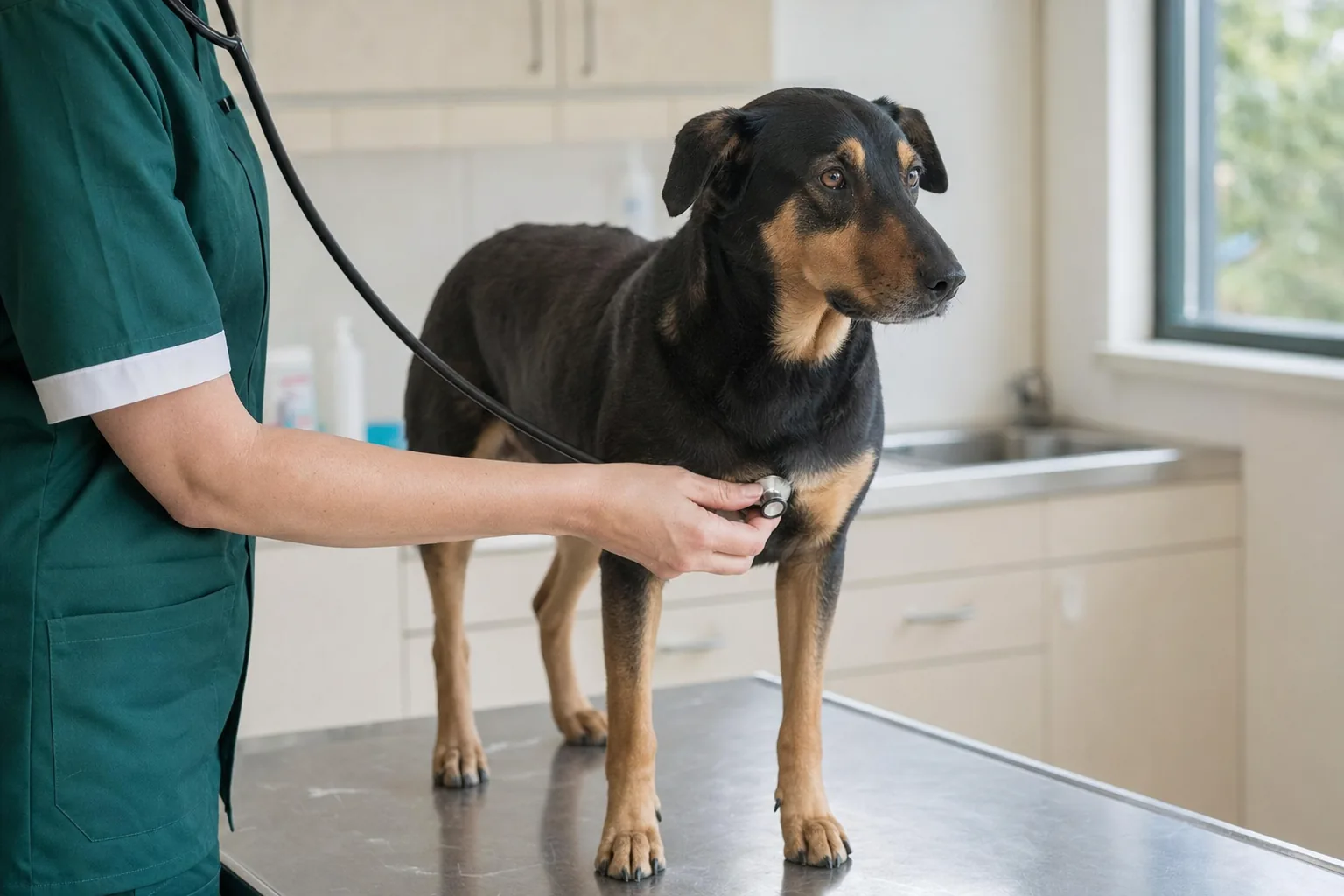
It is three in the morning and you can hear claws on the floor again. Your thirteen-year-old has been doing this for a few months now. He wanders the house, stops with his nose in a corner and stays there until you come and steer him out. He whines without wanting anything in particular. Yesterday he waited for you to open the door on the hinge side. During the day he sleeps, and when visitors arrive he no longer gets up. Last week he weed in the living room, by the door, for the first time since he was six months old. Friends say "he's old, that's just age". Some of what you are seeing may be cognitive decline, the dog version of dementia. Some of it may be pain, or an illness that can be treated. This page helps you tell them apart, shows you what to write down, and describes a proper senior check with your own vet.
Signs that mean ringing the vet today
Cognitive decline creeps in over months. Anything that arrives suddenly, over hours or a few days, has a different cause and needs seeing today:
- the head tilted to one side, eyes flicking from side to side, a drunken walk, falling over, sometimes vomiting. That is what a sudden balance problem looks like, and old dogs get it often. It is frightening to watch; many dogs improve within days, but some cases have another cause and need sorting out quickly;
- circling always in the same direction, pressing his head into the wall or the furniture, unable to stay on his feet;
- the first fit of his life;
- blindness that came on over a few days: walking into everything, pupils wide and not closing down;
- nothing eaten and nothing drunk for 24 hours, or no urine passed;
- fast breathing at rest, or panting at night when it is not warm and he has not been running;
- crying out when you touch his back or hips, unable to get up, dragging his back legs;
- getting lost in the garden or on the street and not finding his way home.
When you ring, say when it started, what you noticed first and whether he is on any medication. With an old dog, "let's wait and see" costs more than it would with a young one.
What to record at home, month by month
Your vet needs the pattern over several months, and you are the only one who sees it. Two tools catch it: a night diary and a checklist you fill in again every month.
The night diary. What time he wakes, what he does (wanders, gets stuck in corners, whines, asks to go out, wants water), how long it lasts, how he settles again. A night spent in pain looks different from a night spent confused. The dog in pain keeps lying down and getting up, changes spots and pants. The confused dog walks with no purpose, gets stuck behind doors and seems not to know where he is.
Video. Thirty seconds on your phone of the circling, the corner, the pacing. On film your vet sees what you cannot put into words: whether the circle always goes the same way, whether he leans on the wall, whether he lifts his feet oddly.
The checklist. On a sheet of paper, dated, write down what you see in six areas. A month later, do it again and compare.
- Disorientation: stuck in corners or behind furniture, waiting at the wrong side of the door, staring blankly at the wall, unable to find his bowl, looking lost in his own garden.
- How he is with you: no longer gets up to greet you, stops asking for a fuss or, the other way round, will not leave your side; growls at people or dogs he knows.
- Sleep: awake at night, pacing or vocalising; asleep for most of the day.
- House training: wees or poos indoors, often in plain sight, apparently without noticing; stops asking to go out.
- Daytime behaviour: wanders aimlessly, licks the floor or the air, circles, stops playing, no longer responds to his name or to words he has known for years.
- Anxiety: new fears of noises or places, can no longer cope with being left, gets restless as evening comes on.
Hearing and sight. Clap behind him where he cannot see you and watch for a flinch. Rustle the treat bag from another room. Drop a ball of cotton wool from his head height, off to one side, and see whether his eyes follow it. Notice whether he bumps into furniture, especially in the evening. A dog who cannot hear or see well looks confused even when his mind is still doing fine.
Movement. How long it takes him to get up, whether he slips on tiles, avoids the stairs, has stopped jumping into the car, squats for less time when he wees. Joint pain is the cause people miss most often when a dog starts having bad nights.
Water, food, weight. Note whether he drinks more than before, and whether he eats less or, the opposite, a great deal more. Weigh him once a month.
What else could be behind it
| What you see |
Could it be cognitive decline? |
Rule this out first |
| Up at night, asleep all day |
Yes, the sleep pattern gradually flips |
Joint pain, needing to wee more often, an illness that drives thirst |
| Stands in corners, waits at the wrong side of the door |
Yes, the classic sign |
Failing sight, blindness, a brain tumour |
| Walks in circles |
Yes, in bouts, with no favoured side |
Always the same side, with a head tilt: inner ear or brain |
| Wees indoors |
Yes, he forgets the rule |
Urinary infection, incontinence, kidneys, diabetes, difficulty squatting |
| No longer comes when called |
Yes |
Hearing; deafness is common after 10–12 years |
| Does not want to go for walks |
Yes, interest drops |
Pain, heart, lungs |
| Cries for no obvious reason |
Yes, especially evening and night |
Pain, high blood pressure, a need he cannot tell you about (water, going out) |
| Growls, seems irritable |
Sometimes |
Pain when touched, poor sight (he startles), thyroid |
Work through the right-hand column first. That is where the treatable things are.
What a good senior check looks like
An appointment for an old dog whose behaviour has changed takes longer than a routine check. Book it in good time and say what it is about when you book.
- History and your checklist. The vet goes through the six areas with you. The video and the night diary save a lot of time.
- General examination, with pain in mind. Spine, hips, knees and elbows felt, every leg flexed and extended, a look at how he lies down and gets up. In a thirteen-year-old dog, something will almost certainly turn up here.
- Neurological examination. Reflexes, head position, gait, the blink when a hand comes towards the eye, and whether both sides of the body match. In cognitive decline the exam is symmetrical with no clear deficits. Asymmetry points somewhere else.
- Eyes and ears. The back of the eye, eye pressure if needed, the ear canal, how he reacts to sound.
- Blood pressure. Often high in old dogs and silent with it. It can bring sudden blindness, night-time restlessness and changes in behaviour.
- Blood and urine tests. Kidneys, liver, glucose, thyroid, calcium, a full blood count; urine for infection, concentration and protein. Plenty of "dementia" turns out to be a sluggish thyroid or tired kidneys, and both can be treated.
- Imaging when things do not add up. X-rays of joints or chest, an abdominal ultrasound, and for the brain an MRI at a referral centre when the neurological exam is asymmetrical or things are moving quickly.
- The diagnosis. Cognitive dysfunction is diagnosed by exclusion: the checklist is full, the other causes have been ruled out or treated, and the signs are still there. No single test confirms it.
- The plan. If the vet has found pain, that comes first. Then diets and supplements designed for the ageing brain, medication where it makes sense, and changes at home (below). The decline does not reverse; the aim is to slow it and keep his life good.
- Follow-up. Every six months for older dogs, with your checklist redone. The difference between two visits tells you more than either visit on its own.
Before you leave, ask how the two of you will keep an eye on his quality of life and which signs should bring you back sooner. It is a hard question. It is easier to ask now than in a year's time.
What not to do at home
- Do not tell him off for weeing indoors. He does not know he has done wrong, and if he does, he cannot help it. Scolding adds fear to confusion and the dog starts hiding.
- No human sleeping tablets, sedatives or sleep supplements to get him through the night. Some are toxic to dogs, others make the confusion worse. If his sleep really needs help, your vet decides what and how much.
- Do not suddenly shut him in a crate or a room at night if he is not used to it. A confused dog who wakes up shut in panics and can hurt himself.
- Do not move the furniture, and keep his bowl and bed where they have always been. The map in his head is the old one, and every change rubs a bit of it out.
- Do not leave him unsupervised in the garden or on the street, even if "he's been finding his own way home for ten years". Dogs with cognitive decline get lost three streets from home.
- Do not take his water away in the evening to stop night-time accidents. In an old dog, dehydration hits the kidneys. Better an extra trip out before bed and an absorbent mat by the door.
- Do not give up on walks because "he can't manage any more". A short, slow walk on a familiar route with his nose in the grass is the best thing you can do for his mind, and it counts as much as any supplement.
- Do not put it all down to age. Pain, high blood pressure, urinary infections and thyroid problems are illnesses. Old age has no treatment; they do.
A home for an ageing dog
Night lights in the hallway and by his bed. Non-slip mats over tiles and wooden floors, from bed to bowl to door. His bed on the ground floor, low down, with a low edge. A fixed routine for meals, going out, walks and bedtime, at the same times each day, because routine does the job memory used to do. Three short walks instead of one long one, letting him choose where to sniff.
Put his food in puzzle toys or scatter it over a rug so he has to find it with his nose. Five minutes of searching tires an old brain out in a healthier way than an extra hour of sleep. Once a week, teach him a new, simple trick with tasty bits and plenty of praise, so every small success is a happy one. In the evening, when he gets unsettled, quiet music or the radio helps.
Dogs well into double figures come to our training sessions too, working short, easy trails. Their people tell us they sleep through the night afterwards. We would not call it treatment. It is what is left for the dog to do with his nose, and that is a lot. If you do not yet have a regular vet to carry out his senior checks, our page on related services will help you choose a practice.
The information on this page is educational and does not replace an examination. For full details and a diagnosis, consult your dog's own veterinarian.