Every evening you hear it from the next room: a wet, rhythmic slurping that does not stop. Your dog is licking his paws, and the fur on his front feet has turned rusty, as if he had been standing in tea. Or he keeps licking the same spot on his front wrist until there is a thick, shiny, hairless patch there, and he licks it even when it bleeds. Or he licks the air, the carpet, the sofa and his lips, swallowing over and over, mostly after meals. All three get called "obsessive licking". And in all three, more often than not, there is a cause your own vet can find before anyone decides it is "in his head". Here is what to watch for, when to see the vet today, what the vet looks for and what not to do at home. At our training sessions we see plenty of "obsessive" dogs who, once you look carefully between their toes, turn out to have a sore paw.
When does licking mean seeing the vet today?
- he licks one paw and limps, or the paw is swollen and hot, with a lump between the toes or a hole that discharges: a grass seed or a splinter has gone under the skin and is travelling;
- he has chewed down to raw flesh, it bleeds or the wound smells;
- he licks his genitals and strains to wee with almost nothing coming out, especially in males. A urinary blockage is an emergency;
- he licks his genitals and has a discharge with pus or blood; or she is an unspayed bitch who, a few weeks after her season, is drinking a lot and seems flat;
- he licks his lips, the air or the floor, swallows over and over, drools, cannot settle, and his belly is swelling or he is trying to be sick and nothing comes up. Go now: that is what a twisted stomach looks like;
- the licking started suddenly, in one spot, and he whimpers when you touch it;
- he is licking a wound after surgery and has pulled out the stitches or the dressing;
- he licks himself raw every night and neither of you is sleeping.
What should you watch and note at home?
The vet starts from a simple question: where does he lick, and when? The answer changes the whole direction of the appointment, and you are the one who has it.
Exactly where. Paws: all four or just the front ones, on top, between the toes or on the pads. One spot on one leg, usually the front wrist or the back ankle. Belly and groin, genitals, the base of the tail, the flank. Or the air and things around him. Draw a dog on a sheet of paper and mark an X. Photograph the area in the same light every week.
What the skin looks like. Redness, rusty staining from saliva on pale fur, thickened, damp or smelly skin, bald patches, lumps, scabs. Between the toes, look for moist redness with a yeasty smell, a soft swelling, a hole. On the pads, cuts, cracks, a thorn.
When. After walks (grass, salty snow, hot tarmac), in bed in the evening, when he is left alone, when the house is busy, after meals, at night. Film one episode. You want to know how long it lasts and whether you can break it by calling his name.
The season. Spring to autumn only, or all year round? In towns in winter, salt and de-icer on the pavements irritate the pads, so he licks them after every walk. In summer, hot tarmac burns them.
The rest of him. Note whether he also scratches his ears or armpits, whether he has had one ear infection after another, what his stools are like. Movement: is he limping, slow to get up in the morning, no longer jumping into the car? Stomach: eating grass, swallowing repeatedly, a rumbling tummy? And whether he is drinking differently.
What is going on in his life. What has changed in the last few months: routine, a move, another animal, a baby, less exercise, more time alone. What he does when he is not licking: sleeps, looks out of the window, nothing. How much exercise he gets a day, and how much of it uses his nose.
History. Parasite treatment, food, medication, operations, and the last time anyone looked closely between his toes.
At our sessions we see dogs stop on a trail and lick a front paw. Most of the time it is a pad cut on broken glass or a thorn between the toes, which the owner had not spotted because at home the dog "isn't limping". He is not limping because he is licking it.
Where he licks and what the vet considers first
| Area |
First suspects |
What else you see |
| All paws, especially the front, between the toes |
Allergy to something in the environment or the food; yeast settling in the damp from licking |
Rusty fur; ear infections; comes with the seasons |
| One paw |
Foreign body (grass seed), cut pad, torn nail, cyst between the toes, joint pain |
Limping; swelling; whimpers when touched |
| One spot on the wrist or ankle; thick, hairless patch |
Lick granuloma: often starts with pain or itching and carries on out of habit |
Large adult dogs; licks even when it bleeds |
| Belly, groin |
Allergy; contact irritation (carpet, detergent, grass) |
Redness where the hair is thin |
| Genitals, under the tail |
Urinary infection, vaginitis, prostate, anal glands, parasites |
Frequent wees; scooting; discharge |
| Over a joint, in an older dog |
Pain (arthritis) |
Slow to get up; stiff after rest |
| Air, floor, carpet, lips; repeated swallowing |
Nausea, reflux or another digestive problem |
After meals; eats grass; rumbling tummy |
| Anywhere, especially when alone or wound up, once the rest has been ruled out |
Behaviour: stress, boredom, compulsion |
Stops when busy; happens in the same situations |
What will the vet check?
- Questions, with your video and photos on the table.
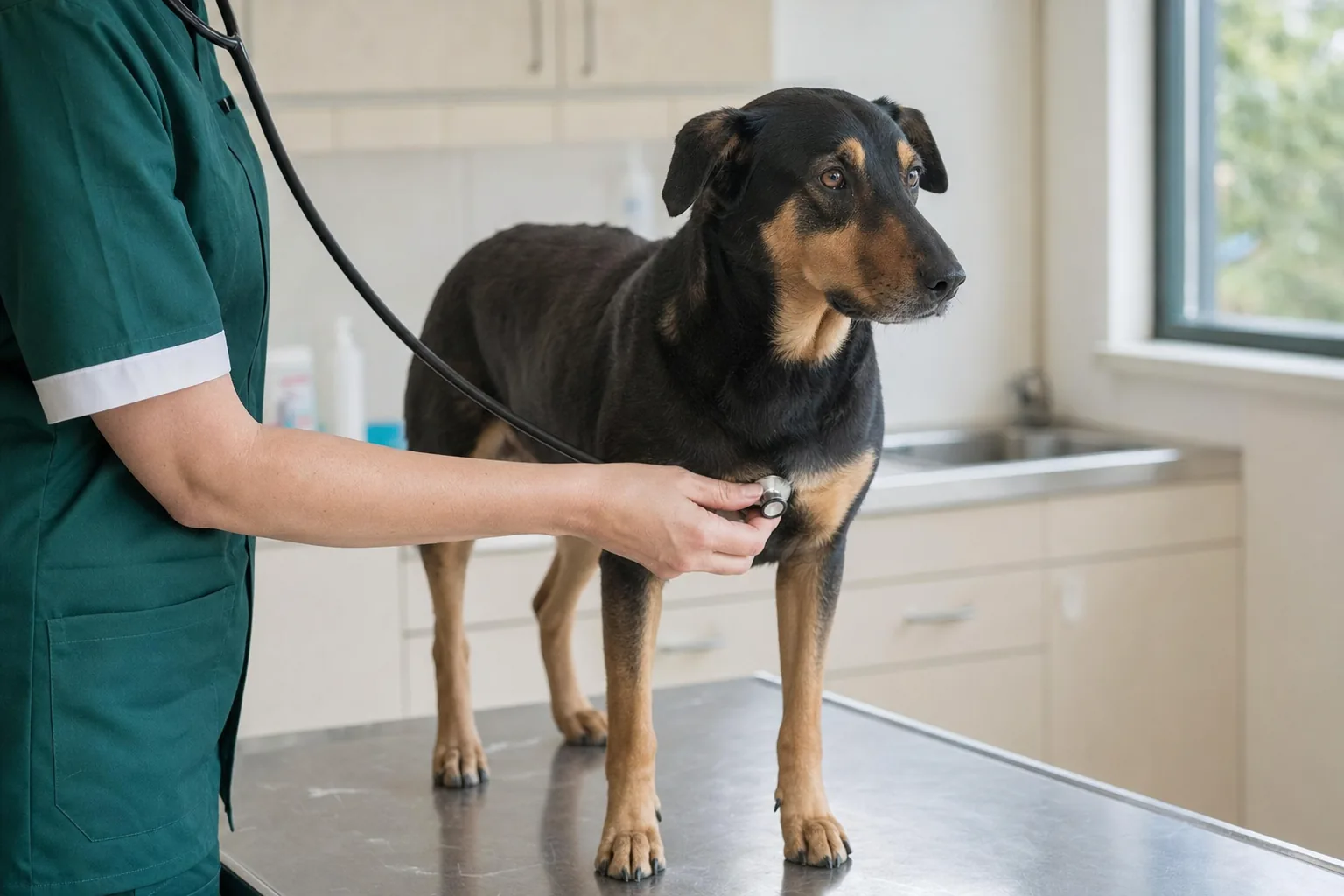
- Skin and paws. Every toe, every pad, the nails and the folds, with a light and a magnifier. Between the toes the vet looks for a seed, a lump or a discharging hole. In a dog who will not keep still, sometimes under light sedation, because you cannot see a grass seed from across the room.
- Skin tests on the spot. A skin scrape (a fine scratch of the skin looked at under the microscope) for mites; sticky tape pressed on a slide for yeast and bacteria; a flea comb; a lamp and a culture for ringworm if there are round patches.
- Orthopaedic and neurological exam. Bending and stretching each joint, feeling the bones, watching him walk and trot. A licked paw is often a painful paw, and in older dogs licking over a joint means pain until proven otherwise. If the exam calls for it, an X-ray follows.
- Genitals and anal area. Anal glands; a urine test for infection or crystals; the prostate in males, the vagina in females; sometimes an ultrasound scan.
- If he licks the air or surfaces. An abdominal examination, blood tests, sometimes an ultrasound. Excessive licking of surfaces often has a digestive problem behind it, and it stops once that is treated.
- Allergy. Strict parasite control for every animal in the house, an eight-week elimination diet, then environmental allergy, in that order.
- Only at the end, behaviour. If everything is negative or treated and the licking goes on, the vet, or the behaviour professional they refer you to, looks at the context: when, where, what happens just before, how long he is left alone, what he has to do in a day for his nose and his brain. The plan gives his nose and mind more work, a routine he can predict, a gentle interruption followed by something else to do and sometimes medication prescribed by the vet, because a compulsion that has been going on for months is not fixed by one more walk. The skin is treated alongside. A lick granuloma keeps itself going, through the itch the licking creates, even after the original cause has gone.
Before you leave, ask what to film before the next appointment and what change you should see in two weeks.
What should you not do at home?
- Do not rely on a bitter-tasting spray alone. It stops him licking one spot and he moves to another. If he is licking because of pain, the pain is still there.
- Do not tell him off or punish him. Stress licking goes up with stress, and pain licking does not stop because you scold him. He just learns to lick when you are out of the room.
- Do not put your own creams or home remedies on him. He licks them off a second later, and some are toxic.
- Do not tie socks on him or wrap the paw unless the vet tells you to. Damp under a bandage makes infection worse, and a bandage that is too tight cuts off the circulation.
- Do not dig out a grass seed yourself once it is under the skin. It snaps and the piece left behind keeps travelling.
- Do not give him human painkillers "to see if he settles". Some are toxic to dogs, and if he does settle, you have hidden the only sign you had.
- Do not diagnose "boredom" yourself before the vet has seen him. A dog licking because of pain looks exactly like a bored one.
- Do not let him lick "so it heals". Saliva does not disinfect. Licking keeps a wound damp and deepens a granuloma.
- Do not take off a cone the vet has fitted, but do not keep it on for months without a plan either. The cone stops the licking; the cause is still there.
What you can do before the appointment
Rinse his paws with water and dry them after walks, especially in winter on salted pavements and in summer after grass. Check the pads and between the toes in good light after every walk. Give his nose something to do as well: scatter his food round the house instead of using a bowl, ten minutes of searching. This is a test, not yet a treatment. If the licking drops when he is busy, you have information for the vet; if it does not drop at all, that is information too.
A dog who licks constantly has something to say and only one way of saying it, so "it's just a habit" is too easy an answer. If you do not have a regular vet, our page on related services helps you choose a practice. And if, once the vet has had their say, a behaviour problem is still there, the plan starts from your diary just the same.
The information on this page is educational and does not replace an examination. For full details and a diagnosis, consult your dog's own veterinarian.