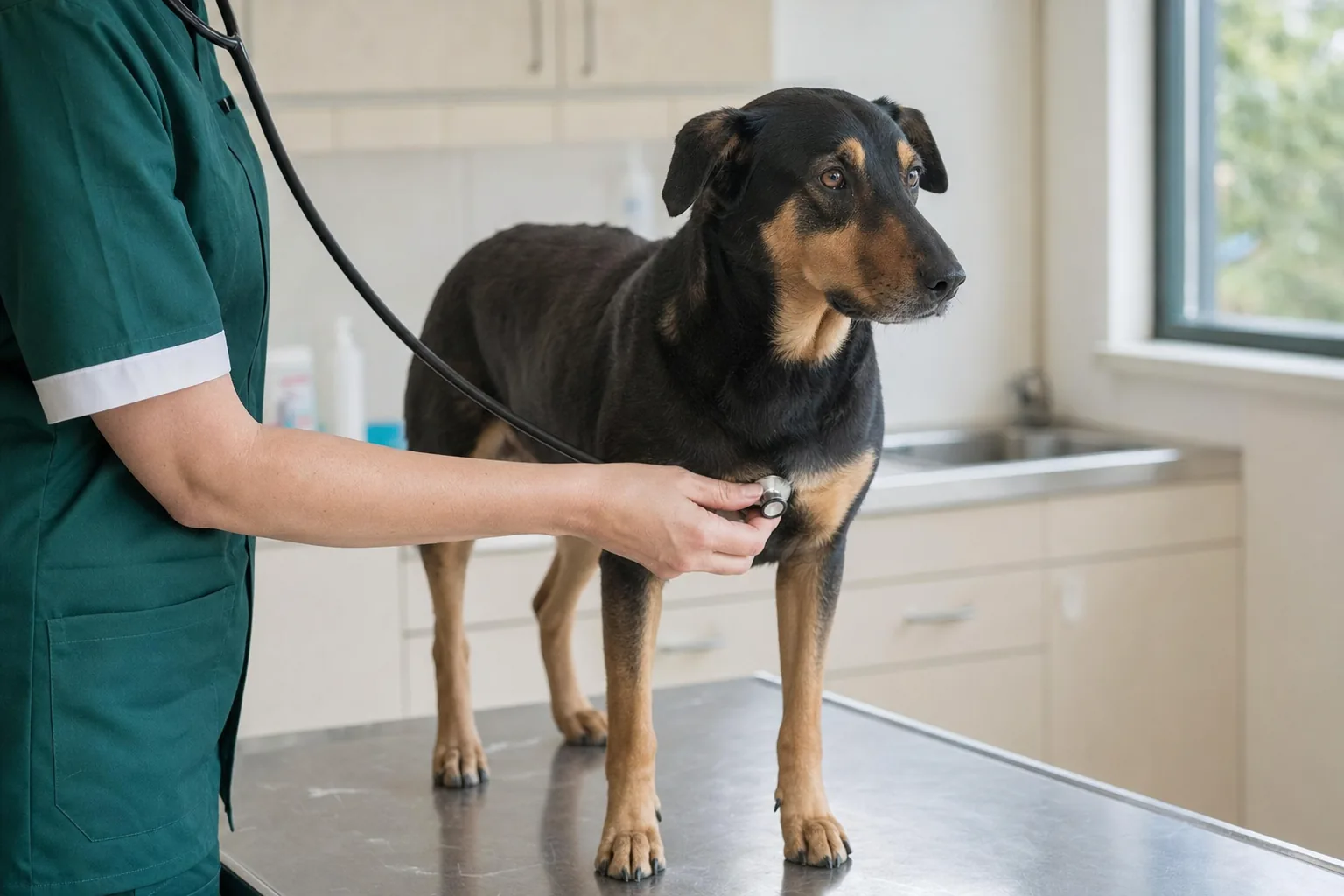
In the morning her bed is wet. She gets up happily, with none of the guilty look of a dog who has had an accident indoors, and the fur on her back legs is damp. She does not seem to have noticed. It has happened a few times this month, always after she has been asleep, and yesterday it was on the sofa. She was spayed three years ago and has never had a problem. What you are seeing is urinary incontinence: the dog leaks urine without realising it, which is a completely different thing from a dog who "isn't house-trained". In most cases the cause can be found, and the common ones respond very well to treatment. Below is what to note and what not to do at home before you see the vet.
Warning signs: when to call today
Incontinence is rarely an emergency, but it does need an appointment within the next few days. A few situations cannot wait:
- the dog is straining to wee and little or nothing comes out, especially a male: a blocked bladder is an emergency and can kill in less than a day;
- there is blood in the urine or it smells very strong, or weeing seems to hurt (whimpering, staying squatted for a long time);
- the leaking started suddenly along with weakness in the back legs, wobbliness, back pain or a tail hanging limp; this can be the spine;
- the dog is drinking much more than before and is flat, vomiting or off food;
- an unspayed bitch is drinking a lot, is flat and has a discharge from the vulva a few weeks after her season; this may be an infection of the womb, and that is an emergency.
What you can watch and note at home
First, settle one question: does the dog know she is weeing, or is it escaping?
With incontinence, the urine leaks without her meaning it to. She does not squat or look for a spot. The wet patch is where she slept or lay down, or urine dribbles as she walks. The fur on the back legs and around the vulva or penis is damp, sometimes red or smelly.
Weeing indoors on purpose looks different. The dog stops, squats or cocks a leg, usually in the same places. The cause there can be training (a puppy, a newly adopted dog), marking, fear, over-excitement when greeting people, or an illness that makes the dog need to go often and urgently. We have separate pages on those.
If it looks like incontinence, keep a short diary for a week, on paper or on your phone. A vet gets more out of seven days of notes than from any account given from memory in the consulting room.
When the patches appear. After sleep, during sleep, on walks, when coughing or barking, when excited.
How big they are. A few drops or a whole puddle.
How much she drinks. Measure it. Put a known amount in the bowl in the morning and see what is left in the evening. A healthy dog drinks roughly 50 millilitres per kilo per day. Well above that is something the vet needs to know.
How she wees outside. A normal stream or dribbles, often or rarely, straining or not. A photo or a few seconds of video helps.
Her history. Age, whether and when she was spayed, how long the patches have been appearing, any past urine infections, any medication she is on now.
The common causes and how they differ
| Cause |
Usually affects |
What you see |
| Weakening of the muscle that keeps the bladder closed |
Spayed bitches, especially large ones, months or years after the operation |
Wet patches after sleep, otherwise a healthy dog |
| Urine infection |
Mostly bitches, at any age |
Going often, small amounts, urgently, sometimes with blood; dribbling |
| Bladder stones |
Any dog; some breeds more often |
Blood in the urine, straining, dribbling; in males, risk of blockage |
| Heavy thirst from other illness (diabetes, kidneys, glands) |
Adults and older dogs |
Drinks a lot, wees a lot, "can't hold it" overnight |
| Ureters in the wrong place from birth |
Puppies, mostly females |
Dribbling since you got her, always damp |
| Spine or nerve problems |
Any dog, after a fall, or long-backed breeds |
Weak back end, losing both urine and faeces |
| Prostate |
Older entire males |
Straining to wee, dribbling, sometimes blood |
| Ageing brain |
Old dogs |
Forgets where the door is, disoriented, other changes in behaviour |
Eight causes for the same patch on the blanket. That is why no decent vet hands out a treatment "for incontinence" before running tests.
What the vet will check
The work-up usually follows the steps below and sometimes takes two visits, because some results come back after a few days.
- The history. Your diary does half the job, so bring it along, with the measured water intake.
- The clinical exam. General condition, the genital area (sore skin, discharge, shape of the vulva), feeling the bladder and, in males, the prostate, plus a neurological check of the back legs and tail.
- Urine test. The vet looks at concentration (very dilute urine points towards an illness causing thirst), blood, crystals, bacteria and sugar. Ideally the sample is taken straight from the bladder with a fine needle guided by ultrasound. It hurts no more than a vaccination and gives a clean result. If infection is suspected, a culture is done as well, so the treatment matches the bacteria found.
- Blood tests, for kidneys, liver, sugar and, if needed, the glands.
- Imaging. Ultrasound of the bladder and kidneys, X-rays for stones. Puppies who have dribbled from the start sometimes need special imaging of the ureters.
- Treatment. It depends on the cause. For a bladder muscle weakened after spaying, there is medication that helps most bitches, usually for life, and the vet picks the dose and adjusts it according to how she responds. Infections, stones, illnesses that cause thirst and spinal problems each have their own treatment. Where medication is not enough, referral clinics also have surgical options.
Ask how you will know the treatment is working and when to come back for a check. Many bitches with incontinence after spaying need an adjustment in the first few weeks.
What not to do at home
- Do not cut back her water so she wees less. A dog who drinks a lot usually has a reason, and dehydration does real harm, particularly to the kidneys. Measure the water; do not ration it.
- Do not tell her off or show her the patch. She does not know she leaked. Scolding frightens her and changes nothing.
- Do not give her medication left over from another dog, or any "bladder" remedy without a prescription. What helps one cause can make another worse.
- Do not leave the skin wet. Urine scalds the skin within a few days and turns it red, and infections take hold easily on sore skin. Wash the area with lukewarm water, dry it well and clip the fur short around it. Ask the vet which barrier cream to use.
- Do not put it off because "she's old, it's normal". Incontinence is not normal at any age, and some of the causes are easy to treat.
Making life easier until it is sorted
Machine-washable beds with a waterproof cover underneath and a thick blanket on top. Keep two, so one is always clean. Put washable pads on the sofa and her favourite spots. For bitches there are special pants with an absorbent pad, for males belly bands; do not leave them on all day, because they irritate the skin, but at night or when visiting they get you out of trouble. A short trip outside just before bed, and the first one in the morning the moment she wakes. For most bitches with incontinence after spaying, the first weeks of treatment change what mornings look like completely.
The information on this page is educational and does not replace an examination. For full details and a diagnosis, consult your dog's own veterinarian.