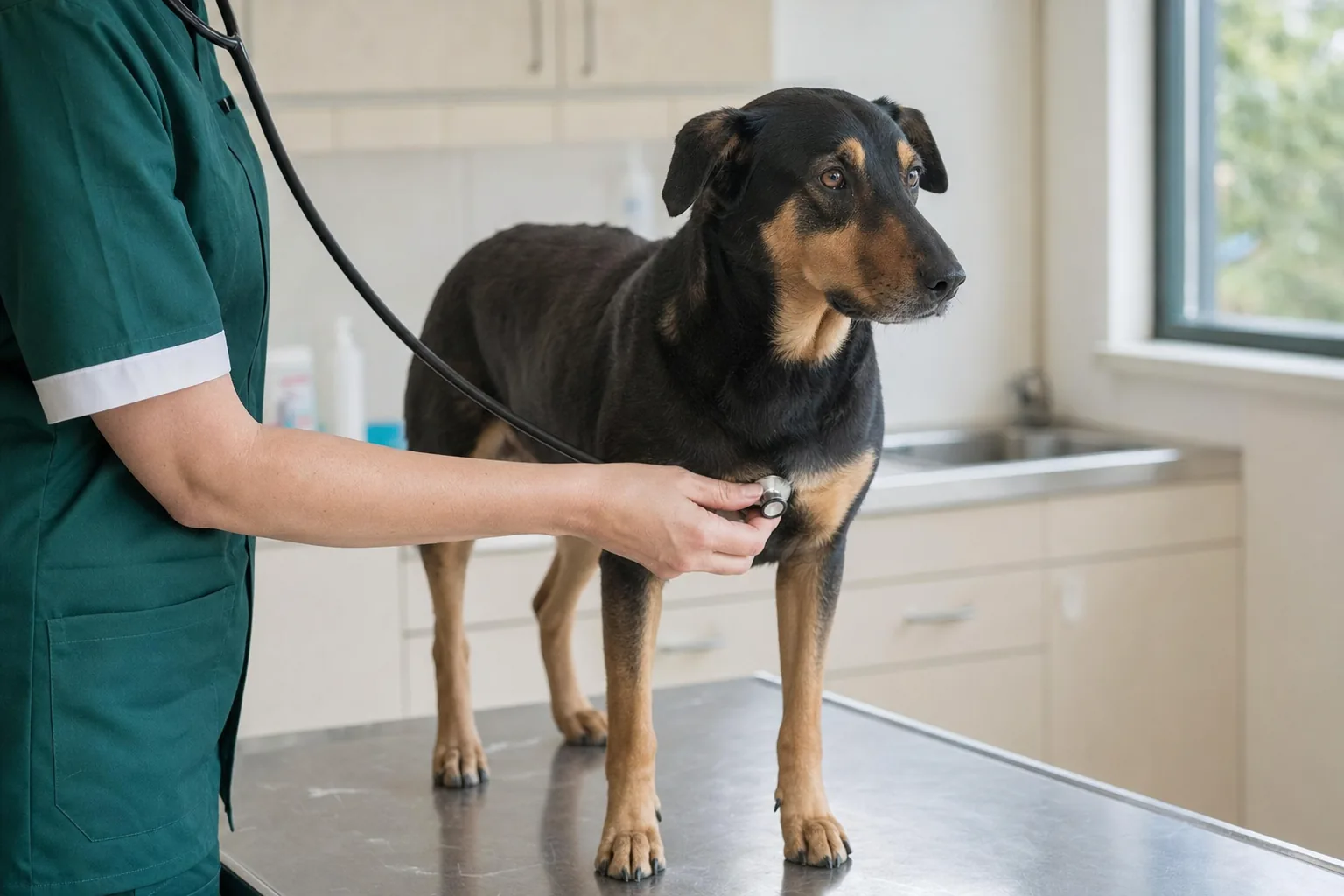
Caution. An unspayed bitch drinking a lot a few weeks after her season, or any dog drinking a lot who vomits, will not eat, lies flat, loses weight fast or passes very little urine: ring your own vet today. Do not cut his water in the meantime.
Noticed something different about your dog? Go straight to their vet.
Do not look for the answer in a Facebook group, on TikTok or on a forum. Look for someone trained for this: your dog's own veterinarian, the only person who can examine, investigate and treat them.
- The same sign, dozens of causes. A dog that vomits may have eaten grass or may have an object stuck in the gut. From two lines you typed, nobody can tell which. The vet feels the abdomen, takes the temperature, runs tests.
- Nobody on the internet sees your dog. They see a photo and a story. A diagnosis comes from an examination and investigations, not from a resemblance to someone else's dog.
- In groups you hear from the people whose dog "got better on its own". Those for whom it ended badly rarely post again. What you read there is a selection, not a statistic.
- Doses are calculated by weight and species. Human medicines that look harmless, paracetamol or ibuprofen, are toxic to dogs. "I gave mine half a tablet" is the most dangerous advice you can get.
- Hours matter. With a twisted stomach, a poisoning or a urinary blockage, the time spent asking online is exactly the time that decides the outcome.
- The vet is accountable for what they say. They have your dog's record, history, vaccinations, past treatments. An anonymous account has none of that and answers for nothing.
Use this page to know what to observe, what to note and what to ask at the appointment, not to treat at home. If you still have doubts after a consultation, ask another vet or a specialist (dermatologist, internist) for a second opinion, not a group. And if you do not have a regular vet yet, find one now, while your dog is healthy: how to choose a veterinary clinic.
You noticed it at the bowl. One fill a day used to do; now it is three. The dog wants out at two in the morning, and in the hall you have found a puddle the size of a dinner plate, from a dog who has not had an accident indoors in years. Or it is a different story: it is August, he has run for an hour in the park and he is drinking as if he had not seen water for a week. The first dog needs a vet. The second needs shade and a full bowl. This page helps you tell them apart: how to measure, which signs mean a phone call today, what the vet will be looking for, and why you do not cut his water, however tiresome the puddles get.
When to ring today, not next week
Thirst usually builds slowly, over weeks, and you only notice when the bowl is always empty. A few combinations should not wait for a routine appointment:
- an unspayed bitch drinking a lot one to two months after her season, especially if she is vomiting, subdued, feverish, has a swollen belly or a discharge from her vulva. That is what a womb infection often looks like, and it gets worse by the hour;
- he drinks a lot and vomits, refuses food or just lies there;
- he drinks a lot and is losing weight, although he eats the same or more;
- his breath smells sweet, like overripe fruit or nail varnish remover;
- he is unsteady on his feet, trembling, weak or has collapsed;
- he drinks a lot but passes very little urine or none, or strains when he squats;
- he may have got at antifreeze, something salty (home-made play dough, sea water) or the medicines in the house.
For every other dog who has been drinking noticeably more for a few days with no reason in sight (a heatwave, hard exercise, a new bag of dry food), book an appointment this week and bring a urine sample. It is not a middle-of-the-night emergency. Leaving it until next month is not an option either.
What to measure and note at home
"He drinks a lot" tells the vet nothing. "He drinks 2.4 litres a day, and has done for three days" tells them nearly everything. You collect the numbers, and it is not hard.
How much he drinks, in litres
- In the morning, fill the bowl from a measuring jug or a bottle of known volume and write down how much.
- Every time you top it up, write down how much you added.
- Next morning, measure what is left. What went in minus what is left is what he drank.
- Repeat for three days. All his water comes from this bowl: toilet lid down, plant saucers moved, no garden puddles.
A healthy dog drinks around 50 to 60 ml per kilogram a day, a bit more in summer and after a run. Over 100 ml per kilogram a day, vets already consider too much. For a 10 kg dog that threshold is a litre a day. A 20 kg dog drinking 2.5 litres three days running, at 20 degrees and without any hard exercise, is drinking too much, whatever the neighbours tell you.
What else goes in the notebook
- Urine: how often he goes, whether he asks to go out at night, whether he leaks in his sleep, what it looks like. Urine that is almost colourless, like water, is typical of a dog who drinks a lot.
- Food and weight: weigh him now and again in two weeks. Eating more, less, the same?
- What has changed lately: a different bag of food, a switch from wet to dry, salty treats, a heatwave, a treatment started recently. Tell the vet what medicines he is on, by name and since when.
- In bitches: the date of her last season and whether she is spayed.
- Anything else: thinning coat on the flanks, a sagging belly, panting while lying down, vomiting, odd-smelling breath.
The urine sample
The vet will almost certainly ask for one, so bring it with you. The best is the first of the morning, caught mid-stream in a clean container (a well-washed food tub does the job, then pour it into a sample pot from the pharmacy). Keep it cool and get it to the clinic within two or three hours. The morning urine is the most concentrated of the whole day, so it tells the vet the most.
Thirst that is fine
The gundog after two hours in stubble. The bitch feeding a litter. The dog switched this week from tins to kibble. The dog who stole a slice of salami. They all drink more, and so they should. At our summer training sessions the dogs drink after every trail, and we carry water in the car for each of them. This kind of thirst has a reason you can see with your own eyes, and it settles within a day or two, along with the reason. The thirst of illness has no reason you can point at, and it does not settle.
What it might be, broadly
| What you see alongside the thirst |
What the vet is thinking of |
| Only in summer, after exercise or after dry food |
Normal, it settles on its own |
| Eats a lot, loses weight, urinates a lot |
Diabetes |
| Older dog, pale urine, sometimes vomiting, weight loss |
Kidney disease |
| Sagging belly, thin coat, panting, eats greedily |
Cushing's (his body makes too much cortisol) |
| Unspayed bitch, 4 to 8 weeks after her season |
Womb infection (pyometra), an emergency |
| Urinates often, small amounts, with discomfort |
Urinary infection |
| Has started a new treatment |
Side effect of a medicine |
| Yellowish gums, vomiting, listlessness |
Liver disease |
The table does not diagnose and does not get you out of the trip. Several illnesses give exactly the same thirst, and in an old dog two of them can run side by side.
What the vet will look for
- The questions. Since when, how much (this is where your numbers come in), what has changed at home, food, medicines, and in bitches her seasons and spaying.
- The examination. Weight, how hydrated he is, feeling the belly (liver, kidneys, womb, bladder), lymph nodes, skin, coat, sometimes blood pressure.
- The urine test. How concentrated it is (specific gravity), whether it contains sugar, protein, blood or bacteria; a culture if needed. The concentration, set next to the litres he drinks, tells the vet a lot on day one.
- Blood tests. A blood count and biochemistry: blood sugar, kidney values, liver values, calcium, electrolytes. Sometimes thyroid hormones too.
- Targeted tests, once the first results are in. For Cushing's there are stimulation or suppression tests with samples taken at set times; for diabetes, a value that shows the average blood sugar over the past few weeks.
- Abdominal ultrasound, especially in older dogs and unspayed bitches.
- The plan. It depends on what was found. Diabetes, Cushing's or kidney disease are kept under control for years, with checks at regular intervals. A womb infection is usually sorted out in surgery, and quickly.
It does happen that, after all the tests, nothing turns up: the dog drinks a lot out of boredom or habit. That conclusion is only acceptable at the end, once illness has been ruled out. No decent vet accepts it at the start, and rightly so.
What not to do at home
- Do not cut his water or ration him to "a cup a day" to get rid of the puddles. If his kidneys no longer concentrate urine or he has diabetes, his body needs every mouthful, and restricting it can dehydrate him within hours. Let him out more often, put a pad down at night and see the vet.
- Do not tell him off for weeing indoors. A bladder filling three times faster does not last until morning, however much he wants it to.
- Do not change his food "so he drinks less" before the tests. You spoil the picture the vet needs to see.
- Do not give kidney supplements or "diuretic teas" because someone in a group said so. You do not yet know why he is drinking, and some of them work exactly the wrong way.
- Do not wait and see with an unspayed bitch drinking a lot after her season. There, the day counts, not the week.
- Do not stop a treatment he is on by yourself, even if you suspect it is making him thirsty. Ring the vet who prescribed it and ask.
Keep the bowl full and clean and within reach, and go to the appointment with the numbers in your phone. A dog who drinks a lot and gets to the vet early has, with most of the illnesses in the table, good years ahead of him.
Frequently asked questions
What dog owners search for most often on the internet about this problem, with the short answer. The answers are a guide only: the decision belongs to your dog's own vet, after an examination.
How much should a dog drink a day?
Around 50 to 60 ml per kilogram a day, more in summer, after a run or on a dry-food-only diet. Over 100 ml per kilogram a day is too much in any vet's eyes: for a 10 kg dog, more than a litre. Before you draw a conclusion, measure for three days running, everything you put in and everything left in the bowl.
Why is my dog drinking so much and weeing a lot?
Sometimes for ordinary reasons: a heatwave, exercise, dry or salty food, a medicine started recently. When it lasts and has no explanation, the commonest causes are diabetes, kidney disease, Cushing's (too much cortisol), urinary infections and, in unspayed bitches, infection of the womb. A urine test and blood tests tell them apart.
My old dog is drinking a lot. Is it serious?
It is not something to put off. In older dogs, new thirst is often the first sign of kidney disease, diabetes or Cushing's, all easier to keep in check when caught early. Book an appointment the same week and bring the litres you measured at home and a morning urine sample.
Should I give him less water so he stops weeing indoors?
No. If he drinks a lot because of his kidneys or diabetes, his body needs that water, and restricting it can dehydrate him within hours. Let him out more often, put a pad down at night and see the vet. Once the cause is treated, the thirst usually drops by itself.
What tests are done when a dog drinks too much?
Usually a urine test (how concentrated it is, whether it contains sugar, protein or bacteria) and blood tests: a blood count and biochemistry, with blood sugar, kidney and liver values and calcium. After the first results, tests for Cushing's or diabetes and an abdominal ultrasound may follow. The vet picks the order from what they find at the examination.
The information on this page is educational and does not replace an examination. For full details and a diagnosis, consult your dog's own veterinarian.