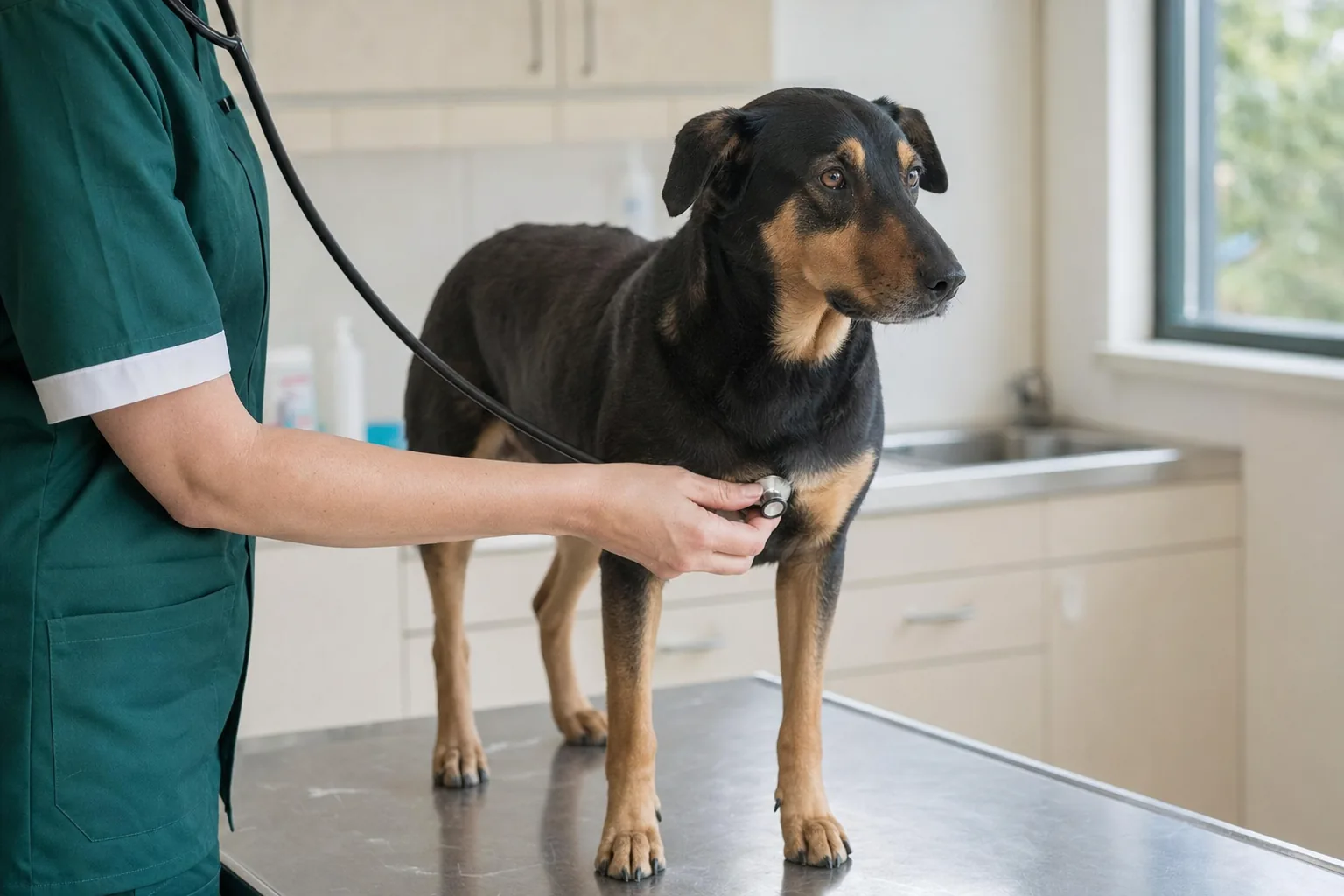
Caution. After surgery: bleeding that will not stop, pale gums, a swelling belly, a wound that is open or oozing pus, a dog who has not eaten after 24 hours or is flatter on day two than day one: ring the practice today.
Noticed something different about your dog? Go straight to their vet.
Do not look for the answer in a Facebook group, on TikTok or on a forum. Look for someone trained for this: your dog's own veterinarian, the only person who can examine, investigate and treat them.
- The same sign, dozens of causes. A dog that vomits may have eaten grass or may have an object stuck in the gut. From two lines you typed, nobody can tell which. The vet feels the abdomen, takes the temperature, runs tests.
- Nobody on the internet sees your dog. They see a photo and a story. A diagnosis comes from an examination and investigations, not from a resemblance to someone else's dog.
- In groups you hear from the people whose dog "got better on its own". Those for whom it ended badly rarely post again. What you read there is a selection, not a statistic.
- Doses are calculated by weight and species. Human medicines that look harmless, paracetamol or ibuprofen, are toxic to dogs. "I gave mine half a tablet" is the most dangerous advice you can get.
- Hours matter. With a twisted stomach, a poisoning or a urinary blockage, the time spent asking online is exactly the time that decides the outcome.
- The vet is accountable for what they say. They have your dog's record, history, vaccinations, past treatments. An anonymous account has none of that and answers for nothing.
Use this page to know what to observe, what to note and what to ask at the appointment, not to treat at home. If you still have doubts after a consultation, ask another vet or a specialist (dermatologist, internist) for a second opinion, not a group. And if you do not have a regular vet yet, find one now, while your dog is healthy: how to choose a veterinary clinic.
Your bitch is five months old. The neighbour says spay her "before her first season"; the breeder says wait a year. Or you have a two-year-old male who marks indoors and takes off after every bitch in season in the area, and you wonder whether castration will settle him. Or the operation is booked for Thursday and you want to know what to watch for afterwards. Spaying and neutering are the most common operations in dogs, and the right time isn't the same for every dog. This page helps you go into the conversation with your own vet prepared, and know what to keep an eye on in the days after.
So we're talking about the same thing: in bitches, spaying usually means removing the ovaries and sometimes the womb as well. In males, castration means removing the testicles. Both are done under general anaesthetic and both are permanent.
After surgery: when to ring the vet today
Most recoveries are uneventful. The first evening he sleeps a lot, the next day he eats a little, and after that your job is mostly stopping him from charging about. Ring the practice that operated today if you see:
- the wound bleeding without stopping within a few minutes, or the stain on the dressing growing;
- pale or white gums, a swelling belly, marked weakness, especially in the first 24 to 48 hours (these can be signs of internal bleeding);
- the wound gaping, stitches broken, or anything poking out;
- a large, warm, red swelling, or discharge with pus and a bad smell;
- nothing eaten more than 24 hours after surgery, repeated vomiting, or a dog who is flatter on day two than day one;
- fast, heavy breathing at rest;
- in males, a scrotum that swells badly and turns purple in the days afterwards;
- in bitches, weeks or months later, signs of a season: swollen vulva, blood, males taking an interest. Occasionally a small piece of ovary has been left behind and it needs checking.
Photograph the wound on the first evening, in good light. Over the next few days you compare against that photo, not your memory.
What to note before deciding, and in the days after
Before you choose the timing
The timing is decided with your vet, for your dog. Note a few things down and take them to that conversation:
- Breed and expected adult size. In large and giant breeds, some studies link very early surgery, before the growth plates close, with more joint problems and certain cancers in some breeds. In small breeds that risk looks much lower. Hence the common advice: around 6 months for small and medium breeds, and waiting until growth has finished in the big ones.
- For bitches: whether she has had a season, and when. Older studies found that spaying before the first season greatly reduces the later risk of mammary tumours. Newer reviews say the evidence is weaker than was thought, but the direction hasn't changed. Spaying also rules out womb infection. Surgery is usually not done during a season or straight after; your vet will tell you how long to wait, typically a few months.
- For males: what you want to change. Castration usually reduces urine marking, roaming after bitches, mounting and squabbles with other males, when those come from hormones. Fear stays the same, fear-based aggression isn't solved, and in a dog who is already anxious it can get worse. If behaviour is what's bothering you, write down exactly what he does and in which situations.
- Testicles. In a male puppy, check, or ask your vet to check, that both have dropped into the scrotum by a few months of age. A testicle retained in the abdomen carries a higher cancer risk and is removed anyway.
- His health: chronic illness, medication, reactions to previous anaesthetics, a short muzzle (flat-faced breeds breathe less easily under anaesthetic and need extra care).
In the days after
| What to watch |
Fine |
Ring |
| The wound |
Slightly pink, dry, a little swollen in the first days |
Open, pus, large warm swelling, bleeding |
| Appetite |
Small on the first evening, back the next day |
Nothing after 24 hours, repeated vomiting |
| Energy |
Sleepy on the first evening |
Flatter on day two than day one, marked weakness |
| Wee and poo |
Wee on the first day, poo within 1–2 days |
No wee for 24 hours, straining with nothing coming |
| Licking the wound |
Tries, you stop him |
Has pulled stitches out or opened the wound |
Write two lines each evening. It takes a minute, and at the check-up it tells your vet more than "he was fine".
What your vet does, before and after
- The timing conversation. Age, breed, size, seasons so far, behaviour. Show them your notes and ask straight out: "For my dog, why now rather than in six months?" A good vet will tell you what convinced them.
- Examination. Heart, lungs, weight, temperature, testicles in males, mammary glands in bitches, general condition.
- Pre-anaesthetic blood tests, recommended especially for adult and older dogs: full blood count, kidneys, liver, sometimes clotting.
- Preparation. How many hours before he stops eating (water is usually fine until the morning), which medicines to give or skip that day, what time to drop him off.
- The operation. Bitches are spayed through an incision in the belly or, in some clinics, by keyhole surgery, with a few small cuts and usually a quicker recovery. Males have a small incision in front of the scrotum. He gets pain relief chosen by the vet; ask what he's having and for how long.
- Going home. Wound care, whether the stitches dissolve or need removing, how long the cone or surgical suit stays on, how much exercise he's allowed.
- Check-ups, usually a few days after and again at 10 to 14 days, when the wound is checked and stitches come out.
- Long term. After surgery the body burns less, and many dogs put on weight if they eat the same. Ask how much to cut the portion and weigh him once a month. Spayed bitches, especially large breeds, can later develop urine leaking in their sleep without noticing. If you see it, tell your vet.
For males there is also a hormonal implant that switches off the testicles' effect for a few months. Some vets use it as a trial when it isn't clear whether a behaviour is hormone-driven. Ask whether it makes sense for your dog.
Rules vary by country. In Romania, where we work, the law requires owned crossbreed dogs to be neutered, with exceptions for registered pedigree dogs. In the UK and most of Western Europe it's a choice you make with your vet, and a few countries, such as Norway, restrict routine neutering of healthy dogs. Check with your own vet what applies where you live.
What not to do at home
- Human painkillers. Some are toxic to dogs even in small amounts. Pain relief is decided by your vet; if it doesn't seem to be enough, ring them.
- Letting him lick the wound "because it's natural". The tongue loosens stitches and brings in infection. The cone or surgical suit stays on day and night until the check-up, however reproachfully he looks at you.
- Baths or swimming before the wound has closed, usually 10 to 14 days.
- Running, jumping, wrestling with other dogs in the first 10 to 14 days. Especially for bitches, whose incision is in the belly. Short lead walks to toilet, then home. For boredom: snuffle mats, food toys, treats hidden round the room. Nothing with jumping.
- Creams, ointments or powders on the wound without asking. Some keep it damp and slow healing.
- A big meal on the first evening. A small portion, water and sleep.
- Booking surgery for a bitch in season or just after, unless your vet has a medical reason to do it then.
- Expecting the operation alone to fix behaviour. It helps with what comes from hormones. For the rest, you work with a specialist.
Most dogs are back to normal within a few days and have forgotten all about it by the time the stitches come out. You'll remember it for longer than they do.
Frequently asked questions
What dog owners search for most often on the internet about this problem, with the short answer. The answers are a guide only: the decision belongs to your dog's own vet, after an examination.
When should a bitch be spayed?
There is no single right age. For small and medium breeds many vets recommend spaying around 6 months, often before the first season, which lowers the risk of mammary tumours. For large and giant breeds some studies support waiting until growth has finished. Surgery is usually not done during a season or straight after.
Does neutering calm a male dog down?
It reduces behaviour driven by hormones: marking indoors, roaming after bitches in season, mounting and squabbles with other males. His temperament and love of play stay, and fear or fear-based aggression doesn't go away; in an already anxious dog it can get worse. For behaviour problems, talk to a specialist first.
How long is recovery after spaying?
Most bitches feel better within a few days, but the wound needs 10 to 14 days to close. Throughout that time she wears a cone or surgical suit, has short lead walks and no running, jumping, baths or swimming. Males usually recover a little faster. The check-up and stitch removal, if they don't dissolve, come at around 10 to 14 days.
Will my dog put on weight after neutering?
He might, because after surgery his body needs less energy while his appetite stays the same or grows. On the same portion he slowly gains weight. Ask your vet how much to cut his food, weigh him once a month and keep up the walks. A neutered dog doesn't have to be fat; it comes down to portion size.
Is neutering compulsory?
It depends on the country. In Romania, where we work, the law requires owned crossbreed dogs to be neutered, with exceptions for registered pedigree dogs. In the UK and most of Western Europe it is a choice made with your vet, and in a few countries, such as Norway, routine neutering of healthy dogs is restricted. Check the rules where you live.
The information on this page is educational and does not replace an examination. For full details and a diagnosis, consult your dog's own veterinarian.