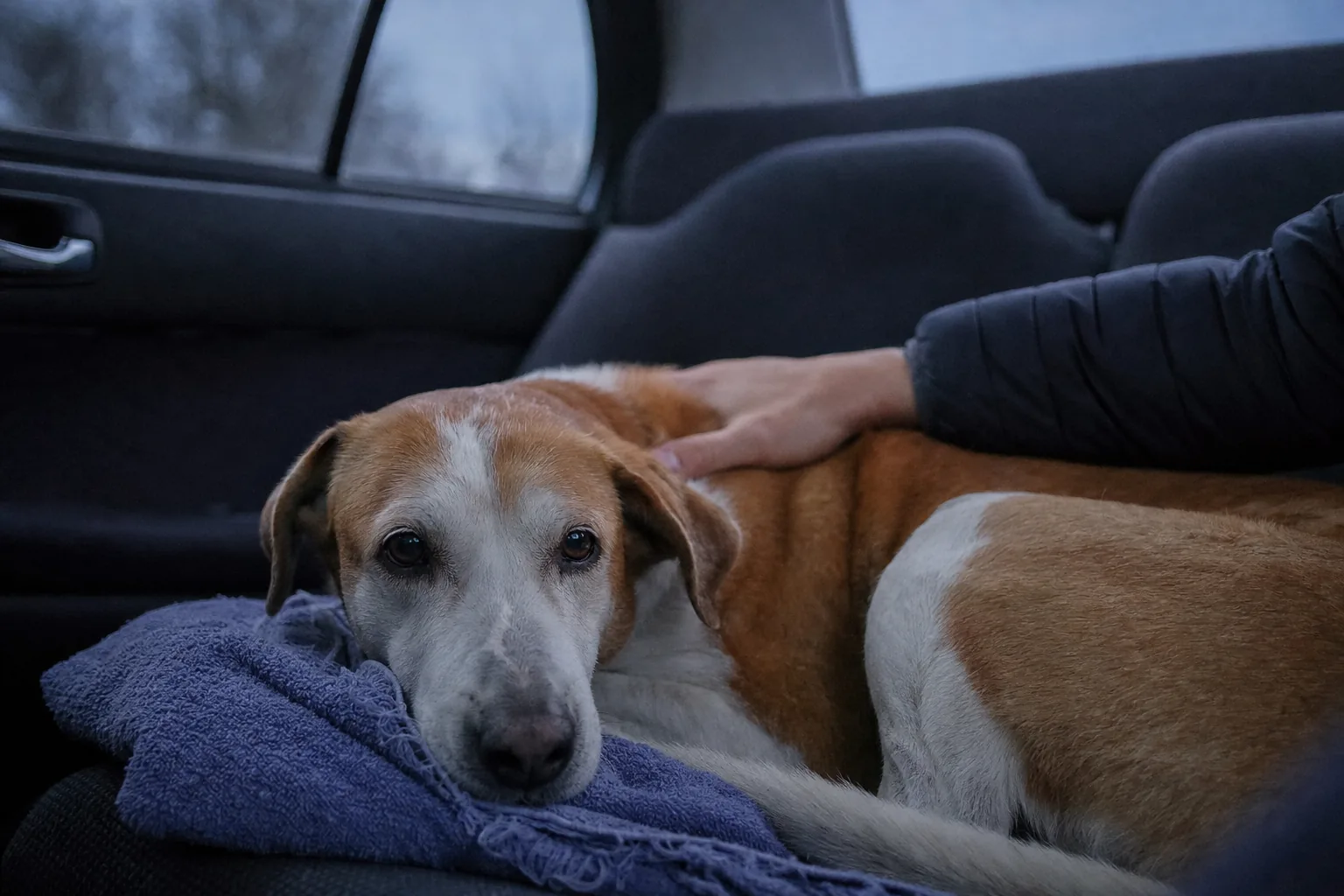
Emergency. Stop everything, get him into shade, soak his whole body with cold tap water and get the air moving; ring your vet or an out-of-hours clinic from the first minute. No wet towels left on him, no water poured into his mouth unless he swallows by himself, no ice on the skin. After 5 to 10 minutes of cooling you leave, cooling him on the way, even if he seems better.
Noticed something different about your dog? Go straight to their vet.
Call your own vet or the nearest clinic with an emergency service now, and set off. Do not ask a group what to do: every answer you wait for there is time lost for the dog.
- The same sign, dozens of causes. A dog that vomits may have eaten grass or may have an object stuck in the gut. From two lines you typed, nobody can tell which. The vet feels the abdomen, takes the temperature, runs tests.
- Nobody on the internet sees your dog. They see a photo and a story. A diagnosis comes from an examination and investigations, not from a resemblance to someone else's dog.
- In groups you hear from the people whose dog "got better on its own". Those for whom it ended badly rarely post again. What you read there is a selection, not a statistic.
- Doses are calculated by weight and species. Human medicines that look harmless, paracetamol or ibuprofen, are toxic to dogs. "I gave mine half a tablet" is the most dangerous advice you can get.
- Hours matter. With a twisted stomach, a poisoning or a urinary blockage, the time spent asking online is exactly the time that decides the outcome.
- The vet is accountable for what they say. They have your dog's record, history, vaccinations, past treatments. An anonymous account has none of that and answers for nothing.
Use this page to know what to observe, what to note and what to ask at the appointment, not to treat at home. If you still have doubts after a consultation, ask another vet or a specialist (dermatologist, internist) for a second opinion, not a group. And if you do not have a regular vet yet, find one now, while your dog is healthy: how to choose a veterinary clinic.
The first properly hot day in June: 31 degrees in the shade. You took the dog out at two in the afternoon like every other day, on tarmac. About halfway round he stopped and went looking for shade. He was panting with a wide red tongue hanging off to one side, and his saliva was coming in thick strings. You walked another two hundred metres and he sat down. Now he is lying on his side, breathing fast and shallow, not getting up when you call him, and his gums are dark red. That is heatstroke. In dogs it kills, sometimes even after the dog seems to have come round. Below is what to do in the next ten minutes, what to tell the vet and how to make sure you never end up here again.
What to do in the next 10 minutes
Dogs do not sweat. They get rid of heat by panting and through the little skin that has no fur on it. When the air is hot and humid, panting stops cooling anything, and body temperature climbs within minutes. Every minute above 41 degrees kills cells in the brain, the kidneys, the gut and the system that stops bleeding. So the order is simple: cool him first, travel second, and do both quickly.
- Stop everything and get him into the shade, or into an air-conditioned building. Take off his harness, muzzle, coat, whatever he has on. If you can, lay him on something cool: tiles, shaded concrete, wet grass.
- Soak him in cold tap water, lots of it, all over. Hose, shower, bucket, bottles of water from the nearest shop, the lake or the river if one is close. The water goes on the body, not the head: belly, groin, armpits, neck, paws, back. If he is a young, conscious dog who can stand, the quickest way to cool him is to put him in cold water up to the neck (a bath, a paddling pool, a stream), head out, with you right beside him. The water has to be running or changed constantly, because water that has warmed up in the coat does nothing.
- Get the air moving. A fan, the car air conditioning with the windows down, any draught at all. Water evaporating off a wet coat cools several times faster than wetting on its own.
- Do not wrap him in wet towels and leave them there. A wet towel on a dog warms up within two minutes and turns into a blanket. If towels are all you have, soak them, lay them on, take them off after a minute, soak them again. Ice straight on the skin and ice baths are not for an old dog, a small dog or one who has lost consciousness: they close down the blood vessels under the skin and can set off shivering, and shivering makes heat. Plenty of cold tap water does more than any ice.
- A little water to drink, and only if he can swallow by himself. Never pour water into the mouth of a dog who cannot stand or is dazed; it goes into the lungs.
- Ring your vet or an out-of-hours clinic while you are wetting him, phone on speaker. Tell them you are bringing in a dog with heatstroke so they have the drip and oxygen ready.
- After the first 5 to 10 minutes of cooling, set off for the practice, or straight away if he is unconscious or fitting. Keep cooling on the way: dog wet, lying on a wet blanket, air conditioning on full, windows open a crack. If you have a thermometer and know how to take a rectal temperature, check it. At around 39.5 degrees you stop active cooling: the temperature keeps falling a few tenths on its own, and you do not want to overshoot. With no thermometer, stop when you can see the panting has eased and the dog starts taking an interest in what is around him.
A dog who has perked up in the park has not been saved yet. The kidneys, the gut and the clotting system fail 12 to 48 hours later, and none of it shows from the outside. The trip to the vet happens regardless.
How to recognise the stages
| What you see |
What it means |
What you do |
| Panting hard, looking for shade, slowing down, tongue wide and drooping |
He is starting to overheat |
Stop, shade, water on his body and to drink, walk home slowly in the shade |
| Thick saliva, bright red gums, wobbling, not responding to his name, vomiting |
Heatstroke |
Cool for 5 to 10 minutes as above, then to the vet, cooling on the way |
| On his side, shallow breathing, pale or bluish gums, bloody diarrhoea, fitting, unconscious |
Severe heatstroke, organs failing |
Leave immediately, cool on the way, ring from the car |
| In the hours afterwards: tiny red dots on the gums or belly, blood in vomit or stool |
Clotting has broken down |
He is already at the clinic, or needs to be now |
What to tell the vet and what they do
On the phone and when you arrive
- What he was doing when it started: walking, running, playing, sitting in the car, out in a garden with no shade; and for how long.
- When the signs started and what you noticed first.
- His temperature, if you took it, and at what time.
- How you cooled him: with what, from what time until what time, and when the panting started to ease.
- Vomiting, diarrhoea, blood, urine, if there was any and what it looked like.
- How aware he was: did he respond to his name, could he get up, did he fit, did he lose consciousness and for how long.
- Breed, age, weight, whether he is flat-faced, whether he is overweight, any heart or breathing disease, any medication.
At the practice
- Temperature and signs of shock: pulse, gum colour, how fast the colour comes back when pressed, blood pressure. That tells the vet whether to carry on cooling or stop.
- Oxygen and a drip, nearly always. The drip holds up blood pressure, protects the kidneys and replaces what he lost through vomiting and diarrhoea.
- Bloods: kidneys, liver, blood sugar (it drops in heatstroke), electrolytes, clotting, full blood count. They get repeated at 12 to 24 hours, because the worst changes turn up late.
- Protecting the gut, which takes the first hit and lets bacteria leak into the blood; plus stopping the vomiting.
- Monitoring for 24 to 72 hours, often as an inpatient: temperature, urine output, breathing, heart rhythm, neurological state. A dog who looks fine in the evening can be in kidney failure by morning. That is why the vet will not send him home just because he "seems fine".
- Complications, if they appear: clotting problems, abnormal heart rhythms, swelling of the brain, infection in the blood. Each has its own treatment, given at the clinic. None of them is something you treat at home.
- At discharge you find out what to keep an eye on (appetite, urine, stools, how he walks, how he behaves), when to come back for a recheck with bloods a few days later, and the rule every vet will tell you: a dog who has had heatstroke once gets it more easily the second time.
A wagging tail in the waiting room is no reason to go home relaxed. If your vet suggests bloods and an overnight stay, say yes.
How to prevent it
Most heatstroke in dogs does not happen in hot cars, although dogs do die in them. It happens on walks and during play in the heat, with a dog who does not know when to stop and an owner who did not know it was their job to stop him.
Who is most at risk
| The dog |
Why |
| Flat-faced breeds: French and English Bulldogs, Pugs, Boxers, Pekingese, Shih Tzus |
Narrow airways make panting weak; they overheat at temperatures other dogs find comfortable |
| Overweight dogs |
Fat insulates, and the heart has to work harder |
| Breeds with a dense double coat: Huskies, Malamutes, Chow Chows, Caucasian Shepherds |
The coat keeps the heat in; they are built for snow |
| Big, heavily muscled dogs |
They produce a lot of heat when they exert themselves |
| Puppies, old dogs, dogs with heart or lung disease or laryngeal paralysis |
They control their temperature less well |
| Black-coated dogs |
They soak up more sun |
| Dogs not used to heat: the first warm days of the year, dogs who have moved from a cooler climate |
The body needs one to two weeks to adjust |
| Dogs in fabric muzzles that hold the mouth shut |
They cannot pant; in summer, basket muzzles only |
Summer rules
- Walk early in the morning and late in the evening. Above 25 degrees, a healthy dog walks slowly, in the shade, with water in your bag. Above 28 to 30, flat-faced and overweight dogs go out for toilet breaks only. Humidity counts as much as temperature: at 26 degrees in humid air, panting cools badly.
- The tarmac test. Hold the back of your hand on the tarmac for five seconds. If you cannot stand it, neither can his pads, and the heat from the ground rises into his body.
- No running, fetch or cycling in the heat. Play is the most common cause, because a dog who is wound up about a ball will not stop on his own. You are the brake.
- Water and shade everywhere: in the garden, in the car, in your rucksack. Wet him before any outing in the heat and let him get into water whenever he finds some.
- The car, never. At 22 degrees outside, a parked car goes past 40 inside within half an hour, and leaving a window cracked changes nothing. Not five minutes, not in the shade.
- A healthy weight. It is the simplest protection against heatstroke, and his joints and heart benefit too.
- The early signs: a tongue wide as a shovel, red, with the tip curling up, panting that does not ease when you stop, looking for shade, slowing down. When you see them, you head home there and then.
- Cooling vests and mats only help while they are wet or cold. They are no substitute for walking at the right time of day.
In summer our training sessions run trails early in the morning and keep them short. A dog working hard with his nose builds up a lot of heat. We have stopped trails halfway because the handler on the end of the line felt perfectly fine, while the dog's tongue was telling us he had had enough. If you do not yet have a regular vet and an out-of-hours clinic saved in your phone, our related services page explains how to choose one. Save the numbers before the first hot day.
Frequently asked questions
What dog owners search for most often on the internet about this problem, with the short answer. The answers are a guide only: the decision belongs to your dog's own vet, after an examination.
What are the signs of heatstroke in dogs?
Early on: hard panting that does not ease when you stop, a wide red tongue, thick saliva, looking for shade, slowing down. Then bright red gums, wobbling, vomiting, sometimes bloody diarrhoea, no response to his name. In the severe stage he lies on his side, breathes shallowly, has pale or bluish gums, fits or loses consciousness. At any stage you cool him and go to the vet.
What do I do if my dog has heatstroke?
Shade, harness and muzzle off, cold tap water over his whole body (hose, shower, bucket; a young, conscious dog can go into cold water up to the neck), air moving. No wet towels left on him, no ice straight on the skin, no water poured into his mouth unless he swallows. Ring the vet from the first minute and leave after 5 to 10 minutes of cooling, with the dog wet and the air conditioning on.
My dog pants a lot. Is that normal in hot weather?
Panting is how he cools down, so in the heat he pants more, and that is fine as long as he settles in the shade within a few minutes. It becomes a warning sign when it does not stop after he rests, when the tongue is wide and very red, the saliva thick, and he looks for shade and slows down. Then you turn back, wet him and keep him cool. If he wobbles or vomits, it is heatstroke.
Can I cool him with ice or wet towels?
Wet towels left on him warm up within two minutes and hold the heat in; if you use them, swap them every minute. Ice straight on the skin and ice baths are not for old, small or unconscious dogs: they close down the blood vessels and can set off shivering. Cold tap water works best, lots of it and constantly replaced, plus moving air; for young, conscious dogs, cold water up to the neck.
My dog recovered after cooling. Do I still need to go to the vet?
Yes, the same day. Heatstroke hits the kidneys, the gut and the clotting system 12 to 48 hours later, and a dog wagging his tail in the evening can be in kidney failure the next day. Your vet runs bloods, puts up a drip and, if needed, keeps him in overnight. A dog who has had heatstroke once gets it more easily the second time, so his summers look different from now on.
The information on this page is educational and does not replace an examination. For full details and a diagnosis, consult your dog's own veterinarian.