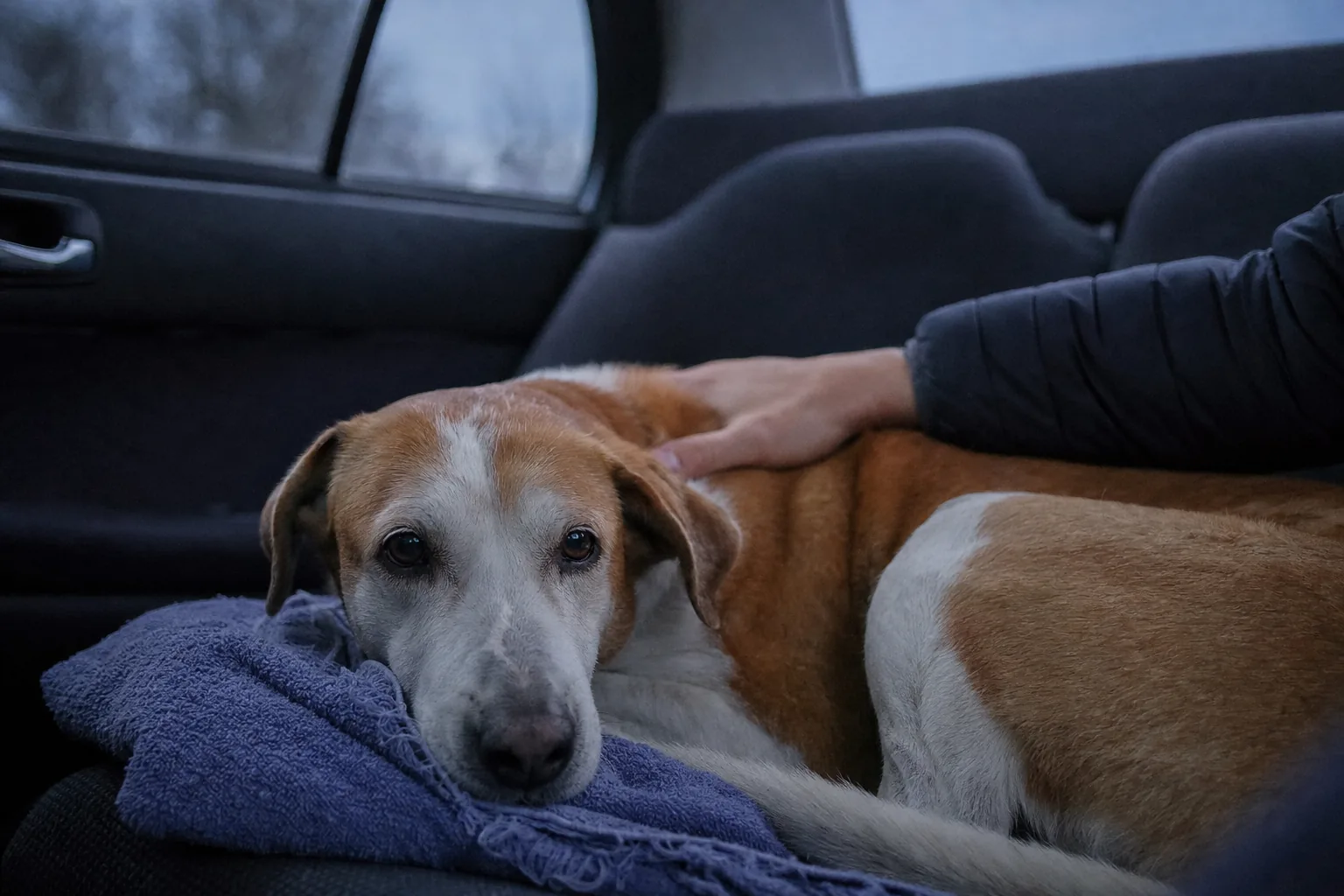
Emergency. A dog who cannot walk on his back legs, drags them or leaks urine: do not let him take a single step, put him in a crate, carry him with his back straight and ring your vet or an out-of-hours clinic with surgery now. No medicines from home.
Noticed something different about your dog? Go straight to their vet.
Call your own vet or the nearest clinic with an emergency service now, and set off. Do not ask a group what to do: every answer you wait for there is time lost for the dog.
- The same sign, dozens of causes. A dog that vomits may have eaten grass or may have an object stuck in the gut. From two lines you typed, nobody can tell which. The vet feels the abdomen, takes the temperature, runs tests.
- Nobody on the internet sees your dog. They see a photo and a story. A diagnosis comes from an examination and investigations, not from a resemblance to someone else's dog.
- In groups you hear from the people whose dog "got better on its own". Those for whom it ended badly rarely post again. What you read there is a selection, not a statistic.
- Doses are calculated by weight and species. Human medicines that look harmless, paracetamol or ibuprofen, are toxic to dogs. "I gave mine half a tablet" is the most dangerous advice you can get.
- Hours matter. With a twisted stomach, a poisoning or a urinary blockage, the time spent asking online is exactly the time that decides the outcome.
- The vet is accountable for what they say. They have your dog's record, history, vaccinations, past treatments. An anonymous account has none of that and answers for nothing.
Use this page to know what to observe, what to note and what to ask at the appointment, not to treat at home. If you still have doubts after a consultation, ask another vet or a specialist (dermatologist, internist) for a second opinion, not a group. And if you do not have a regular vet yet, find one now, while your dog is healthy: how to choose a veterinary clinic.
Last night your five-year-old dachshund jumped off the sofa, gave a short yelp and has been sitting hunched up ever since. He is trembling. He screams when you pick him up. This morning his back legs are wobbling and one foot knuckles over when he steps. Or your French bulldog set off for a walk perfectly normal and came home dragging his back legs.
The most likely culprit is a slipped disc. Between the vertebrae sit small cushions, the discs, and one of them has burst or bulged and is now pressing on the spinal cord. It is an emergency where hours count, and how you hold and carry him on the way to the vet matters just as much. Below is what to do now, what the vet will do and how to prevent it.
What to do in the next 10 minutes
- Stop all movement. No walking, no stairs, no jumping, no shaking himself off. Every step can push more disc material against the cord.
- Put him somewhere small: a travel crate, a puppy pen or a large box with a blanket in it. If you have none of those, a small room with no furniture he can climb on.
- Ring your vet or an out-of-hours clinic now. If he cannot walk at all, ask straight away for a clinic that does MRI and spinal surgery, or ask your vet where they will refer you. If it comes to surgery, every extra journey costs time.
- Carry him with his back straight. Hold a small dog level against your body, one hand under the chest and one under the hips. Lay a big dog on a board, a door taken off its hinges, a large piece of cardboard or a blanket pulled taut between two people. Do not lift him by the belly, do not let him dangle and do not cradle him like a baby with his back bent.
- Mind your hands. A dog in severe back pain may bite, even if he has never done it before. If you have to move him and you are worried, you can tie a soft scarf loosely round his muzzle for a few minutes, as long as he is breathing easily.
- Do not give him anything for the pain from your own cupboard. Human medicines are dangerous for dogs, and some clash with what the vet will want to give him.
- Keep an eye on his bladder. If he is leaking urine or, on the other hand, has not weed for many hours, tell the vet.
How serious is it, from what you can see
| What you see |
What it usually means |
How fast |
| Hunched back, trembling, cries when lifted, will not do stairs, but walks normally |
Disc pain; the cord is not yet badly compressed |
Vet the same day |
| Wobbly walk, back legs crossing, feet knuckling over |
The cord is compressed |
Now |
| Drags his back legs but moves them a little when lying down |
Severe compression |
Now, to a clinic with surgery |
| Back legs do not move at all, leaking urine |
Paralysis |
Top emergency |
| No reaction even when a toe is pinched hard |
The cord is badly damaged |
Top emergency, hours count |
The last row is for the vet to check, not you. If you see paralysis, do not wait for the morning.
When it looks similar but is something else
In large dogs, sudden weakness in a single leg, without pain, can come from a tiny plug of cartilage blocking a blood vessel in the spinal cord. In older dogs, weakness that creeps in over months, also without pain, may be a degenerative disease of the cord. Rarely, a tick that has been attached for a long time causes weakness that climbs up from the legs. All of these need the vet, and the vet tells them apart.
What to tell the vet and what happens next
On the phone
- breed, age, weight;
- what happened and when: a jump, a fall or nothing in particular;
- what you see now: pain, wobbly walking, dragging legs or legs that do not move;
- whether he has weed and whether he is leaking;
- whether he has had episodes of back or neck pain before;
- anything you have given him.
At the clinic
- The neurological exam. The vet watches how he stands and, if he can, how he walks. They test reflexes, check whether he turns a knuckled foot back over, and press along the spine to find the sore spot. In a paralysed dog they check for deep pain sensation by pinching a toe with forceps. Of everything in the exam, that test says the most about his chances.
- X-rays sometimes show calcified discs or a narrowed space between vertebrae. They do not show the spinal cord. Their main job is ruling out a fracture or a tumour.
- An MRI or CT scan, under anaesthetic, shows exactly where the disc is and how hard it is pressing. It is needed if surgery is on the table.
- Surgery is for dogs who can no longer walk, dogs whose pain will not settle and dogs who are getting worse. The surgeon opens a small window in the vertebra and removes the disc material pressing on the cord. In paralysed dogs, the sooner the operation, the better the odds.
- Treatment without surgery is for dogs who can still walk and whose pain can be controlled. That means strict crate or pen rest, usually for 4 to 6 weeks, out only for the toilet, carried or on a short lead, plus pain relief chosen by the vet. The rest is the hard part and the most important one. A dog who "seems better" after three days and is allowed to run about can slip a second disc, worse than the first.
- The bladder. Paralysed dogs cannot empty their bladder on their own. The vet will show you how to help him, and while he is in the clinic they will empty it several times a day.
- Rehab. Physiotherapy, assisted walking exercises, hydrotherapy and, for some dogs, a cart for the back legs. Many walk again within weeks or months, even if they stay a little unsteady.
Ask the vet plainly what your dog's chances are with surgery and without. And ask what the rest actually involves: where he sleeps, how he goes out, for how long.
How to prevent a slipped disc
Some breeds are born with discs that age early: dachshund, French bulldog, beagle, Pekingese, shih tzu, corgi, bichon, cocker spaniel. In these breeds disc problems often appear between 3 and 7 years old, frequently out of the blue. You cannot change the genetics. You can take a lot of load off the spine.
Weight
An overweight dog loads his spine harder with every step and every jump. In the at-risk breeds, you should feel the ribs easily under your palm.
Jumping and stairs
Put ramps or steps by the sofa and bed, or keep him off the furniture altogether. Jumping down is riskier than jumping up. Lift him in and out of the car rather than letting him leap from the boot. A young, fit dachshund can manage the stairs a few times a day. One who has had a disc problem before gets carried.
How to lift him
Always one hand under the chest and one under the hips, back level. Never under the armpits with his bottom hanging down.
Harness
A harness beats a collar, especially for dogs who pull and for those who have had neck pain.
Exercise
Daily walks at a steady pace over varied ground keep the back muscles fit. Choose sports with jumping, sharp turns and repeated sudden stops carefully for the at-risk breeds. Nose games and long sniffy walks are good exercise for them: plenty of work for the nose, very little load on the spine.
When you choose a puppy
If you go for an at-risk breed, ask the breeder whether the parents have had back problems. Some countries run X-ray screening schemes for dachshunds.
If a dog from an at-risk breed cries when you lift him or suddenly stands hunched, treat it as a possible slipped disc from the start. Rest in those first hours and a prompt vet visit are the simplest things that change how it ends.
Frequently asked questions
What dog owners search for most often on the internet about this problem, with the short answer. The answers are a guide only: the decision belongs to your dog's own vet, after an examination.
Why can my dog suddenly not walk on his back legs?
Most often, especially in dachshunds, French bulldogs or beagles, because a slipped disc is pressing on the spinal cord. It can also be a tiny plug of cartilage blocking a vessel in the cord, a degenerative cord disease in older dogs, an injury or, rarely, a tick. All of them need a vet the same day, often within the hour.
What are the signs of a slipped disc in a dog?
First comes pain: a hunched back or a stiffly held neck, trembling, crying when picked up, reluctance to climb or jump. Then a wobbly walk, feet knuckling over, back legs dragging and, in severe cases, paralysis with loss of bladder control. The signs can get worse within hours.
Can a slipped disc in a dog heal without surgery?
In dogs who can still walk and whose pain can be controlled, often yes: strict crate rest for four to six weeks, pain relief chosen by the vet and then a gradual return to exercise. Stick to the rest even if he looks fine after a few days. In paralysed dogs or dogs who are getting worse, surgery usually gives better odds.
Can a dog paralysed by a slipped disc walk again?
Many do, particularly those who still feel deep pain in their toes and are operated on quickly. Recovery takes weeks or months, with physiotherapy and sometimes hydrotherapy. Dogs who have lost deep pain sensation have lower odds, and for them the time to surgery matters most. Ask your vet what your own dog's chances are.
How do I prevent a slipped disc in my dachshund?
Keep him lean, put ramps by the sofa and bed, lift him in and out of the car with one hand under the chest and one under the hips, and use a harness rather than a collar. Daily walks at a steady pace keep the back muscles fit. You cannot change the genetics, but you can take a lot of load off his spine.
The information on this page is educational and does not replace an examination. For full details and a diagnosis, consult your dog's own veterinarian.