Your dog jumps out of the car after a training session and puts his front paw down on tiptoe, as if the tarmac were sticky. Another story: for two weeks your six-year-old Labrador has been slow to get up in the morning, lame on a back leg for the first few steps and then "warming out of it" after five minutes, so you assumed it would pass. A third: he will not put a leg down at all, holds it up and whimpers when you touch it.
Three situations, three levels of urgency. The first is most often a bit of glass or a thorn in a pad, which you can find yourself in two minutes. The second needs a booked appointment, not one a month away. The third needs the vet today. Below: what to check at home, how to tell which leg it is when a dog seems lame "all over", what your vet will do and, above all, what not to give him for the pain.
When should it not wait until tomorrow?
- he will not put weight on the leg at all, holds it up, and has done for more than an hour; or the limp started after a fall, a jump, a car, a scrap with another dog;
- the leg sits at an odd angle, is swollen, moves where it should not or you can hear something when it moves;
- there is an open wound, bleeding that does not stop after a few minutes of pressure, or bone showing;
- a joint is swollen and hot and he has a temperature and is flat; or the lameness moves from one leg to another (tick-borne diseases, immune conditions);
- a puppy suddenly goes lame and cries. Puppy bones break easily, and differently from adult bones;
- a large dog over seven has been lame on a front leg for a few weeks, getting worse, and the area above the wrist or near the shoulder is swollen and painful. Some bone tumours look like this, and time matters;
- he cannot get up at the back, drags his back legs, does not feel it when you pinch his toes, has stopped weeing. That is the spine, and an emergency measured in hours;
- he is lame and the leg is cold and pale with no pulse you can feel. It is rare, but it is an emergency;
- he is already on pain relief and the limp is getting worse;
- there is a swelling between his toes with a small hole in it, or a toe that is swollen and red with a crooked nail.
What to check and write down at home
Which leg is it?
It sounds simple. It is not. A dog lame in front drops his head as he steps onto the sound leg and lifts it as he steps onto the sore one: the head bobs up exactly on the bad paw. When it is a back leg, he drops the hip on the sound side, while on the painful side he hitches the hip up and shortens his stride. He often shifts weight forward too, so it looks as though something is wrong with his front legs as well.
Film him walking and trotting on a hard surface, from the front, from behind and from the side. Twenty seconds of video show the vet what cannot be reproduced at the practice, where your dog, full of adrenaline, walks perfectly.
When does he limp?
On the first steps after rest, then better: typical of arthritis. All the time: typical of a fresh injury. After exercise: typical of a ligament or joint slowly wearing out. Only on certain surfaces: his pads. Only on stairs or getting into the car.
How badly?
From "something's not quite right with how he moves" to "won't put the paw down at all". Give it a score from 1 to 5 every day, at roughly the same time.
The paw, up close
Turn it towards the light. On the pads, look for cuts, cracks, burns (July tarmac), a splinter of glass or a thorn, a small stone caught between them. On the toes, look for swelling, redness, a broken nail or one grown into the pad, a grass seed between the toes. Compare with the other paw: is it warmer, thicker? Press gently on each toe and watch how he reacts.
The whole leg
Run your palm slowly up both legs, from the bottom, and compare. You are feeling for heat, swelling, a spot where he pulls away or turns his head to you. Do not force the joints. If a light touch hurts, you have learned what you needed to know.
What happened before
What he has done in the last 48 hours: jumped out of the car, played rough, chased a ball on hard ground, been out in cold and wet, gone on a much longer walk than usual. Falls. Ticks in the last few weeks. His age, his weight (extra kilos press straight onto the joints) and his breed, since some carry hip, elbow or kneecap problems in the family. Old operations, earlier bouts of lameness on the same leg.
The rest
Note whether he has a temperature or seems flat, how he is eating, whether other joints have swollen and whether he has lost weight lately.
On the trail, when a dog starts limping we stop. There is nothing heroic about finishing the trail; the scent will still be there tomorrow. Most of the time it is a pad cut on a bit of glass hidden in a bush, which the handler finds back at the car. Sometimes it is the first sign of a ligament slowly giving way, and then he goes to the vet before it gives way completely.
What you see and what the vet thinks of first
| What you see |
What the vet thinks of first |
| Sudden, one leg, otherwise healthy dog, after a walk |
Cut pad, thorn, glass, broken nail, sprain |
| Back leg, adult dog, sudden or after exercise; holds the paw up or barely touches down; after a few days puts some weight on it but limps when getting up |
Cranial cruciate ligament rupture in the knee, the most common cause of hind-leg lameness in adult dogs |
| Back leg, small dog who "skips" a step or carries the leg for a few strides, then walks normally |
Kneecap slipping out of place (patellar luxation) |
| Young large-breed dog, between 5 and 14 months; lameness moving from leg to leg, sometimes with lethargy |
Growing pains in the long bones; developmental joint problems (elbow, shoulder, hip) |
| Front leg, young large-breed dog; worse after exercise |
Developmental elbow or shoulder problems |
| Older dog; worse on getting up and in the morning, better once moving, worse after hard exercise |
Arthritis |
| Older large dog, front leg, getting steadily worse, with swelling above the wrist or at the shoulder |
Bone tumour; vet as soon as possible |
| Several joints, temperature, lameness moving between legs, with or without ticks in the history |
Tick-borne diseases; immune-mediated inflammation of several joints |
| Weak, dragging back legs, poor balance, no obvious pain |
Spine or nerves, not joints; prompt vet visit |
What will the vet check?
- Your account and your video.
- His gait, walking and trotting, in the corridor or outside, from several angles, sometimes on stairs.
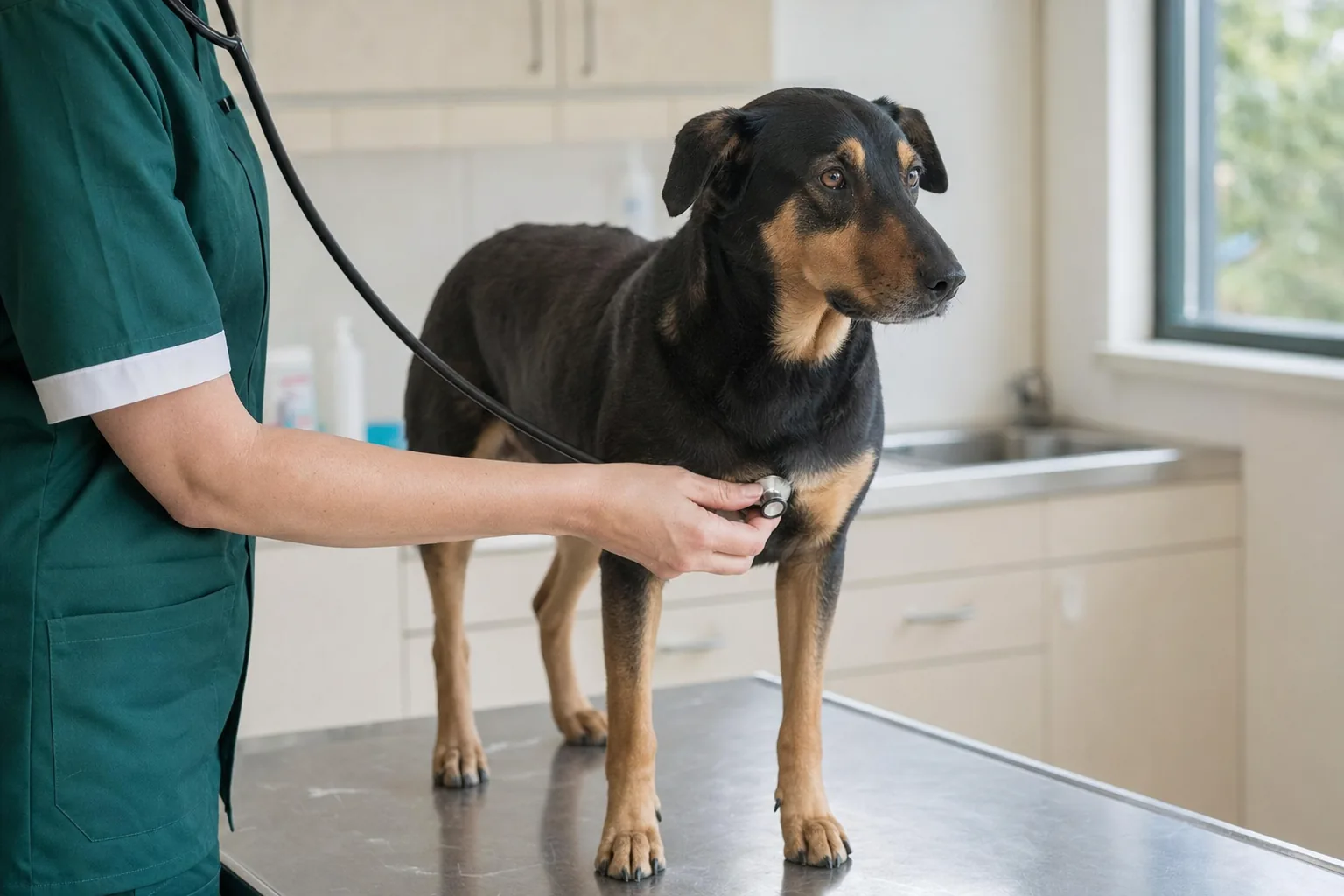
- They feel and move every joint and every bone in turn, both sides, from the toes up, with specific tests for the cruciate ligament, the kneecap and the hip. They check the pads and between the toes, then the spine. A dog who is sore or tense will brace the leg so nothing can be felt, which is why the full exam is sometimes done under sedation.
- A neurological exam if the signs point to the spine: reflexes, paw position, sensation in the toes.
- X-rays, usually under sedation so he can be positioned properly. They cover the suspect joint and often the one on the other side for comparison. Ligaments and cartilage do not show on X-rays, so the hands-on exam stays the foundation and the X-ray confirms or rules out.
- Further tests when needed: blood tests (inflammation, tick-borne diseases), fluid drawn from the joint with a needle, tendon ultrasound, CT or MRI, arthroscopy (a small camera inside the joint).
- A plan to fit the cause. A pad or nail gets cleaned and dressed, and the dog rests. A sprain means a few weeks of strict lead-only rest, with a check-up. A ruptured cruciate is operated on in most medium and large dogs; in small dogs, treatment without surgery is sometimes tried. You decide together with the vet, after the X-rays. A slipping kneecap, depending on its grade, ranges from monitoring to surgery. Arthritis calls for getting his weight to normal, regular moderate exercise on soft ground, physiotherapy and pain relief prescribed and monitored by the vet over the long term. A tumour needs a quick diagnosis and a conversation about options with a veterinary cancer specialist.
Ask how long the rest should last and what it actually means. Usually: short lead for toilet trips, no stairs, no jumping on the sofa, no play. And when the check-up is.
What not to do at home
- Do not give him any of your own painkillers. Not one. Some wreck a dog's stomach and kidneys at doses you would think were small, others attack the liver. It is one of the most common medicine poisonings in dogs, and it comes from love.
- Do not give him another dog's veterinary medicine, or leftovers from an old problem, without the vet. The dose and the risks were worked out for that dog, weighed back then.
- Do not let him "work it off" with normal walks, ball games or play. A partly torn ligament tears completely, a hairline crack becomes a fracture.
- Do not massage it, try to "put it back" or pull on the leg.
- Do not improvise splints from cardboard and tape. A badly fitted splint does more harm than none. If the leg is deformed, keep it as still as possible, get him onto a blanket and go.
- Do not put heat on a hot, swollen joint. In the first hours after an obvious sprain you can use ice wrapped in a tea towel for ten minutes, if he will let you. Anything beyond that, discuss with the vet.
- Do not put off the vet for an older dog because "it's his age". Arthritis hurts, and pain can be treated.
- Do not let him stay overweight. Every extra kilo bears down on his joints. If he is carrying extra weight, that is the first thing to discuss at the appointment, before any treatment.
- Do not try to dig out a grass seed that has gone under the skin between his toes. It breaks and travels.
- Do not let him lick the wound or the dressing.
- Do not wait with a dog who cannot get up at the back or has stopped weeing.
What rest really looks like
Rest does not mean staying indoors and leaping on and off the sofa twenty times a day. It means five minutes on a short lead for the toilet, on flat ground. No stairs (carry him if you can), no play with other dogs, no ball. Block off the sofa and the bed, or put a ramp up.
For a young dog that is hard, so give his nose a job. Hide his food around the room, give him something to chew, have him search for tasty treats for ten minutes, no running. A tired head stays calm, and the leg gets time to heal.
A limping dog is telling you the only thing he can tell you. A daily score and a twenty-second video turn "he's been limping for a while" into something your vet can work with. If you do not have a regular vet yet, our page on related services explains how to choose a practice. For big dogs, an orthopaedic vet nearby is a real asset.
The information on this page is educational and does not replace an examination. For full details and a diagnosis, consult your dog's own veterinarian.